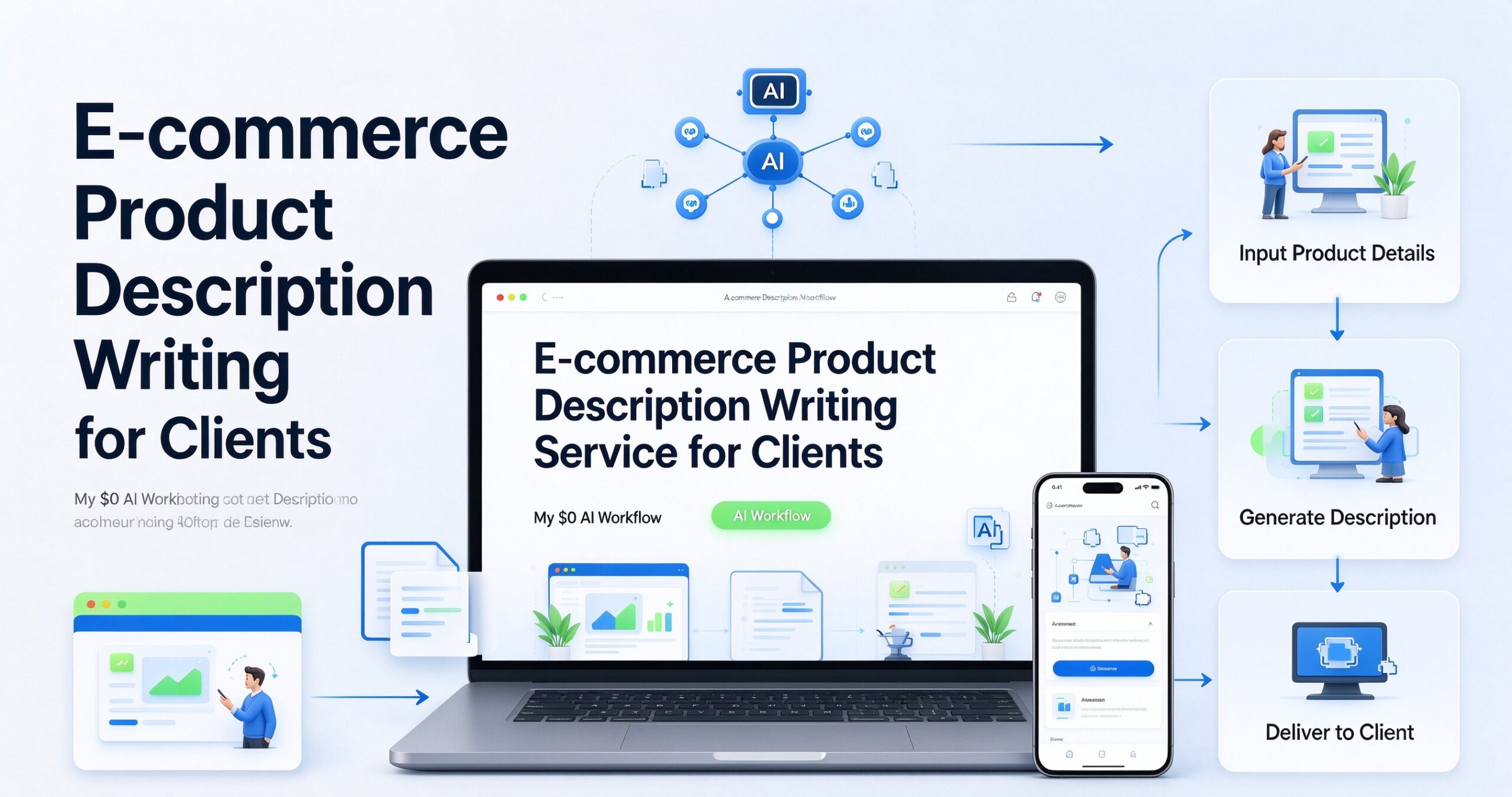
An online store with 400 SKUs hired me to rewrite every product page, starting with their best sellers, and I did the writing with tools that cost nothing. No agency, no $99-a-month copywriting suite, no “SEO content package.” That first project — six product descriptions a week — showed me that e-commerce product description writing is one of the most overlooked freelance income streams in 2026: every store on the internet has product pages, most of them are thin, duplicated, or written by the manufacturer, and almost none of them have a writer who can turn a spec sheet into copy that actually sells.
This is the exact $0 workflow I use to write and deliver client product descriptions — the tools, the process, how to price it, where the clients are, and the quality checks that turn a one-off batch into a recurring retainer.
Why Clients Pay for Product Description Writing
Store owners don’t buy “words.” They buy conversions. A product page has one job: answer the shopper’s questions fast enough that they hit “add to cart” instead of bouncing to a competitor. Too many stores paste the manufacturer’s bland spec dump — the same text sitting on fifty other sites — which means the page ranks for nothing, convinces no one, and earns nothing. That gap between “we have products” and “our pages sell” is exactly where a reliable freelancer running product description writing for clients wins.
Agencies bundle this into $2,000–$5,000 content retainers and take weeks to onboard. AI-only text generators churn out keyword-stuffed paragraphs that read like a robot and get flagged by Google as spam. The sweet spot I occupy is in between: conversion-aware copy and genuine SEO, at freelancer speed and price, with a human guaranteeing nothing embarrassing or duplicated ships.
I have written for fashion, home goods, electronics, supplements, and handmade Etsy sellers turned Shopify brands. The common thread: they need clean, accurate, on-brand descriptions for every product — and they want someone who just handles the backlog.
The $0 Software Stack I Actually Use
You don’t need a paid copywriting assistant or an expensive e-commerce platform add-on to start. Here is the free stack that powers my entire product description writing service:
- Free AI chat assistants — for turning raw specs into a first draft and for generating benefit angles. I treat them as a tireless junior copywriter, never as the final deliverable.
- A free product-description generator — every page starts as a skeleton: hook, benefits, specs, objection-handling, call to action. I use my free outline generator to shape that structure before a single selling sentence is written.
- A free grammar and clarity checker — after drafting, I run every description through my free grammar checker to catch comma splices, weak verbs, and the awkward phrasing AI drafts love to leave behind.
- A free image caption / alt-text tool — product images need descriptive alt text both for accessibility and for image search. I generate it with my free image caption generator so every listing is search-ready.
- A free meta description generator — the description isn’t finished until the search snippet is. I write click-worthy meta descriptions with my free meta description generator to lift click-through from search results.
- A local, offline toolkit — for clients in health, supplements, or any regulated category, I keep everything on my own machine. My portable AI toolkit runs drafting, cleanup, and export without uploading product data to a third party — a detail that instantly wins privacy-conscious brands.
Every tool above is free at freelance volume. What the client is really paying for is judgment: knowing which benefit to lead with, which spec matters to a shopper, and which competitor claim to beat.
My Exact Product Description Workflow
Here is the process I run on every product, start to finish:
- Build a voice and format guide once. Before the first product I write a one-page brief with the client — formal or playful, short or detailed, bullet specs or paragraph prose, brand words to use and banned words to avoid. This single document is the biggest quality lever on a recurring product job.
- Harvest the raw material. I ask for the spec sheet, current page, competitor pages, customer reviews, and FAQ. Reviews are gold — they reveal the exact words buyers use and the objections that stop them.
- Outline, then draft. Each description gets a skeleton from my outline generator — a compelling hook, a benefits block, a specs block, and a close — then a first draft with my free AI assistant in the client’s voice.
- Edit for conversion and clarity. This is where the real work happens. I lead with the strongest benefit, translate every spec into an outcome (“500ml” becomes “a full week of water without a refill”), cut filler, and run the draft through a grammar pass.
- Optimize for search without stuffing. The primary keyword goes in the title, the first sentence, and once more naturally — never more. I write the meta description and image alt text so the listing can actually be found.
- Deliver ready to paste. I hand back clean, formatted copy for their platform — Shopify, WooCommerce, Amazon, Etsy — plus the title, meta description, and alt text. That packaging is what turns a one-off batch into a monthly retainer.
How to Price Product Description Writing for Clients
Pricing is where most freelancers leave money on the table. Here is what I charge and why:
- Per product, to start. $15–$60 per description for a standard SKU, higher for technical or regulated products that need research.
- Per batch, for volume. 20–50 products at a bundle rate — the workhorse arrangement, because stores usually have a backlog bigger than one page.
- Monthly retainer, for consistency. New-product drops and seasonal refreshes keep a store’s catalogue current; a retainer covers the steady flow.
- Per category cluster, for SEO projects. Rewriting a whole category — with internal links and a hub page — prices well as a one-time project.
Because my software stack is free, my margin on every description is essentially 100% of my time. That is the whole point of running e-commerce product description writing this way.
Where to Find Product Description Clients
You don’t need to cold-call agencies. Here is where the work actually comes from:
- Freelance marketplaces. Upwork and Fiverr both carry steady product-copy demand — niche down (e.g. “descriptions for handmade jewelry”) to stand out.
- Shopify, WooCommerce, and Etsy stores. Every growing store has thin or duplicated product pages; pitching a batch rewrite of their top ten sellers is an easy yes.
- Amazon and marketplace sellers. Listing optimization is an ongoing need — sellers constantly test titles, bullets, and A+ copy.
- Agencies that white-label. E-commerce and SEO agencies routinely subcontract product copy for overflow.
- Your own inbound. A simple page describing your product description service, ranking for “product description writer for [niche],” brings leads while you sleep.
The Quality Bar That Keeps Clients Coming Back
The reason my clients renew isn’t speed or price — it is that I never ship raw AI output. Every description gets a human pass for accuracy, voice, and conversion. I verify specs against the source, keep a voice guide so the writing sounds like the same brand every time, format deliverables to match their platform, and flag anything I changed so there are no surprises.
That reliability is what shifts a client from a single $200 batch to a $900-a-month retainer. And it is why a free-tool workflow can compete with agencies charging five times as much.
Put This Into Practice
Pick one product category you understand, set up your free stack today — an AI assistant for first drafts, my free outline generator for structure, my free grammar checker for the final pass, and my free meta description generator for the search snippet — and rewrite five products for one store as a free sample. Charge per product to start, turn the happy ones into a monthly retainer, and raise your rate as the results stack up.
Product descriptions are one of those services every store needs and few freelancers deliver well. Build a product description writing service for clients on a free stack, hold a high quality bar, and you have a genuinely repeatable income stream — no degree, no paid software, no office required.