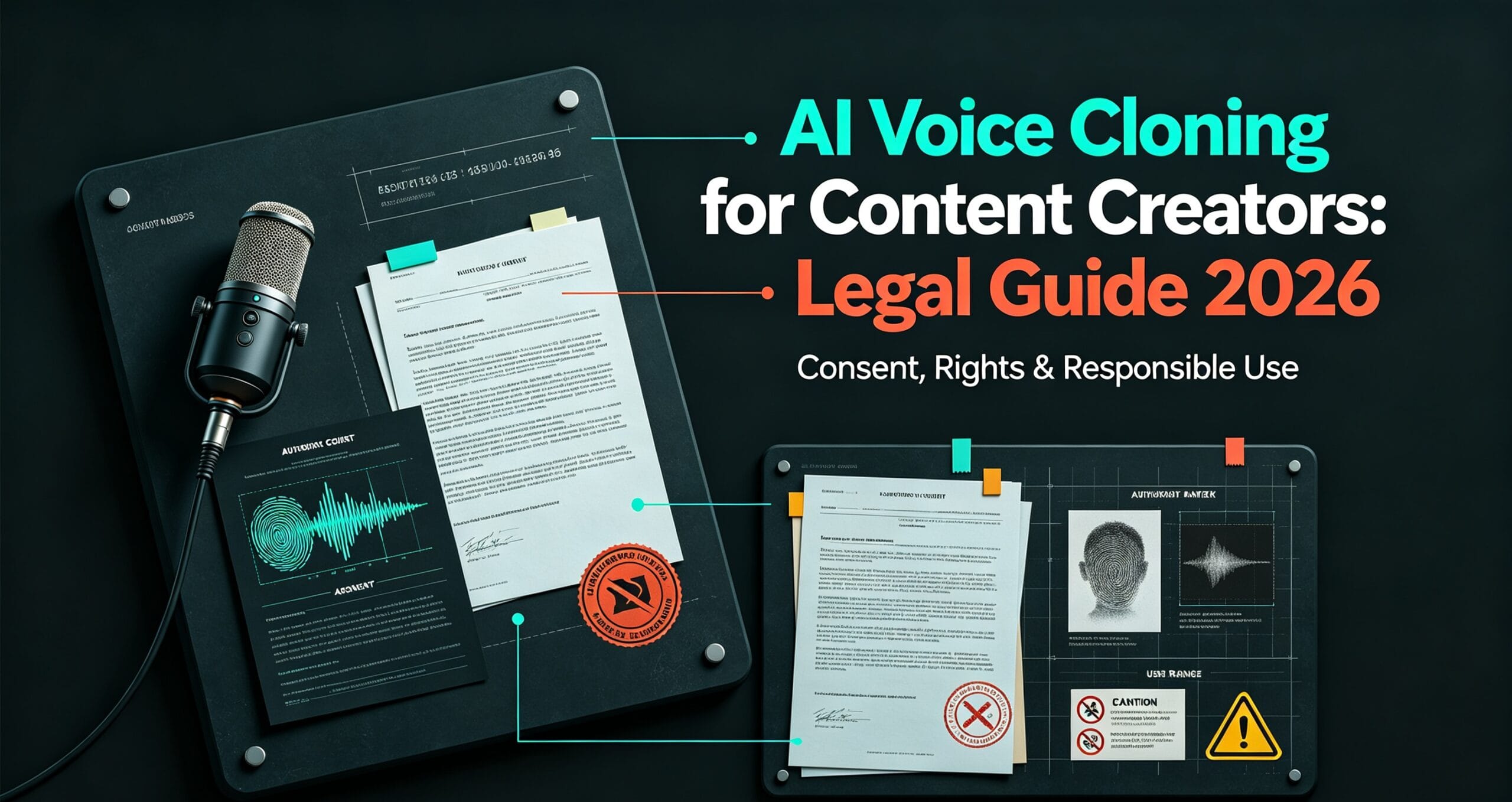
AI voice cloning for content creators exploded in 2026 — but so did the lawsuits. Cloning a voice is now trivially easy, which means the legal side matters more than the tech. This guide is the compliance playbook: what you can legally do with a cloned voice, how to protect your own, and exactly how to turn a voice clone into revenue without ending up in a cease-and-desist.
Why Content Creators Suddenly Need a Voice Cloning Legal Strategy
Voice cloning went mainstream in 2025-2026: ElevenLabs, OpenAI, and dozens of local tools can replicate a voice from seconds of audio. That democratized the tech — and it also created a wave of imitation claims from actors, podcasters, and YouTubers whose voices were cloned without consent. If you create content for a living, AI voice cloning for content creators is no longer optional entertainment; it is an asset you must protect and a risk you must manage.
The 3 Legal Risks of Cloning Any Voice (Including AI Voices)
Before you clone anyone — even with “permission” — understand what you are actually copying:
- Right of publicity / voice likeness. In many U.S. states (California, New York, Tennessee) and in the EU, your voice is protected as a personal identifier. Cloning a real person’s distinctive voice for content can trigger likeness claims even if you name no one.
- Consent & contracts. Verbal “yeah sure” is not consent in court. You need a signed agreement that states the purpose, the platform, the duration, and the compensation for using the voice. This is the #1 mistake creators make.
- Copyright in the underlying audio. Training a clone on someone’s podcast, audiobook, or interview — even a clip you “found online” — may infringe copyright in that recording, separate from any voice-likeness issue.
If you are cloning an AI-generated voice you do not own, the same logic applies: most commercial voice-AI licenses restrict re-cloning or reselling the voice. Read your terms.
How to Legally Clone Your Own Voice (The Safe Path)
The clean route most creators miss: clone your own voice, document ownership, and keep the source data private. AI voice cloning for content creators is fully legal when the voice is yours or you hold written rights.
The safest setup keeps your voice samples on your own machine. Cloud cloning uploads your raw recordings to a third party — which introduces data-ownership and resale questions no creator should ignore. A local, offline cloning tool (like VoiceVault) means your voice data never leaves your desk, so you retain full control of your most personal asset.
Free Voice Cloning Consent Template
When you hire a voice actor or feature a guest’s voice, use a written release before publishing anything. Copy this template into your own doc:
Voice Usage Consent & License
I, [Name], grant [Creator/Company] a non-exclusive, royalty-bearing license to record, clone, and use my voice in [describe content/platforms, e.g., YouTube videos and podcast episodes] for a term of [duration] in exchange for [compensation]. I confirm I am the owner of the voice recordings provided, and I may revoke this license only for future uses not covered here. Signed: ______ Date: ______.
Keep the signed consent with your project files. If you ever sell the content or get flagged, this paper is your defense.
Platform Policies You Must Know in 2026
- YouTube: AI-generated content that realistically imitates a real person must be disclosed via the altered-content toggle; undisclosed deep voices can get strikes or takedowns.
- Podcast platforms (Spotify/Apple): require disclosure for synthetic voices in many jurisdictions (EU AI Act provisions took effect in 2026).
- Social (Instagram/TikTok): label AI voices in ads or risk ad-rejection and account flags.
Disclosure is your friend: it keeps you compliant and actually builds audience trust.
How to Actually Monetize Your Own Voice Clone (VoiceVault)
Once your consent and disclosure ducks are in a row, a voice clone becomes a scalable revenue asset. You can narrate faceless YouTube channels, localize your podcast into 140+ languages, generate voiceovers for courses and ads — all in your voice, all day, while you sleep.
For creators who want maximum control and zero subscription bleed, VoiceVault is the local-first pick: a one-time $79 USB tool with a lifetime license, 140+ languages, offline text-to-speech and voice cloning. Because it runs on your machine, your voice data stays private and your licensing stays clean — exactly what this guide recommends. If you are still comparing mainstream options, our free text-to-speech roundup covers the no-signup cloud alternatives.
Frequently Asked Questions
Is AI voice cloning legal for content creators? Cloning your own voice (or a voice you hold written rights to) is legal. Cloning another real person without consent is not, and can trigger likeness and copyright claims.
Can I monetize a cloned voice on YouTube? Yes, if the voice is yours or licensed, and you use YouTube’s altered-content disclosure. Unlicensed celebrity or actor voices will get you strikes.
Do I need a lawyer to clone my own voice? For your own voice, no. For hired voices or clients, use the written consent template above — and see a lawyer for anything large-scale.
Is cloud or local voice cloning more legally risky? Local tools lower data-risk because your recordings never leave your machine. Cloud tools may retain or reuse your samples under their terms — read them.
The Bottom Line
AI voice cloning for content creators is a golden opportunity in 2026 — if you treat your voice like the asset it is. Clone your own voice, get written consent for anyone else’s, disclose AI content on every platform, and keep your source data under your control. Do that, and you can scale narration and localization with zero legal hangover. Do it sloppily, and your first cloned-video “win” could be your last.