Three years ago a German e-commerce brand paid me $340 to translate and localize a 40-page product catalog into English. I did the whole job from my laptop with free tools, no translation degree, and a turnaround of four days. That single order taught me that an AI translation service for clients is one of the most underrated freelance income streams available right now — every business with international ambitions needs it, and almost none of them have a reliable freelancer on call.
This is the exact $0 workflow I use to deliver professional translation and localization for clients, along with how to price it, where to find buyers, and the quality checks that keep them coming back.
Why Clients Pay for an AI Translation Service
Companies don’t buy “words in another language” — they buy access to new markets. A Shopify store selling to German shoppers with broken German copy loses sales at checkout. A SaaS startup launching in Spain needs landing pages that read like they were written by a native. A restaurant chain distributing menus across France needs fast, accurate, on-brand translations every quarter.
Traditional translation agencies charge $0.10–$0.25 per word and take a week or more. Machine translation alone is fast but reads robotic and often gets nuance, idioms, and brand voice wrong. That gap — between “cheap but sloppy” and “accurate but slow and expensive” — is exactly where a skilled freelancer running an AI translation service for clients wins. I deliver near-agency quality at freelancer speed and price.
I’ve now worked with e-commerce brands, indie app developers, tourism operators, and content agencies that white-label me for their own clients. The common thread: they need multilingual content fast, and they want a human to guarantee it doesn’t embarrass them.
The $0 Software Stack I Actually Use
You don’t need a $200 language plugin or a pricey localization suite. Here’s the free stack that powers my entire AI translation service:
- Free AI chat assistants — for a fast first-pass translation, tone adjustments, and idiomatic alternatives. Treat it as a tireless bilingual assistant, never as the final deliverable.
- Free grammar and clarity checkers — after the first pass, I run every English target text through my free grammar checker to catch comma splices, article errors, and awkward phrasing that machine translation loves to produce.
- Free translation consistency checks — I use my free AI translation checker to compare source and target line by line, flag missing segments, and verify terminology stays consistent across a whole document.
- Free readability tools — for marketing copy, I check that the translated text sits at the right reading level for each market using a free readability score checker.
- A local, offline toolkit — for client files that contain confidential contracts, medical text, or unreleased products, I keep everything on my own machine. My portable AI toolkit runs translation, cleanup, and document export without uploading anything to a third party — a detail that wins me privacy-conscious clients instantly.
Every tool above is free forever at freelance volume. The real value I sell is judgment: knowing what to translate literally, what to adapt culturally, and what to rewrite entirely.
My Exact Translation & Localization Workflow
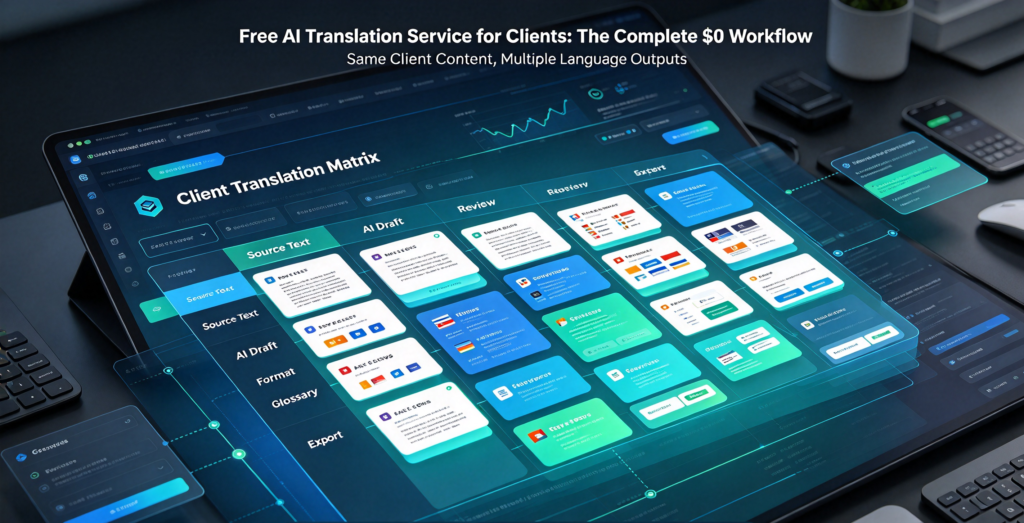
Here’s the process I run on every order, start to finish:
- Confirm scope and tone. I ask what the text is for, who reads it, and whether they want literal accuracy or marketing polish. A legal notice and a product slogan need very different treatment.
- Build a glossary first. I list the brand’s key terms — product names, taglines, technical vocabulary — and lock the agreed translation for each. This is the single biggest quality lever on long jobs.
- First-pass translate in chunks. I translate section by section with my free AI assistant, keeping paragraph and heading structure intact so the client can drop it straight back into their CMS.
- Line-by-line QA. I compare source and target in my translation checker, then run the target through a grammar and readability pass. This is where 80% of the perceived quality comes from.
- Localize, don’t just translate. Prices, units, dates, currency, formality level, and cultural references all get adapted. “Black Friday” copy for a market that calls it something else gets rewritten, not transliterated.
- Deliver clean, and offer the upsell. I return a formatted file matching their template, plus a short glossary and a note on anything I adapted. That documentation is what turns a one-off job into a monthly retainer.
How to Price an AI Translation Service for Clients
Pricing is where most freelancers leave money on the table. Here’s what I charge and why:
- Per word, for bulk text. $0.04–$0.08 per word for straightforward translation, higher ($0.10+) for technical, legal, or marketing copy that needs heavy localization.
- Per page or per item, for catalogs. Product descriptions and menu items price better per line or per SKU than per word.
- Hourly, for review-only work. When a client already has a machine translation and wants a human polish, I quote an hourly rate and cap the hours.
- Retainers, for recurring content. Blogs, newsletters, and social posts become a monthly package — the holy grail, because it’s predictable income.
Because my software stack is free, my margin on every order is essentially 100% of my time. That’s the whole point of running an AI translation service for clients this way.
Where to Find Translation Clients
You don’t need to cold-call agencies. Here’s where the work actually comes from:
- Freelance marketplaces. Upwork, Fiverr, and ProZ all have steady translation demand — niche down (e.g. “German e-commerce to English” or “Spanish app localization”) to stand out.
- E-commerce and SaaS companies going international. Localized product pages and app stores are a constant need; many small brands have no vendor at all.
- Agencies that white-label. Localization agencies and marketing studios constantly subcontract overflow work to reliable freelancers.
- Your own inbound. A simple page describing your translation and localization service, ranking for “translate [language] to [language] for business,” brings leads while you sleep.
- Existing clients. The cheapest new order is from a happy past client — always ask what else needs localizing.
The Quality Bar That Keeps Clients Coming Back
The reason my clients rehire me isn’t speed or price — it’s that I never deliver raw machine output. Every piece gets a human pass for grammar, tone, and cultural fit. I keep a glossary so terminology stays consistent across orders, I format deliverables to match their existing files, and I flag anything I adapted so there are no surprises.
That reliability is what shifts a client from a single $200 job to a $1,500-a-month localization retainer. And it’s why a free-tool workflow can compete with agencies charging ten times as much.
Put This Into Practice
Pick one language pair you’re genuinely good at, choose a niche (e-commerce, apps, tourism, legal), and set up your free stack today: an AI assistant for first passes, my free translation checker for line-by-line QA, and my free grammar checker for the polish pass. Offer three sample translations to prospects, charge per word to start, and raise your rate as reviews stack up.
Translation is one of those services every growing business needs and few freelancers deliver well. Build an AI translation service for clients on a free stack, hold a high quality bar, and you have a genuinely repeatable income stream — no degree, no expensive software, no office required.