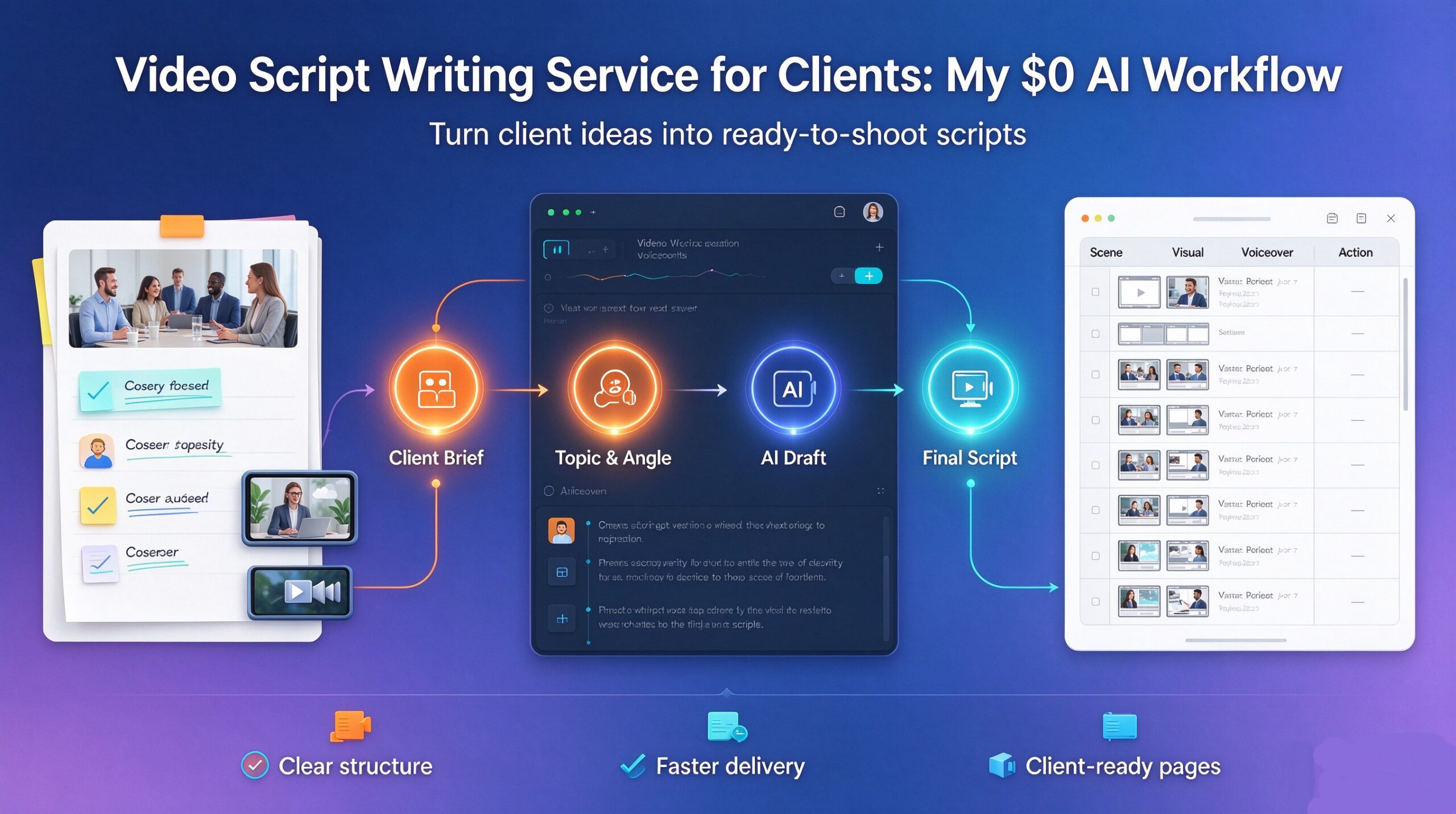
Every YouTube channel, course creator, and brand account needs scripts. The problem is that writing a good video script is slow, repetitive work, and the people who are best on camera are usually the worst at writing. That gap is a real freelance niche, and you do not need expensive software or a film degree to fill it. I run a client video script writing service using nothing but free browser tools, and this post is the exact workflow I use from pitch to final delivery.
The reason video scripts pay well is structural. A creator who publishes twice a week needs 8 to 10 scripts a month, and they would rather record than write. A five-minute script that takes you 90 minutes to research and write can sell for $150 to $400, and a batch retainer is the most stable income a freelance writer can hold. The barrier is not talent, it is process: knowing how to research a topic, structure a hook, and keep a viewer watching.
The $0 Tool Stack I Actually Use
You do not need a subscription suite to write scripts. Here is the free stack that covers every stage of a script job:
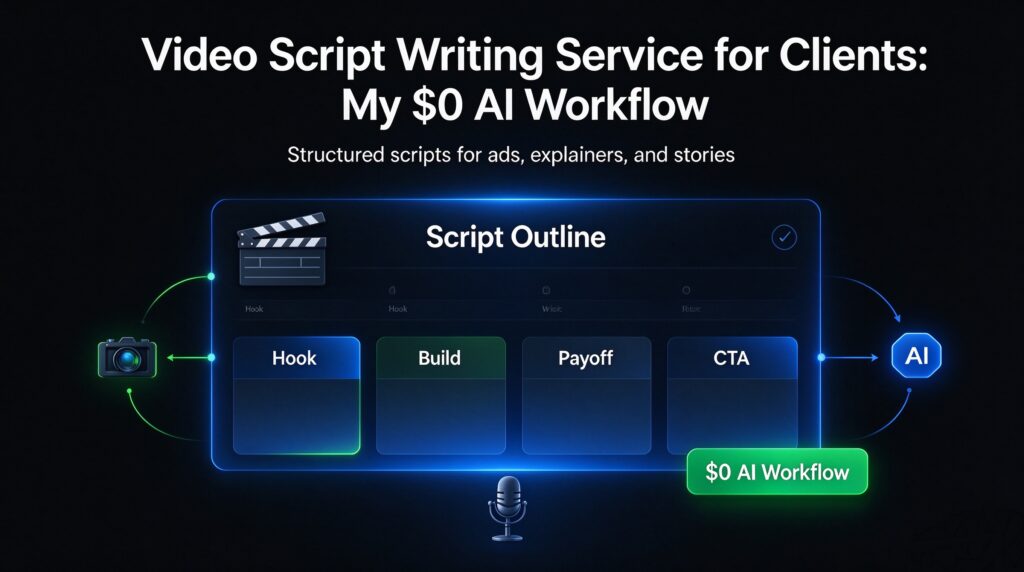
- Article Outline Generator — turns a rough topic into a structured skeleton. For scripts it produces the beat sheet: hook, promise, three points, payoff. I refine it, I never ship it raw.
- Blog Title Generator — a video title and a blog title live or die the same way, on curiosity plus clarity. I use the tool to generate 20 options and pick the strongest.
- Readability Checker — the single most useful tool for scripts. Spoken language must be simpler than written language; anything that scores too dense gets shortened. If a sentence is hard to read, it is harder to say aloud.
- Grammar Checker — the final pass. Clear, error-free copy is the product you are selling.
- Text to Speech — I generate a rough audio read of the draft and listen back. A script that sounds clumsy out loud gets fixed before the client ever records. This one trick has saved me more rework than anything else.
- Pocket AI — my offline desktop app. I use it when a client’s script is for an unreleased product under NDA and I cannot paste anything into a cloud tool. It runs entirely on my machine, so confidential details never leave my laptop.
Every one of those is available as a free online tool on this site — no account, no install, no credit card. The offline versions matter mainly for the privacy cases I get into later.
How I Run a Client Script Job (Step by Step)
Here is the workflow I follow for a typical engagement: a batch of four 5-minute YouTube scripts for a creator in a defined niche.
Step 1: Scope the job before you quote it
I ask for three things: the channel or brand and two reference videos the client thinks are “good”, the target audience in one sentence, and the call to action (subscribe, buy, book a call, watch a related video). That last question changes the whole ending. A script that does not know its CTA is not finished. Scope determines price, so get this in writing before you write a word.
Step 2: Build the beat sheet with an outline tool
I feed the topic and audience into the free article outline generator and get a structural draft. For video I force it into a fixed shape: a 15-second hook, a one-line promise, three body points, and a payoff. AI is genuinely good at enumeration; it is bad at knowing what a real person will watch, so the beat sheet is scaffolding, never the script.
Step 3: Write the hook first, and rewrite it three times
The first 15 seconds decide whether the other four minutes matter. I write the hook, read it aloud, and cut it until it fits in one breath. The pattern that works is specific and slightly uncomfortable: name the exact problem the viewer has, promise the fix, then move. I write this before the body because a strong hook tells me what the body owes the viewer.
Step 4: Write for the ear, not the eye
Every section follows the same shape: one claim, one concrete example, one line of payoff. Then I run the whole draft through the free readability checker and cut anything that scores as dense. Spoken sentences need to be shorter than written ones — if a line has three clauses, it becomes three lines. Short sentences also give the editor places to cut, which clients quietly appreciate.
Step 5: Listen to the draft before you deliver it
I paste the draft into the free text to speech tool and listen at normal speed. Awkward phrasing, repeated words, and sentences that are impossible to say jump out instantly. When I am happy, I generate a title with the blog title generator and add a one-line description and 5 tags for the client’s upload, because throwing those in makes me look like a partner rather than a typist.
Pricing: What Video Scripts Are Worth
This is the part most freelancers get wrong, and it is why the niche is underrated. Because the work is repeatable and the alternative is a creator writing instead of filming, rates are healthy. Here is how I price jobs:
| Job type | Typical price |
|---|---|
| Single 5-minute script | $120 – $300 |
| Batch of 4 scripts (monthly content) | $400 – $1,000 |
| Long-form 15-minute deep dive | $300 – $700 |
| Shorts / Reels pack (10 scripts) | $250 – $500 |
| Monthly retainer (8 scripts) | $700 – $1,500 / month |
Two notes on these numbers. First, quote per script or per batch, never per hour — hourly punishes you for getting faster, and you will get faster. Second, retainers are the real prize: once you know a creator’s voice and audience, writing the next batch is fast, repeatable work. One or two retainers becomes a stable base income that most freelancers never reach.
Where to Find Paying Clients
You will not find these jobs by scrolling generic gig boards. The clients are where the videos are:
- YouTube itself — find channels that publish weekly but look ad-libbed or inconsistent. The inconsistency is your opening: offer to take scriptwriting off their plate for one video, paid, at a pilot rate.
- Course creators — anyone selling a course on Teachable, Kajabi, or their own site has a curriculum to script. Lesson scripts are higher priced than YouTube scripts and rarely advertised.
- B2B SaaS teams — every product now runs a YouTube channel and a webinar program. Marketing managers are the easiest people to pitch because they already have a budget line for content.
- Your own portfolio — write one spec script for a small channel for free, publish it as a sample with the video it produced, and put it in your pitch. A finished video beats any résumé line.
The outreach message that works is short: name one specific thing you noticed about their last video, offer a small paid pilot, and link one sample. No cover letters.
Where Confidentiality Changes the Tools
Here is the catch nobody warns you about: product launch scripts and webinar scripts are often under NDA. Pasting an unreleased feature into a random cloud tool can breach your client contract. This is exactly why I keep an offline option. AI Power Suite bundles offline desktop tools that run the same outline, readability, and text-to-speech functions entirely on my machine — no data leaves the laptop. For NDA work I switch to it and mention that in my pitch. Security-conscious clients love hearing it, and it justifies higher rates.
Frequently Asked Questions
Do I need to be a great writer to script videos?
You need to write clearly and structure a story. Scriptwriting is closer to conversation than to literature — plain, direct language wins. If you can hold a friend’s attention while explaining something, you can write a script.
How long does a 5-minute script take?
Research plus draft plus polish runs about 90 minutes to 3 hours depending on the topic. Quote the deliverable, not the hours.
Should I use AI to write the script?
Use it for structure, enumeration, and a first draft, never for the final voice. The value you add is a hook that lands and sentences that sound natural when spoken — things a generic model cannot hear.
Should I include hooks, B-roll notes, and CTA?
Yes. A script that includes on-screen text suggestions, B-roll cues, and a clear call to action is worth noticeably more than a wall of narration. It shows you understand filming, not just writing.
Can I do this niche part-time?
Yes. One batch or one retainer a month is meaningful income, and deadlines are rarely same-day, so it fits alongside a day job.
Start With a Free Sample
The fastest way into this niche is to script one video for a small channel for free and put the result in your portfolio. Pick a topic you already understand, run it through the free tools above, and send it to three creators whose videos are inconsistent. That single sample will do more for your client work than any amount of marketing. Grab the free tools, script one practice video, and you will see how quickly this becomes a repeatable service.
Related reading: API Documentation Writing Service for Clients: My $0 AI Workflow.
Related reading: AI Content Writing Service for Clients: My $0 AI Workflow.