Maria, a high school science teacher in Chicago, used to spend four hours every Sunday grading assignments and planning lessons. Then she discovered an AI teaching assistant. Now she finishes her prep work in 45 minutes and uses the extra time to give one-on-one support to struggling students. “My students’ test scores went up 18% in one semester,” she says. “Not because the AI taught them — because I finally had time to actually teach.”
Artificial intelligence is quietly revolutionizing education. Not with flying robots or hologram teachers, but with practical tools that help educators save time, personalize learning, and keep students engaged. According to a 2025 survey by the International Society for Technology in Education (ISTE), 63% of K-12 teachers in the U.S. now use AI tools at least weekly, up from 27% in 2023. In higher education, the number jumps to 71%.
The global AI in education market is expected to reach $4.2 billion by 2026, according to HolonIQ (2025), with the fastest growth in personalized learning platforms and automated assessment tools. But adoption comes with challenges — from academic integrity concerns to the digital divide.
This guide covers how AI is actually being used in education right now, with practical examples, real-world data, and tools you can start using today.
How Teachers Are Using AI to Save Time and Teach Better
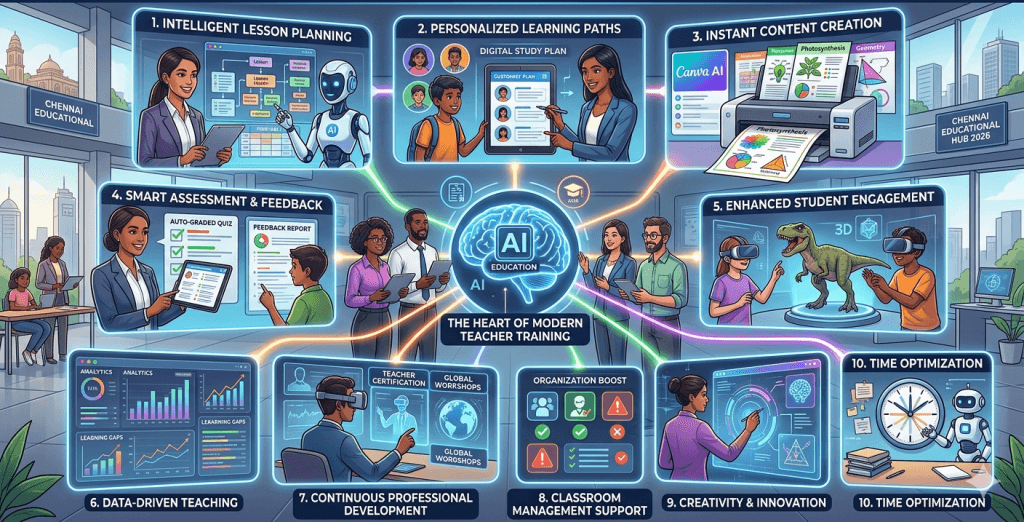
Teachers consistently cite time as their most scarce resource. AI addresses this directly by automating the most time-consuming parts of teaching.
AI Lesson Planning
Platforms like Eduaide.AI and Curipod allow teachers to generate complete lesson plans in minutes. A teacher inputs the topic, grade level, and learning objectives, and the AI produces a structured plan with activities, discussion questions, and assessment ideas. A 2024 study from Stanford’s Center for Education Policy Analysis found that teachers using AI lesson planning tools saved an average of 5.2 hours per week.
“I used to dread Sunday evenings because of lesson planning. Now I spend 15 minutes on Monday morning. The AI doesn’t replace my expertise — it handles the structure so I can focus on the creative parts.” — James K., Middle School Teacher, Oregon
Automated Grading and Feedback
AI grading tools have improved dramatically. Platforms like Gradescope and Turnitin Revision Assistant can evaluate essays, short-answer responses, and even coding assignments — providing consistent, rubric-based feedback in seconds. According to Turnitin’s 2025 impact report, teachers using AI-assisted grading reported a 40% reduction in grading time while maintaining grading accuracy comparable to manual methods.
Differentiated Instruction
Every classroom has students at different levels. AI tools like Khanmigo (Khan Academy’s AI tutor) and DreamBox adapt content in real-time based on each student’s performance. If a student struggles with fractions, the AI provides additional practice and alternative explanations. If they excel, it moves them ahead. Research from Carnegie Learning (2024) showed that AI-differentiated math instruction improved test scores by 22% compared to traditional methods.

How Students Are Using AI to Learn More Effectively
Students have adopted AI even faster than teachers — sometimes officially, sometimes not. Here is how they are using it productively.
AI Tutoring and Homework Help
Tools like Photomath, Khanmigo, and Wolfram Alpha have become essential study aids. These tools don’t just give answers — they explain the reasoning step-by-step. A 2025 study by the University of Michigan found that students who used AI tutoring tools for at least 30 minutes per week scored 13% higher on final exams than those who did not.
Research and Writing Assistance
AI tools like Scite.ai and Elicit help students find and evaluate academic sources. Instead of spending hours searching through databases, students can ask natural language questions and get relevant, cited papers. For writing, tools like Grammarly and ProWritingAid help students improve clarity, grammar, and structure — acting like an always-available writing coach.
Language Learning
AI-powered language apps like Duolingo Max (powered by GPT-4) and ELSA Speak offer personalized conversation practice. Duolingo reported in 2025 that its AI-powered features increased learner retention by 34% compared to non-AI versions, as measured by 30-day active user rates.
How Schools and Universities Are Adopting AI
Institutional adoption varies widely, but forward-thinking schools are developing comprehensive AI policies.
AI Literacy Programs
Countries like Finland, Singapore, and South Korea have introduced national AI literacy curricula. In the U.S., the state of California launched a $50 million AI in Education initiative in 2025, funding teacher training and pilot programs in underserved districts. According to UNESCO (2025), 21 countries now have national AI education policies, up from just 7 in 2022.
AI Detectors and Academic Integrity
The rise of AI-generated essays has forced schools to rethink assessment. Tools like Turnitin AI Detection and GPTZero claim 98%+ accuracy in detecting AI-generated text. But the more interesting shift is toward “AI-augmented assignments” — tasks where students are explicitly encouraged to use AI as a collaborator while demonstrating their own critical thinking.
A 2025 Harvard Graduate School of Education report recommends that schools focus on process over product: assess how students use AI tools, their editing process, and their ability to evaluate AI outputs, rather than banning the technology outright.
Equity and the Digital Divide
AI adoption in education risks widening existing inequalities. Students in well-funded districts have access to AI tutoring while those in under-resourced schools do not. Organizations like UNICEF and One Laptop Per Child are working on open-source AI education tools designed to run on low-cost devices and work offline.
The Best AI Tools for Education in 2026
For Teachers
- Eduaide.AI — AI lesson plan generator with standards alignment
- Curipod — Interactive lesson creation with AI
- Gradescope — AI-assisted grading for any subject
- Khanmigo — Khan Academy’s AI tutor (free for teachers)
- Canva for Education — AI-powered classroom visuals and presentations
- MagicSchool.ai — All-in-one AI platform for educators
For Students
- Khanmigo — Personalized AI tutoring across subjects
- Photomath — Step-by-step math problem solving with AI
- Grammarly — AI writing assistant and grammar coach
- Scite.ai — Smart citation search and source evaluation
- Duolingo Max — AI-powered language learning
- Notion AI — Note-taking and study organization with AI
For Schools and Administrators
- Turnitin AI — Plagiarism and AI-generated content detection
- Panorama Education — AI-powered student engagement analytics
- PowerSchool AI — Predictive analytics for student performance
- Elevate K-12 — AI scheduling and resource allocation
Challenges and Responsible AI Use in Education
Academic Integrity Concerns
The most immediate challenge. A 2025 survey by the Pew Research Center found that 58% of high school students admitted to using AI for assignments without their teacher’s knowledge. Schools are responding with clearer policies and AI literacy education rather than outright bans.
Data Privacy
Student data is protected by laws like FERPA (U.S.) and GDPR (Europe). Schools must ensure that AI tools they adopt are compliant. A 2025 audit by the Electronic Frontier Foundation found that 34% of popular education AI apps shared user data with third-party advertisers — a significant concern for school districts.
Teacher Training
AI tools are only effective if teachers know how to use them. A 2025 report by the U.S. Department of Education found that only 28% of teachers felt “well-prepared” to integrate AI into their classrooms. The report recommends at least 20 hours of hands-on AI training for every educator.
Bias in AI Systems
AI models trained on historical data can perpetuate biases. A 2024 study by MIT Media Lab found that some AI grading systems consistently scored essays by non-native English speakers lower than those by native speakers, even when the content quality was identical. Regular auditing and diverse training data are essential.
The Future of AI in Education
Several trends will shape education AI over the next few years:
- AI Teaching Assistants in Every Classroom — Many schools are piloting always-on AI assistants that handle administrative tasks, freeing teachers to focus on instruction
- Lifelong Learning Platforms — AI-powered platforms that follow students from K-12 through college and into their careers, adapting to changing skill requirements
- Immersive Learning with VR + AI — Virtual reality classrooms where AI creates personalized learning environments — imagine studying ancient Rome by walking through it
- AI-Powered Special Education — Personalized interventions for students with learning differences, including real-time speech-to-text, reading assistants, and behavioral pattern analysis
“AI will not replace teachers. But teachers who use AI will replace those who don’t. The question is not whether to adopt AI — it’s how to adopt it responsibly.” — Dr. Andreas Schleicher, Director of Education, OECD
Frequently Asked Questions
Is AI in education expensive for schools?
Many high-quality AI education tools offer free versions for teachers and students, including Khanmigo, Canva for Education, and basic Grammarly. School-wide implementations typically cost $5-15 per student annually.
Can AI replace teachers entirely?
No. AI handles routine tasks and personalization, but it cannot provide the emotional support, mentorship, creativity, and human connection that effective teaching requires. AI augments teachers — it does not replace them.
How do I know if my child’s school uses AI?
Ask the school administration about their AI policy. Many schools now publish AI usage guidelines on their websites. You can also ask teachers what tools they use in the classroom.
Will AI make cheating easier?
AI tools can be misused, but many schools are shifting to AI-integrated assessments where students must demonstrate their process and reasoning. The focus is moving from “catching cheaters” to “designing assignments that are AI-resistant.”
Start Using AI in Education Today
Whether you are a teacher looking to reclaim your evenings, a student trying to study more effectively, or an administrator planning your school’s AI strategy, the tools are ready. Start small: pick one AI tool, try it for a week, and measure the difference.
Education is at an inflection point. AI offers the chance to personalize learning at scale — but only if we use it thoughtfully, ethically, and with the ultimate goal of helping every student reach their full potential.
Share This Article
If you found this guide helpful, please share it with your network:
Share on Twitter |
Share on Facebook |
Share on LinkedIn |
Pin on Pinterest
Get in Touch
Have questions about AI in education? Drop us a message and we will get back to you: