A press release is one of the few pieces of writing that has to do three jobs at once: get picked up by journalists, survive a skim by a busy editor, and still read well when it lands on a customer’s screen. Most startups and small agencies treat it as a formality — something to fire off after a launch — and then wonder why nobody covers them.
The uncomfortable truth is that PR is not about a magic distribution list. It is about a tight, factual, well-structured document that saves a reporter time. Before I started charging for press release writing, I assumed the work required expensive wire services and agency retainers. It does not. Most of the heavy lifting — the structure, the angle, the headline, the quote polish — can be done with free AI tools in under an hour. This is the exact workflow I use to write press releases for clients, and what I charge for it.
Why press releases are an underrated freelance service
Every funded startup, every product launch, every funded grant, every new hire announcement needs a press release. Most of those companies have no in-house writer. The ones that do are usually founders who are good at building and bad at writing, and they know it. That gap is the opportunity. A press release writing service is easy to explain, easy to scope, and easy to price — because the deliverable is one document with a clear finish line.
It also fits neatly into an existing content or SEO freelancing business. If you already write blog posts or landing page copy for clients, adding press releases is a natural upsell. You already have the client relationship, the voice guide, and the trust. You just need a repeatable process so you can deliver a polished press release without starting from a blank page every time.
The $0 tool stack
You do not need a PR agency software suite. Five free browser tools cover the entire workflow, and none of them cost a cent or require an account:
- Outline generator — turns a one-line brief into the skeleton (headline, dateline, lead, body, boilerplate).
- Blog title generator — rapid-fire headline variations you can keep or discard.
- Grammar checker — catches the passive voice and tense slips that make releases read amateurish.
- Readability score checker — keeps your sentences at reporter speed, not academic speed.
- Meta description generator — for the web version of the release you publish on the client’s site.
Everything runs in the browser at the free AI tools hub, and nothing gets saved to a server. For clients with NDA concerns — and PR clients always have NDA concerns — that matters. You can also run the whole stack offline if you keep the downloadable version on a USB stick, which I mention whenever a client asks where their unpublished announcement lives.
The five-step workflow
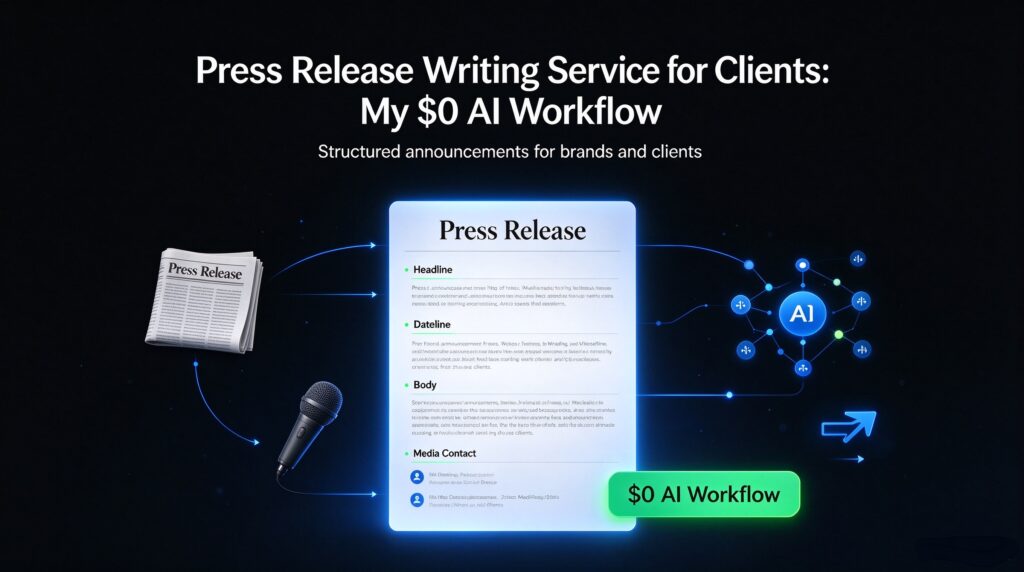
1. Extract the news, not the marketing
Ask the client one question: what actually happened? Not “we’re excited to announce” — what changed. A new funding round, a launch, a partnership, a hire, an award, a milestone. Write that down in one sentence. This is your lead, and everything else supports it. Open the article outline generator, paste that one sentence as the topic plus a couple of supporting facts, and choose a news-release structure. You will get a skeleton in seconds.
2. Build the headline before the body
The headline is 80% of whether a journalist clicks. Take your structure and the core fact into the blog title generator and generate twenty options. You are not looking for the perfect one — you are looking for the verb. Good release headlines start with an active verb (“announces,” “launches,” “raises,” “acquires”) and put the company name and the concrete number early. Keep the ones that read like a news wire, not a slogan.
3. Draft fast, in plain language
Now fill the outline. The standard structure is: headline, subhead, dateline (city, date), the lead paragraph answering who/what/when/where/why, two or three supporting paragraphs with detail, one quote from a spokesperson, one optional customer or partner quote, then the boilerplate and contact block. Write it plainly. If a sentence needs a comma to survive, split it. Once the draft is down, run it through the grammar checker before you read it yourself — you will spot more when the obvious errors are already gone.
4. Tune it for readability and skimmers
Journalists read the first sentence, scan the subheads, and jump to the quote. Paste your draft into the readability score checker and aim for a score a general reader can clear without effort. Break long paragraphs, front-load each paragraph with its point, and make sure the quote sounds like a human said it out loud. This step is what separates a release that gets opened from one that gets archived.
5. Package it for the web and for email
Most clients also want the release posted on their own site for SEO. Give them a clean web version with a generated meta description, one canonical URL, and the newsroom contact block. If they have an existing tool stack, hand the asset off in a format they can paste directly. Deliver both the formatted copy and a plain-text version, because some distribution services strip HTML.
What to charge
| Deliverable | Typical freelance price |
|---|---|
| Single standard press release (400–600 words) | $150 – $350 |
| Launch package (release + web version + meta) | $350 – $600 |
| Monthly retainer (2–4 releases) | $600 – $1,500 / month |
| Rush turnaround (under 24h) | +30–50% surcharge |
These numbers are not aggressive. Agencies charge several times this. Your advantage is speed and a clear per-document price. A founder who needs three releases this quarter will happily pay for someone who can turn one around in a day without a retainer negotiation.
Where to find clients
- Startup communities — founder Slack groups and accelerator alumni networks always have launches coming.
- Product Hunt makers — every launch is a press release waiting to be written.
- Freelance marketplaces — search “press release” and you will find steady demand with thin supply of good writers.
- Your existing clients — the fastest sale is an upsell to someone who already trusts you.
Confidentiality and the offline option
Unannounced funding rounds and product launches are some of the most sensitive documents a company produces. If a client is nervous about putting that text into an online tool, run the workflow offline. A downloadable local version keeps the entire draft on the machine, so nothing unpublished leaves the building. Being the writer who can offer that — instead of the one who says “just paste it into ChatGPT” — is a genuine competitive edge with security-conscious clients.
Frequently asked questions
Do I need PR agency experience to sell this?
No. The core skill is clear news writing, which is learnable and demonstrable. A portfolio of three well-structured sample releases with real (or plausibly anonymized) facts is enough to win first clients.
How long does one press release take?
With this workflow, a standard release takes 60 to 90 minutes from brief to delivered draft. Rush jobs can be done in under an hour if you have the facts up front.
Should I include a quote even if the client gives me none?
Yes. A release without a quote reads incomplete. Draft a plausible quote from the founder or spokesperson and send it back for approval rather than waiting on them. Clients almost always accept an edited version of what you wrote.
Is it worth doing this for free to build a portfolio?
Do two free releases for early clients or your own projects, then stop. Free work signals low value, and the workflow is fast enough that paid pricing is justified from the third client onward.
Start with one free sample
The easiest way to sell a press release service is to send a prospect a sample release about their own company, written from public information, before they ask. It takes twenty minutes with this workflow and it converts better than any pitch email. If you want the free tools in one place so you can build that sample today, start at the free AI tools hub — and if you would rather run everything offline for sensitive announcements, the AI Power Suite bundle includes the local versions.
Related reading: Grant Writing Service for Clients: My $0 AI Workflow.