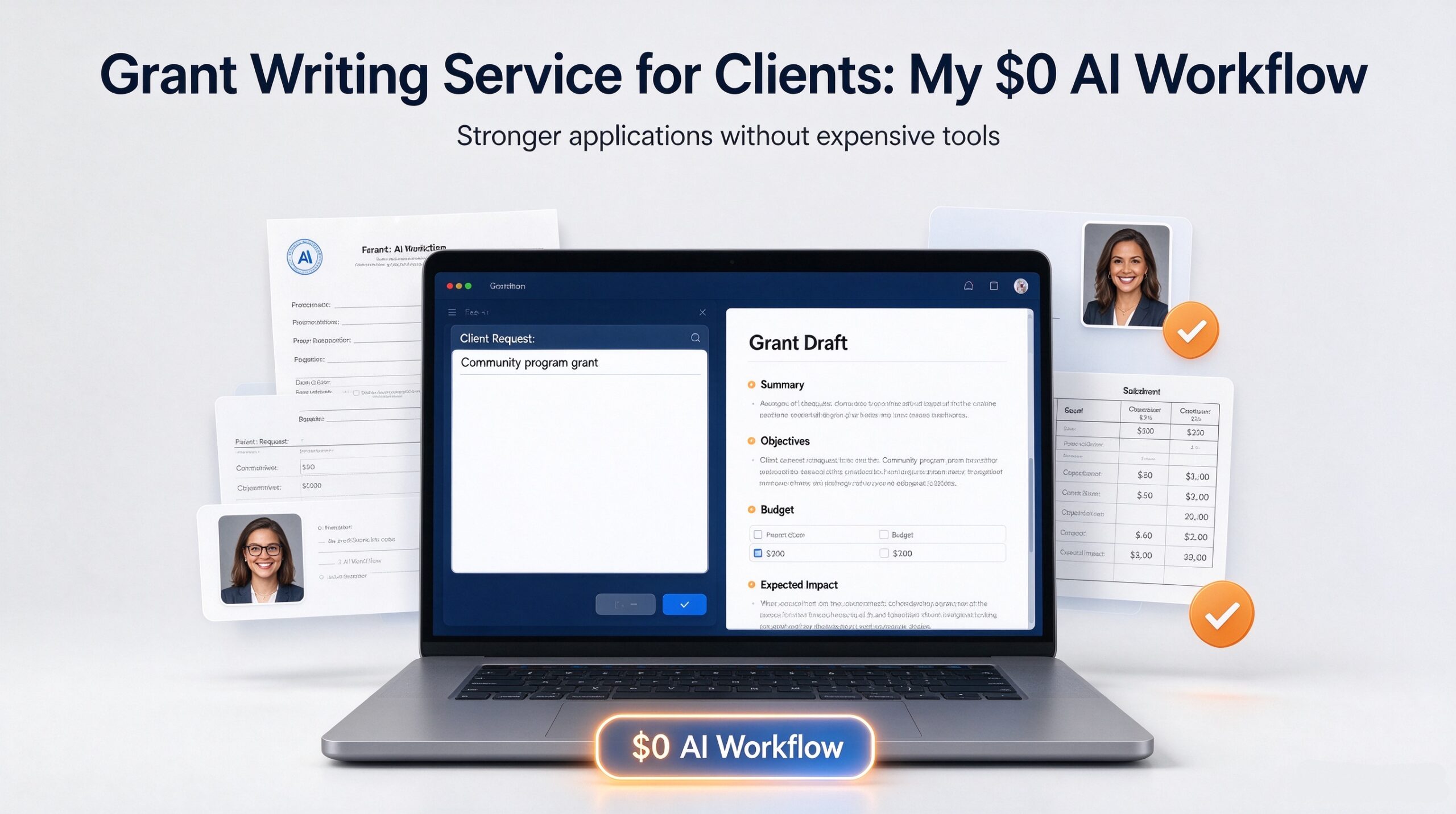
Running a grant writing service is one of the most under-served freelance offers on the market — and one of the most valuable. Nonprofits, research labs, community programs, and small municipalities all need funding proposals written, and almost none of them have a staff grant writer. They either pay an agency thousands per application or let the deadline slip. That gap is a serious opportunity for a freelancer with a reliable workflow.
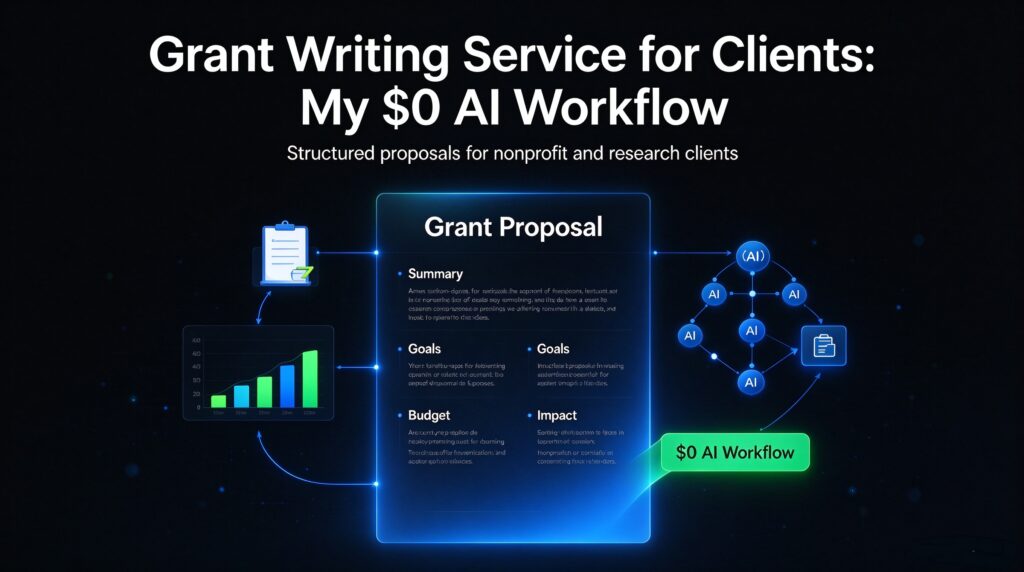
The catch is that grant proposals are unforgiving. Reviewers read hundreds of applications, they know boilerplate when they see it, and a single missed eligibility rule or vague outcomes section can sink an otherwise strong project. This is exactly where a disciplined, mostly-free AI workflow earns its place: not to write the proposal for you, but to keep the research organized, the language tight, and the compliance checks honest. Here is the exact process I use to run a grant writing service for clients.
Why Grant Writing Is a Repeatable, High-Margin Service
Most freelance writing is a chicken-and-egg problem: you need examples to win clients, and you need clients to produce examples. Grant writing works differently. Funders publish their priorities, their formats, and their scoring rubrics. The work is judged on clarity, fit, evidence, and compliance — all things a careful writer can control. That means you can build a credible offer quickly without being a subject-matter expert in every field.
It also repeats. Organizations that win grants apply again, and again, and next year. A single satisfied client can become an annual engagement, which is far better economics than one-off blog gigs. The three things that make a proposal competitive are:
- Fit — does the project actually match what the funder says they pay for?
- Evidence — are claims backed by data, citations, and measurable outcomes?
- Compliance — does every section hit the word count, format, and required attachments exactly?
Notice that none of these require you to be the world’s expert in the client’s field. They require organization, precision, and a willingness to trace every number to a source. That is the work the workflow below makes manageable.
The 9-Step Grant Writing Workflow
Grant proposals fail for predictable reasons, and almost none of them are about writing talent. They fail because the project didn’t fit the funder, because the outcomes were vague, because the budget didn’t add up, or because a required section was missing. The nine steps below are ordered to catch those failures before they reach a reviewer — screening first, drafting last, and evidence threaded through every stage.
1. Qualify the opportunity before writing a word
The most expensive mistake in grant writing is spending 20 hours on a proposal the client was never eligible for. Before intake, pull the funder’s guidelines and answer three questions: is the organization eligible, is the project within scope, and is the deadline realistic? If any answer is no, stop and look for a better-matched funder. Screening saves more time than any writing speedup.
I keep a short internal brief for every opportunity — eligibility, priority themes, required sections, word limits, and scoring weights. A free article outline generator is a fast way to turn raw guidelines into a structured skeleton you can share with the client for approval before drafting.
2. Run a structured intake interview
You cannot write a strong needs statement from a form. Book a focused call with the program lead and record it with written consent. Ask about the problem they’re solving, the population they serve, the evidence they already have, and what success would look like in numbers. This conversation is the raw material for the entire proposal — never draft from assumptions.
3. Turn the transcript into a working outline
Transcribe the call, then compress it into a one-page outline mapped to the funder’s required sections. If the recording is podcast-style, a summary generator gives you a clean digest of the key points and the specific numbers the client mentioned. The outline becomes your contract: the client approves it, and you write to it.
4. Draft the narrative section by section
Grant narratives reward plain, specific prose — not adjectives. Draft one section at a time, always starting from the client’s real facts. When a sentence feels vague, a sentence rewriter can help you tighten it without changing the meaning. Keep the tone factual and the claims traceable; a reviewer who can’t verify a number stops trusting the rest of the page.
5. Build the case with citations and evidence
Every claim in a proposal should point somewhere. Pull statistics from primary sources, government datasets, and peer-reviewed research, then cite them properly. This is where grant work overlaps with research report writing — the same discipline of tracing each figure to an authoritative origin pays off in both. In the past, cleaning and reconciling a client’s impact data was a separate chore; a data cleaning workflow now handles the messy tables before they go into the budget justification.
6. Write the budget narrative that matches the spreadsheet
Funders reject proposals where the budget numbers and the narrative disagree. Build the budget first, then write the justification line by line so every figure is explained. Keep totals exact and reuse the same figure in both places. This is tedious, high-stakes detail work — and it’s precisely why clients pay for a careful writer instead of doing it themselves at 11 p.m. before a deadline.
7. Proofread for compliance, not just grammar
There are two proofing passes and they are different jobs. The grammar pass catches typos and awkward phrasing — a free grammar checker handles the mechanical layer. The compliance pass is human: does each section hit its word limit, are all required attachments present, does the format match the rubric? Compliance failures are the quiet killers, so build a checklist per funder and tick it manually.
8. Stress-test readability for a tired reviewer
Reviewers skim. A dense, jargon-heavy narrative loses their attention before the strong part arrives. Run the draft through a readability score checker and aim for short sentences and concrete language. If a paragraph needs three reads, cut it. Clarity is not dumbing down — it is respecting the reader’s time.
9. Assemble the final package and deliver
Merge the narrative, budget, attachments, and cover sheet into a single clean PDF, named to the funder’s specification. Doing this by hand invites mistakes; a batch PDF workflow keeps the file names, page order, and headers consistent across every application. Deliver a folder with the final PDF plus the editable source, so the client can reuse it next cycle.
Five Mistakes That Sink Otherwise Good Proposals
- Writing before qualifying. Drafting a narrative for a funder the client isn’t eligible for is wasted effort. Screen first, always.
- Vague outcomes. “Improve community well-being” is not a measurable result. Every objective needs a number and a timeframe the client can actually collect.
- Budget and narrative drift. If the spreadsheet says one figure and the justification says another, reviewers notice. Build the budget first and mirror it exactly.
- Ignoring the rubric. Funders literally publish how they score. Write to the scoring criteria, not to what the client feels proudest of.
- Untraceable claims. A statistic with no source is a liability. Cite everything important, and prefer primary sources over secondhand blog posts.
Reviewers at major funders routinely say that most proposals are rejected on structure and fit rather than ambition. Organizations like the U.S. federal grants portal publish the eligibility and format rules openly, which is exactly why a disciplined writer can outperform a busy program director trying to squeeze an application in alongside their day job.
The $0 Tool Stack Behind the Workflow
Everything above runs on a stack that costs nothing to start. The free AI tools cover outlining, summarizing, rewriting, grammar, and readability — all in the browser, no signup. For the document side, a white paper workflow shares the same long-form editing logic you need for a narrative, and a presentation design workflow helps when a funder asks for a pitch deck alongside the written proposal.
When volume picks up, the one-time-purchase desktop tools pay for themselves fast. Document generation, PDF assembly, and formatting that would otherwise be manual become a few clicks, and because they run locally, sensitive client financials never leave your machine. That privacy point matters more in grant work than in most niches — you are handling an organization’s budgets, salaries, and strategy.
If you want the whole set in one purchase, the AI Power Suite bundle packages the document, PDF, image, and video tools together for less than the cost of a single monthly subscription. For pure grant writing, a document generator and a PDF editor are the two workhorses you’ll touch every day.
The intake questionnaire that saves hours
A structured questionnaire turns a vague client into a brief you can actually write from. I send it before the call so the conversation starts informed, and I keep it identical across every project so nothing is ever missed. The core fields are: legal organization name and status, the specific program seeking funding, the population served and its size, the problem in the client’s own words, the evidence they already hold, the activities the grant would pay for, the intended outcomes in measurable terms, and the total budget plus the amount requested.
Two fields matter more than the rest. First, existing evidence — many organizations sit on data they never think to present, and surfacing it early is often the single biggest quality lift you can deliver. Second, sustainability — funders almost always ask what happens after the grant ends, and clients rarely have an answer ready. Making them think about it during intake means the narrative writes itself later. A keyword density checker is also worth running at the end so the funder’s own priority language appears naturally and at a sensible frequency rather than being stuffed in.
Pricing and Packaging the Service
Grant writers are paid for judgment, not word count. Price per project, and price by the value of the funding at stake — not the hours it takes you. A proposal competing for a $50,000 grant is worth far more than one for a $2,000 micro-grant, and clients understand that framing. Charge a discovery fee for the eligibility and fit review so that speculative work is never free.
Package it as tiers. An entry tier covers a single small application or a proposal review. A middle tier — the one you lead with — covers full narrative, budget narrative, and compliance check for one application. A top tier covers a multi-application campaign or a retainer for the whole grant season. The top tier anchors the price and makes the middle tier feel like the obvious choice. Every tier includes the intake interview, the evidence pass, and the final delivery folder, because those are the parts that separate a professional proposal from a rushed one.
Why Clients Pay a Writer Instead of Using AI Themselves
A skeptical client will ask: if AI can draft text, why hire you? The honest answer is that drafting was never the hard part. The hard parts are qualifying the funder, extracting real facts from an organization that has never written them down, tracing every number to a source, and making sure the package survives a rubric. Anyone can generate 1,500 words; very few will spend the hours verifying claims and matching formats. That gap is your moat, and it is exactly the work the workflow above makes bearable.
Getting Your First Grant Client
Start local. Small nonprofits, community centers, libraries, and school programs rarely have in-house grant staff, and they are reachable. Offer a free eligibility review on one open opportunity — it takes an hour, demonstrates your value, and gives you a natural reason to pitch the full service. One credible, well-formatted proposal that gets funded is worth more than a dozen cold pitches.
Build a one-page service sheet that states exactly what you deliver: screening, narrative, budget narrative, compliance check, and a final delivery folder. Keep a small portfolio of redacted samples — an anonymized needs statement, an outcomes table, a budget justification — so a prospective client can see the quality before they commit. When you land the first engagement, ask for a testimonial the moment the proposal is submitted, not months later when the funding decision arrives.
Then let the work compound. Every funded application becomes a case study, every case study becomes a referral, and every referral becomes next year’s retainer. Grant writing rewards the writer who stays organized and honest about the numbers — and that, more than any tool, is what keeps clients coming back.
Related reading: case study writing service for clients workflow.
Related reading: video script writing service for clients workflow.