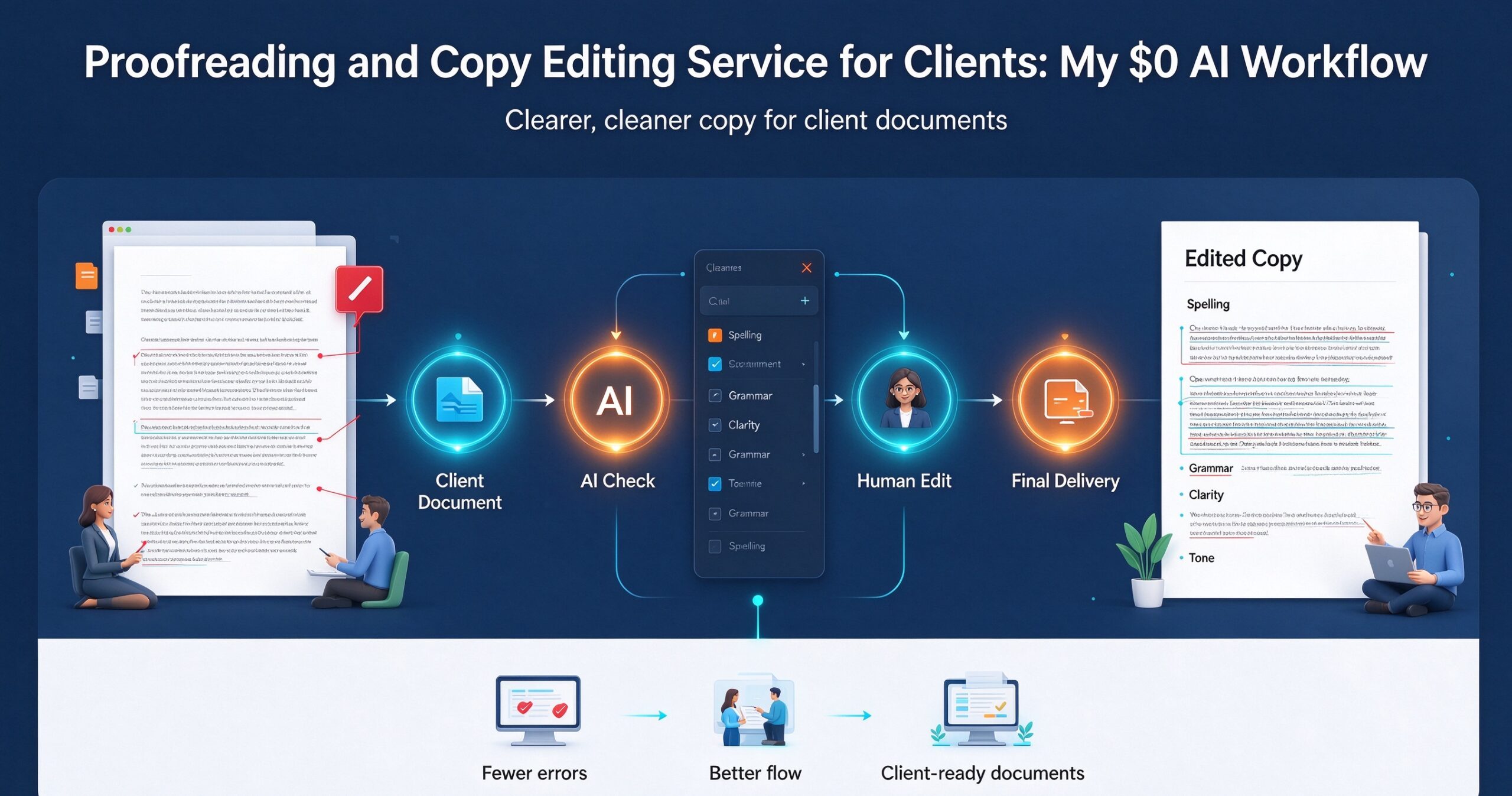
Proofreading and copy editing are the quiet backbone of every freelance writing business. Clients do not pay for the first draft — they pay for the version that reads clean, consistent, and professional. The good news: you do not need a $30/month subscription to run a proofreading service. With a small stack of free AI tools and a repeatable workflow, you can deliver publication-ready copy for clients and keep the margin.
This is the exact workflow I use to proofread and copy edit client work — newsletters, blog posts, ad copy, and reports — without paying for a single subscription.
What “proofreading” vs “copy editing” actually means (and why clients pay double)
Before you quote a price, get the scope right. Clients often use the words interchangeably, but they are two different jobs:
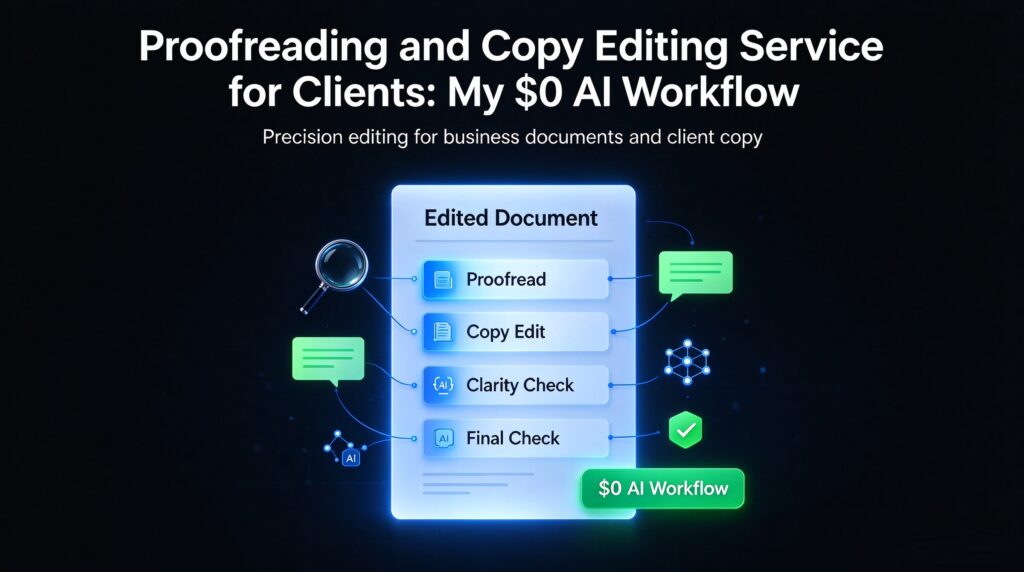
- Proofreading = the last pass. Typos, spelling, punctuation, grammar, and obvious consistency slips. It assumes the writing is already finished.
- Copy editing = the structural pass. Clarity, flow, tone, word choice, sentence rhythm, and whether the piece actually says what the client meant.
Proofreading is fast and cheap to deliver. Copy editing takes judgment and time — and that is where the margin lives. Most freelancers undercharge because they blur the two together and quote one flat rate. Separate them and you can sell a two-line item: “proofread” as an add-on, “copy edit” as the main service.
Step 1: Get the clean source and fix the brief first
Ninety percent of “editing” problems are actually briefing problems. Before you touch a word, ask the client:
- Who is the audience, and what should they do after reading?
- Is there a style guide, brand voice doc, or reference piece I should match?
- US or UK spelling? Which style — AP, Chicago, or house rules?
- Is this final text, or should I flag bigger structural issues?
Locking these down in writing protects you from endless revisions and is the fastest way to look professional. Then paste the text into a plain doc and strip any tracked-change noise so you are editing one clean version.
Step 2: Run the mechanical pass with free AI tools
This is where the free stack earns its keep. Do the mechanical, boring checks with tools so your brain is free for the judgment calls:
- Grammar and spelling: paste the text into a free grammar checker to catch agreement errors, comma splices, and typos in seconds. Accept the real fixes; ignore the false positives that flatten your client’s voice.
- Readability: run it through a free readability score checker. Long sentences and dense paragraphs are the number-one reason a draft “feels wrong” without an obvious error. Split anything that scores poorly.
- Consistency: check numbers, dates, capitalization, and product names against the client’s own preferences. Most tools miss this — it is the detail clients actually notice.
The trick is to treat AI as a first-pass assistant, not the editor. It finds the mechanical issues so you can spend your paid time on meaning.
Step 3: Do the human pass — clarity, tone, and flow
Now the part no tool does well. Read the piece out loud, or at least imagine reading it to the client’s target customer. You are listening for:
- Sentences that make you stumble — usually too long, or with the point buried.
- Jargon the audience would not use.
- Paragraphs that repeat the same idea twice.
- Calls to action that are vague (“learn more”) instead of specific.
Edit in this order: cut, then clarify, then polish. Cutting first means you never waste time polishing a sentence you end up deleting. When you are done, re-run the grammar and readability checks on the edited version — one more pass catches anything the rewrite introduced.
Step 4: Deliver like a pro (this is what gets you rehired)
The edit is only half the job. Delivery is the other half:
- Return two files: a clean final version, and a version with comments or tracked changes explaining your bigger suggestions.
- Add a short editor’s note (3–5 bullets) covering what you fixed, what you flagged, and any questions.
- State clearly what you did not touch — for example, if you proofread only and did not restructure.
Clients rehire the freelancer who makes the handoff effortless. Three bullets of context routinely turn a one-off job into a monthly retainer.
A worked example: proofreading a client newsletter
Say a client sends a 900-word newsletter. My pass looks like this:
- Fix the brief: confirm audience, CTA, and US spelling. (5 min)
- Grammar + readability pass with free tools. (5 min)
- Human pass: tighten intro, cut two redundant paragraphs, sharpen the CTA. (25 min)
- Re-check and package: clean file + commented file + editor’s note. (10 min)
Roughly 45 minutes for a job you can charge $40–$80 for — and the tools cost nothing. Run three of those a week on top of writing work and the service pays a real bill.
How to price a proofreading and copy editing service
Two models that work for freelancers:
- Per word: proofreading at $0.01–$0.03/word, copy editing at $0.03–$0.08/word. Fast to quote, easy for clients to compare.
- Hourly: $30–$75/hour depending on niche. Better when scope is fuzzy.
Pricing anchor for a solo marketer: start at $0.02/word for proofreading and $0.05/word for copy editing, then raise as you build testimonials. Always quote a range plus a not-to-exceed cap so neither side gets surprised.
Why free tools are enough to start
The tools in this workflow do one job each and do it well: a grammar checker for mechanics, a readability checker for flow, and your own judgment for everything that matters. If you want to keep client drafts private — NDA work, unpublished campaigns, sensitive documents — the smart move is to run everything offline instead of pasting confidential text into a free web tool. Our AI Power Suite bundle includes pay-once desktop versions of these tools so sensitive copy never leaves your machine.
The bottom line
You do not need a subscription stack to run a proofreading and copy editing service. You need a brief, a mechanical pass with free AI tools, a disciplined human pass, and a delivery habit that makes rehiring obvious. Start with one client piece this week, charge for the scope you actually deliver, and let the reviews compound. Proofreading is the least glamorous service in freelancing — and one of the easiest to turn into steady, repeat income.
Related reading: Video Editing Service for Clients: My $0 AI Workflow.