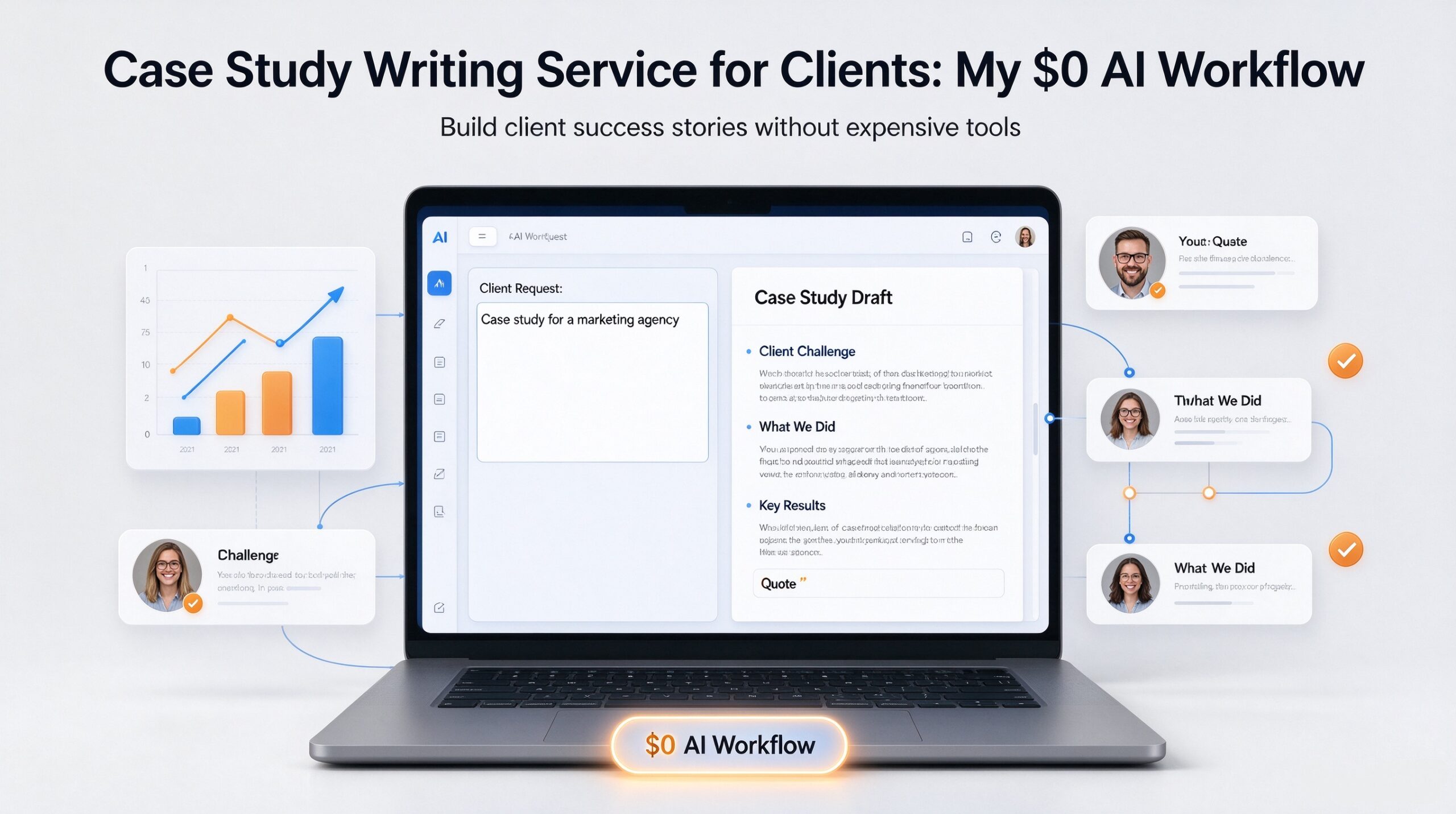
Running a case study writing service for clients is one of the highest-paid freelance offers in B2B content — and one of the few most freelancers avoid because the research looks intimidating. It doesn’t have to be. A good case study isn’t a testimonial with a logo slapped on top. It’s a small piece of journalism: a customer had a problem, tried things, hit a wall, and got a result you can measure. Get that structure right and a single case study can close deals for years. Get it wrong and you’ve got 800 words of adjectives nobody reads.
I run case study projects for clients using a $0 stack of AI tools plus a repeatable workflow. This is the exact process — from the intake call to the final PDF — including how I keep the numbers honest and the quotes real. Everything here runs in a browser or a one-time desktop app, so no client data ever sits in a subscription service.
Why a Case Study Writing Service Sells When Nothing Else Does
Buyers trust specific numbers over polished promises. “We increased efficiency” is wallpaper. “We cut invoice processing from 11 minutes per document to 40 seconds” is a purchase decision. A case study’s job is to move a warm prospect from “this sounds nice” to “this worked for someone like me.”
That means three things have to be true:
- Specificity — real numbers, real timeframes, real names (with permission).
- Structure — a clear before / problem / approach / result arc, not a brag sheet.
- Credibility — quotes that sound like the customer actually said them, verified against a transcript.
Most freelancers fail at #3 and #1, because verifying quotes and tracing numbers is tedious. That’s exactly where the workflow below earns its keep.
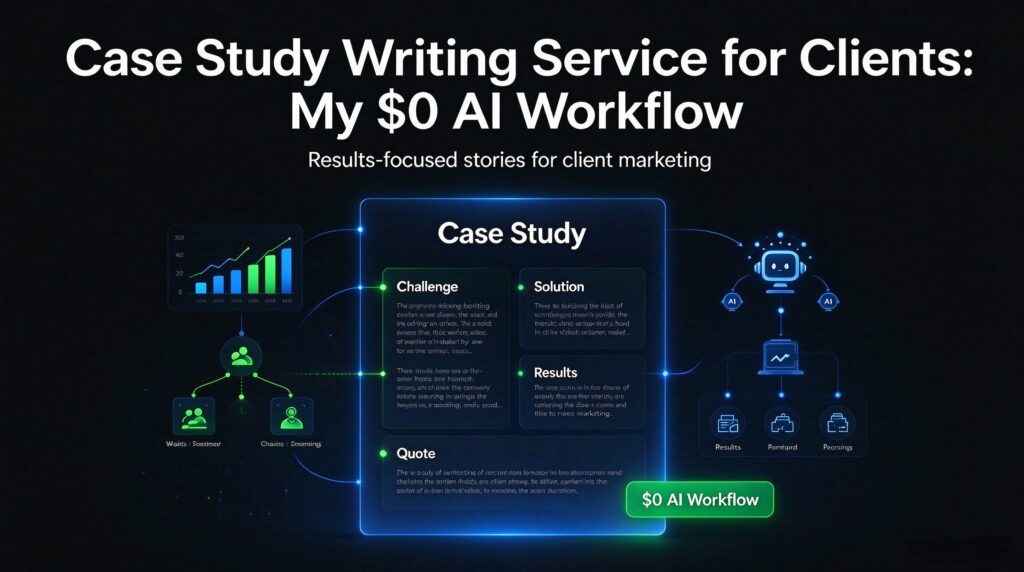
The 8-Step Workflow
1. Intake call and raw transcript
I record a 30–45 minute interview (with written consent) using any call recorder. Then I get a clean transcript. If it’s a podcast-style recording, a podcast transcription workflow already covers the mechanics. If it’s a plain call, any free transcriber works. The transcript is the raw material for the entire case study — never write from memory.
2. Pull the numbers first
Before writing a single sentence, I list every metric the client mentioned and mark each one as verified (they can show a dashboard or invoice) or claimed. Unverified numbers get framed as estimates or cut. This one habit is the difference between a case study prospects believe and one they quietly dismiss.
3. Outline the arc
I run the transcript through a free article outline generator to draft a skeleton, then fix it by hand. The outline I want is always the same four beats: the situation, the problem, what they tried, the result + how. I also force in a “what almost went wrong” section — the objection section that makes the whole thing credible.
4. Draft the narrative
I write the first draft fast and ugly, following the outline. The trick is to quote the client’s own words from the transcript wherever possible. When I need a crisp summary of a rambling answer, I run it through a summary generator to condense, then rewrite so it sounds like a human.
5. Tighten the headline and meta
A case study lives or dies on its title. “How [Company] Cut [Metric] by [X]% in [Timeframe]” beats “Customer Success Story” every time. I use a blog title generator to spin up 10 options, then pick and sharpen. For the web version, the meta description generator gives me a clean 155-character summary for search snippets.
6. Run the readability pass
Case studies get skimmed, not read. I score the draft with a readability score checker and aim for a Flesch reading ease around 60 — clear enough for a busy executive scanning on a phone. Long sentences and passive voice get broken up.
7. Proofread against the transcript
Every quote gets checked word-for-word against the transcript. A grammar checker catches the mechanics, but the real value is the verification step: if a quote doesn’t appear in the transcript, it doesn’t ship. Clients notice — and they trust the final piece because of it.
8. Package and deliver
Final deliverables are usually: a web-ready HTML version, a print PDF, and a one-slide summary for sales decks. For the PDF work I use a one-time desktop app (the AI Power Suite bundle includes the PDF and design tools) so I’m not paying a monthly subscription to export a couple of files a week. Delivering a case study writing service well means the handoff is as polished as the prose — clients judge the whole package, not just the words.
The Interview: Where Case Studies Are Won or Lost
If there’s one part of this job that separates a $300 case study from a $900 one, it’s the interview. Everything downstream — the numbers, the quotes, the arc — is only as good as the raw material you collect in those 30–45 minutes. Most writers treat the interview as a formality and then wonder why the draft feels thin.
Here’s how I make sure it doesn’t. First, I send the client an agenda a day ahead so they aren’t scrambling for numbers on the call. People remember stories, not statistics, so giving them a heads-up means they arrive with both. Second, I ask for the before-state first: what did the process look like before they hired you, fixed you, or bought your tool? That baseline is what makes the “after” numbers meaningful. “Cut processing time by 70%” means nothing without “from where to where.”
Third, I ask about the mess. What went wrong? What almost derailed the project? Where did you almost give up? Clients are usually nervous about this — they think admitting friction makes them look bad. It’s the opposite. A case study with no obstacles reads like an advertisement, and readers instinctively discount advertisements. A case study that says “the first migration attempt failed and we had to roll back” reads like the truth. That single sentence of friction is often the most persuasive line in the whole document.
Fourth, I always close the interview by asking the client to describe the outcome in their own words, as if they were telling a friend. Those off-the-cuff sentences almost always become the pull quote at the top of the finished piece. They’re the closest thing to a genuine testimonial you’ll get, and they’re impossible to fabricate.
How I Keep the Numbers Honest
Anyone can write a case study that says a client got great results. The skill is writing one where a skeptical procurement lead can’t find a hole. That comes down to a simple discipline: separate what you can prove from what you can’t, and never blur the line.
When a client tells me “we saved about $40,000,” my next question is always “can we show that?” If it’s in an invoice, a dashboard, or a signed contract, it’s a verified number and I can state it plainly. If it’s an estimate a manager pulled from memory, it becomes “the team estimates savings in the range of $40,000” — same information, honestly framed. If it’s pure vibes, it gets cut. It’s harsh, but a single inflated claim that a prospect spots is enough to poison the credibility of the entire study, and by extension the client’s sales deck.
The same rule applies to timeframes and percentages. “In six weeks” is stronger than “quickly,” and “weeks” is stronger than “months.” Precision is credibility. When a number has to be rounded for confidentiality, I say so, and I round in a way that’s conservative rather than flattering. Nobody has ever lost a sale because their case study was too honest about a modest improvement.
The Shape of a Case Study Writing Service Deliverable
Structure is the invisible work. A reader should never have to guess why the details in front of them matter — the document should carry them down a slope from problem to solution to proof to next step, and never let them lose the thread.
The opening has to earn the rest. I never start with “Acme Corp is a leading provider of…” I start with the stakes: the number that was bleeding, the deadline that was closing in, the cost of doing nothing. The client’s background comes later, once the reader cares. Then I establish the problem in concrete terms — not “operational inefficiencies” but “the support inbox was missing its response-time target on four out of five business days.” Then the approach, told as a sequence of decisions rather than a feature list. Then the result, stated in the same units as the problem so the comparison is instant. And finally a short, honest note about what’s next.
Two structural habits reliably lift the quality of a draft. First, every section ends by teeing up the next one — a question the reader now wants answered. Second, I keep the client’s own language wherever the transcript gives it to me. When a client says “we were drowning,” I don’t translate that into “experiencing volume pressure.” The original phrase is doing real work, and smoothing it out removes the texture that makes the story believable.
What I Charge for a Case Study Writing Service
Case study pricing depends almost entirely on how much of the research you do versus the client. Here’s how I scope it:
- Simple case study (600–900 words, client supplies all quotes and numbers): $250–$450.
- Full case study (1,200–1,800 words, you run the interview): $500–$900.
- Case study series (3–5 pieces, consistent format for a sales team): $400–$700 per study, sold as a package.
The upsell that clients ask for almost every time: turning the case study into a short presentation deck for sales calls, or repurposing it as a white paper. Both are natural add-ons once you’ve done the interview work, and both command their own price.

Turning One Case Study Into a Sales Asset Library
The mistake most freelancers make is treating a case study as a one-off deliverable. The clients who get the most value — and come back for more — treat it as the seed of a whole library. One interview can feed a web page, a PDF, a deck slide, a series of social posts, a sales email, and an intro paragraph on a pitch deck. The research is the expensive part; once it’s done, repurposing is nearly free.
So when I deliver, I don’t just hand over the document. I hand over a short menu of ways to reuse it, and I price the reuse separately. That’s how a single $700 project turns into a $2,000 relationship without either side feeling like they’re being nickel-and-dimed. The client gets more mileage out of work they already paid to research; I get paid for the part that genuinely saves them time.
This is also why case studies pair so well with the analytics side of the business. Once you can point to a case study that moved a specific deal, clients start asking you to look at what else is underperforming — which is exactly the door into SEO audits and broader content work.
Where the Money Actually Is in a Case Study Writing Service
Case studies sit at the highest end of the content market because they touch revenue directly. A single well-verified case study can be reused by a client’s sales team for years, which is why smart B2B companies will pay a premium for one that’s genuinely well researched. The freelancers who win this work consistently are the ones who treat it like reporting, not copywriting: verify the numbers, protect the quotes, structure the story.
If you’re already doing research reports or data cleaning work, case studies are the natural next offer — same research muscles, much higher price per word.
Common Mistakes to Avoid
Before the checklist, a note on sourcing: when you need outside context, cite it. For industry benchmarks on B2B content performance, the Content Marketing Institute publishes free annual research, and Harvard Business Review is a reliable source for B2B buying-behaviour studies. Linking out to real sources signals to both readers and search engines that you verify claims rather than invent them.
A short list of the traps I see most often, and how to sidestep each one:
- Leading with the company instead of the outcome. The reader cares about the result, not the client’s founding story. Lead with the number.
- Burying the constraint. The obstacle is what proves the result was earned. If the project was easy, say so — but most weren’t.
- Quoting the client in your words. If you paraphrase a testimonial, it reads as marketing. Use the transcript.
- Padding with adjectives. “Revolutionary,” “cutting-edge,” and “seamless” all mean nothing. Cut them and add a number.
- Forgetting the next step. Every case study should end with one clear action. Not five.
- Never reusing it. A case study locked in a PDF nobody opens is wasted research.
Pricing Psychology: Why Clients Pay More for Research
It’s worth pausing on why case studies command these prices when a plain blog post doesn’t. The answer isn’t length — it’s risk. When a client commissions a case study, they’re not buying words; they’re buying a persuasive asset they’ll put in front of a prospect who represents real revenue. The higher the deal size, the more the client is willing to pay for something that de-risks the conversation. A $900 case study that helps close a $50,000 contract is, from the client’s point of view, cheap.
That framing changes how you pitch the work. Instead of quoting a word count, quote the outcome: this is a sales asset your team will reuse for a year. Instead of competing on speed, compete on verification — the thing nobody else wants to do. And instead of dropping your price to win the first project, offer a smaller scoped version that still delivers one verified, checkable study. Clients who buy the small version and see the quality almost always come back for the full one.
There’s a second reason research-heavy case studies hold their price: they’re hard to commodity. Any freelancer can generate 1,500 words of marketing fluff with an AI tool in ten minutes. Very few will spend three hours transcribing an interview, tracing every number to its source, and checking quotes word-for-word. That gap is your moat, and it’s exactly the work the $0 tool stack below makes bearable.
Building the Offer: A Repeatable Product, Not One-Off Gigs
The freelancers who earn consistently from this kind of work stop thinking in terms of single gigs and start thinking in terms of a product. A clear offer — a named package with a defined scope, a fixed price, and an obvious outcome — is far easier to sell than an open-ended “I’ll write you a case study, let’s talk.”
I package it as three tiers, and I lead with the middle one because it’s the best value and the easiest yes. The entry tier exists mainly to get a foot in the door; the top tier exists to anchor the price. That’s classic good-better-best positioning, and it works for freelance services just as well as it does for software. Every tier includes the interview, the verification step, and the final delivery — the only thing that changes is scope and reuse.
Once the offer is packaged, marketing it becomes simple. You put the package on a simple sales page, you show three real examples, and you let the case study itself be the proof that you can do the work. There’s a pleasant loop here: your own case studies for clients are also the best portfolio pieces you have. The work markets the work.
Start With One Good Study
Don’t wait for a perfect client. Take the last project that went well, interview whoever ran it for 30 minutes, and write it up properly. One credible case study — with real numbers and quotes that survive verification — will do more for your offer than ten generic blog posts.
If you want to try the $0 stack first, the free AI tools cover outlining, summarizing, titles, meta, readability, and proofreading — all in-browser, no signup. Do the interview, run the eight steps, and see what a properly researched case study looks like when you’re done.