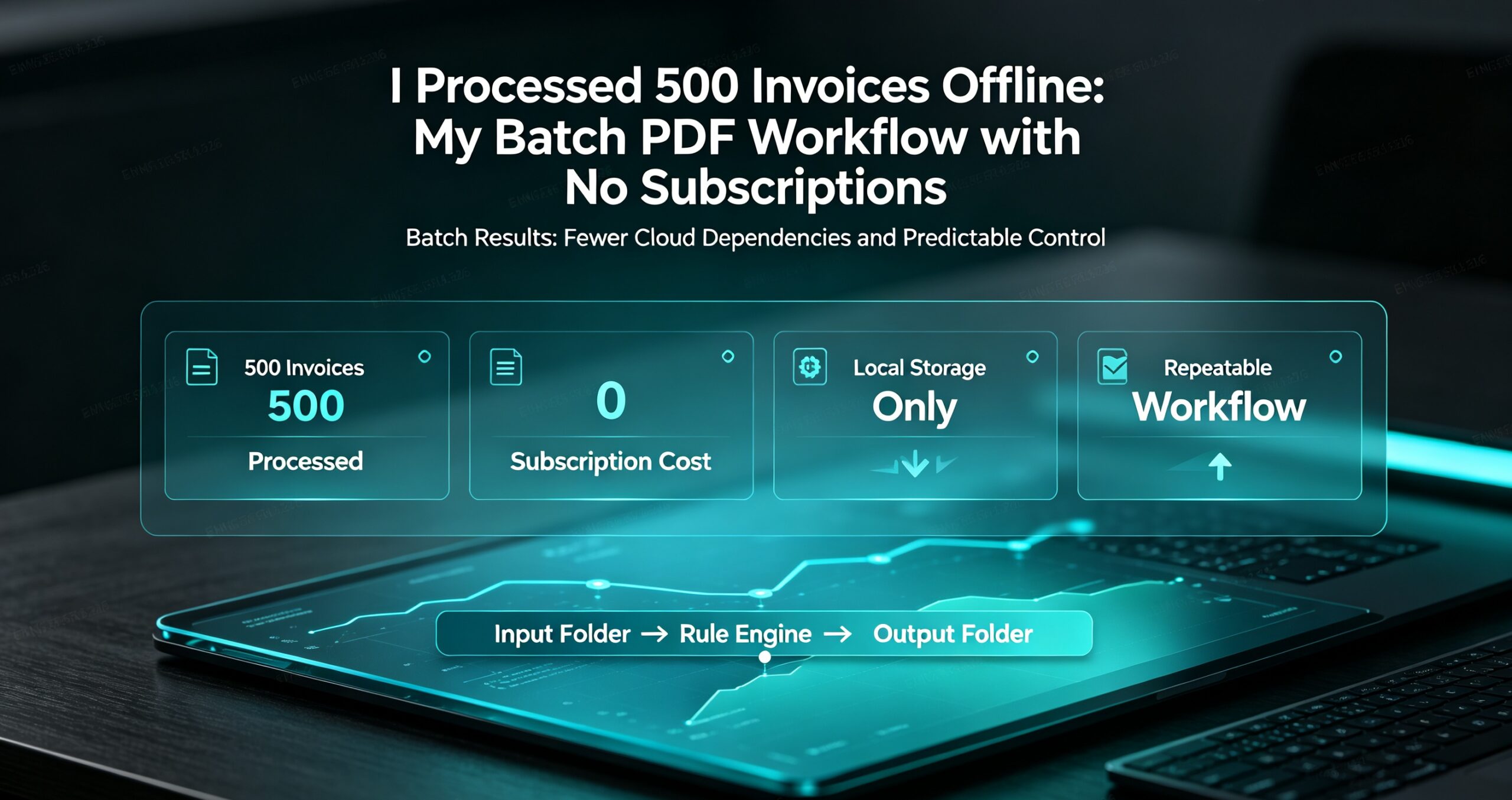
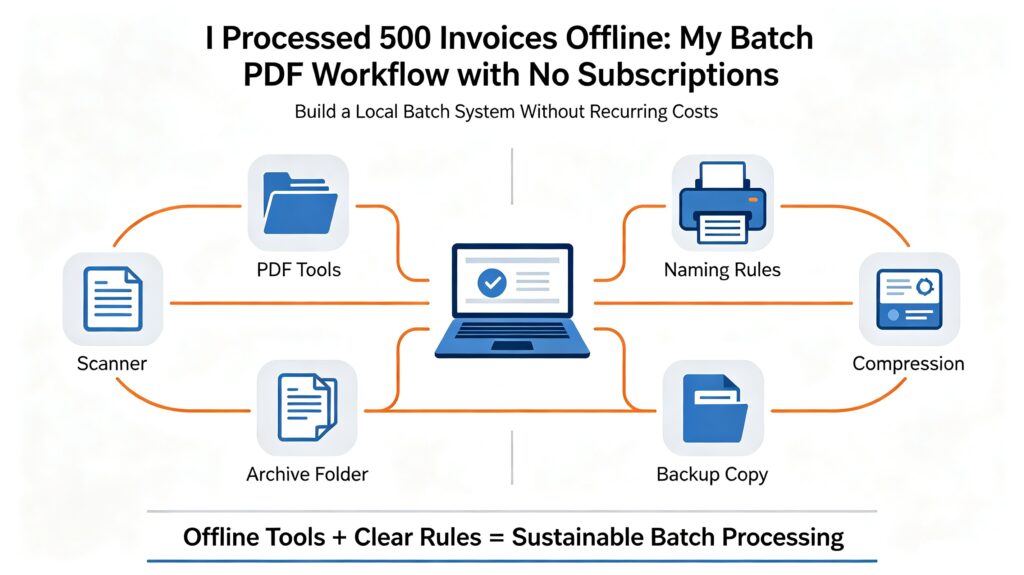
Last month a small accounting firm handed me a folder with 500 scanned invoices — a mix of PDFs, phone photos saved as PDF, and half a dozen formats that had been exported from three different systems over four years. The job: turn the mess into one searchable, consistently named, compressed archive.
Every cloud PDF tool I looked at wanted either a monthly subscription, a per-file credit, or — worst of all — an upload of confidential client financial documents to a server I did not control. So I did the whole thing offline, on my own laptop, with a one-time-purchase toolbox. Total time: about 40 minutes. Total recurring cost: $0.
This is the exact batch PDF workflow I used, step by step, with the real numbers and the honest limits — so you can run the same pipeline on invoices, contracts, scans, or any pile of documents that has gotten out of hand.
Why Batch PDF Work Piles Up (And Why Cloud Tools Fail at It)
Single-PDF tasks are easy. The pain starts when the count goes up and the variety goes up with it. A folder of 500 invoices is not one task repeated 500 times — it is five or six different tasks that each need to run across the entire set:
- Scanned files that are just pictures — no text layer, so nothing is searchable and “Ctrl+F” finds nothing.
- Inconsistent file names — some by date, some by vendor, some by invoice number, some called
scan_0042 (1).pdf. - Bloated file sizes — 12 MB scans that only need 400 KB because someone set 600 DPI color.
- Mixed orientation and margins — rotated pages, upside-down pages, junk blank pages from the scanner.
- Confidentiality — client financial data that should never touch a third-party server.
Cloud tools handle one file at a time nicely and then charge you per file, per month, or per “credit” — which is exactly the wrong pricing model for a 500-file batch. And the upload requirement is a non-starter for anything confidential. That is the gap an offline PDF toolbox fills: the same computer that stores the files does the processing.
The 5-Step Offline Batch PDF Workflow
I run these steps in a fixed order because each one makes the next cheaper. Skipping ahead (especially OCR before compression) wastes time and produces worse output.
Step 1 — Triage: Split “One Pile” Into Clean Groups
Before touching anything, I sort the folder into two buckets: born-digital PDFs (already have text) and scans (image-only). This matters because only the scans need OCR, and OCR is the slowest step. On the 500 invoices, it turned out 180 were born-digital and 320 were scans — so I had a precise scope for the expensive step instead of a vague “OCR everything” instruction.
I also spot-check a few files with different names to learn the naming patterns. Once you know the patterns, the rename step becomes mechanical.
Step 2 — OCR the Scans (The Step That Makes Everything Searchable)
OCR converts each image-only page into a real text layer while keeping the visual layout intact. After this, the files are searchable and copy-pasteable — which is the whole point of a digital archive.
Batch OCR is where offline tools win outright: the pages never leave the machine, and there is no per-page fee. I ran all 320 scanned invoices in one pass rather than one at a time. The machine spent a few minutes working; I spent zero minutes babysitting it.
Ordering rule: always OCR before compressing. Compress first and you feed low-quality images into the OCR engine, which lowers accuracy. OCR first, then compress the text-layer PDFs.
Step 3 — Clean Up Pages: Rotate, Straighten, Drop the Junk
Scanners produce garbage: blank backs, rotated spreads, the odd page fed at an angle. I run a quick pass to rotate pages that are sideways, delete the blank scans, and fix the file order where a batch got interleaved. This is the step people skip, and it is the one that makes the delivered archive actually pleasant to use.
Step 4 — Rename by a Consistent Scheme
A searchable archive with random names is still a mess. I standardise to YYYY-MM-Vendor-InvoiceNumber.pdf so the folder sorts chronologically and each file is self-describing. Doing this in batch — pulling the date and vendor from the content I just OCR’d — is the difference between a one-hour and a three-hour job.
Step 5 — Compress and Merge
With the text layer in place and the files clean, I compress the archive. The 320 scans started around 4 GB; after OCR-then-compress they landed near 300 MB with no visible loss on-screen. Finally I merge logical groups (all invoices from one vendor per month) into single PDFs where that helps the client, and keep individual files where they do not.
Real Numbers: What 500 Invoices Actually Cost Me
| Task | Files | Time (offline) |
|---|---|---|
| Triage into digital vs scan | 500 | ~6 min |
| Batch OCR | 320 | ~14 min (mostly unattended) |
| Rotate / clean / de-blank | 500 | ~8 min |
| Batch rename | 500 | ~5 min |
| Compress + merge | 500 | ~7 min |
| Total | 500 | ~40 min |
Compare that to the per-file cloud route: at a typical $0.05–$0.10 per file for OCR, 320 scans alone would run $16–$32 for a single job — and you could not legally send client financials to most of those services anyway. A monthly subscription at $10–$15 only makes sense if you process documents every single week, which most freelancers and small firms do not.
Honest Limits of an Offline Batch PDF Workflow
I am not going to pretend offline tools beat everything. Here is where this approach genuinely falls short:
- It runs on your hardware. A very old laptop will feel a 320-file OCR batch. Modern machines shrug it off, but do not expect a 2009 netbook to fly.
- No cloud collaboration. If your team needs three people editing the same PDF simultaneously in a browser, an online tool is the right call. Offline is a single-operator workflow.
- You are responsible for backups. Offline also means the files are only where you put them — keep a second copy.
- OCR accuracy depends on scan quality. A 200 DPI crooked phone photo will always OCR worse than a clean 300 DPI flatbed scan. No tool fixes bad input.
For the 90% case — a solo freelancer, a small firm, or anyone handling confidential documents in bulk — the trade-offs are heavily in favour of doing it locally. For real-time multi-user PDF editing, stay in the cloud.
When to Use Paid vs Free
Free online PDF sites are fine for one-off, non-sensitive files you do not mind uploading. The moment any of three things is true, switch to an offline workflow:
- The files are confidential (invoices, contracts, IDs, client data).
- You are processing more than a handful at once, so per-file pricing gets silly.
- You need repeatable batch steps (OCR → clean → rename → compress) as a routine.
That is the niche a one-time-purchase offline toolbox like PDF Magician targets: pay once ($29), run unlimited batches forever, and keep every file on your own machine. If you want the broader feature tour first, see AI PDF processing in 2026. And if you want to turn this skill into paid work, the same pipeline powers a freelance PDF editing service.
Frequently Asked Questions
Can I OCR 500 PDFs at once for free?
You can, but “free online” usually means per-file limits, upload requirements, or watermarks at scale — and sending 500 confidential documents to an unknown server is a real risk. Offline batch OCR avoids all three problems, though you pay once for the tool.
Does compressing a PDF hurt OCR quality?
Only if you compress before OCR. Always OCR first to build the text layer, then compress. Compressing first degrades the image the OCR engine reads and lowers accuracy.
Is offline PDF processing actually private?
Yes — the files never leave your computer. That is the single biggest reason to choose an offline toolbox for invoices, contracts, and anything with client data.
How much can I compress a scanned PDF without visible loss?
For typical 300 DPI document scans, dropping from several gigabytes to a few hundred megabytes is common with no visible loss on screen. Exact ratios depend on your original scan settings — high-DPI colour scans compress far more aggressively than already-lean files.
What is the best free alternative to paid PDF subscriptions?
A one-time offline toolbox plus a strict workflow beats a $10–$15 monthly subscription for anyone who processes documents in bursts rather than every day. You get unlimited files, full privacy, and no recurring bill.
Bottom Line
Batching 500 invoices offline took me 40 minutes and cost $0 in recurring fees. The five steps — triage, OCR, clean, rename, compress-and-merge — are the same whether you are handling 50 files or 5,000, and the order matters more than the tool. If your documents are confidential or your volume is high, stop paying per file and process them on your own machine.
Put this into practice: grab PDF Magician (offline PDF toolbox, one-time $29) and run your own batch tonight — or browse the full 9-tool offline suite if you want the whole toolkit.
Disclosure: this post contains affiliate links. If you buy through them, we may earn a commission at no extra cost to you.