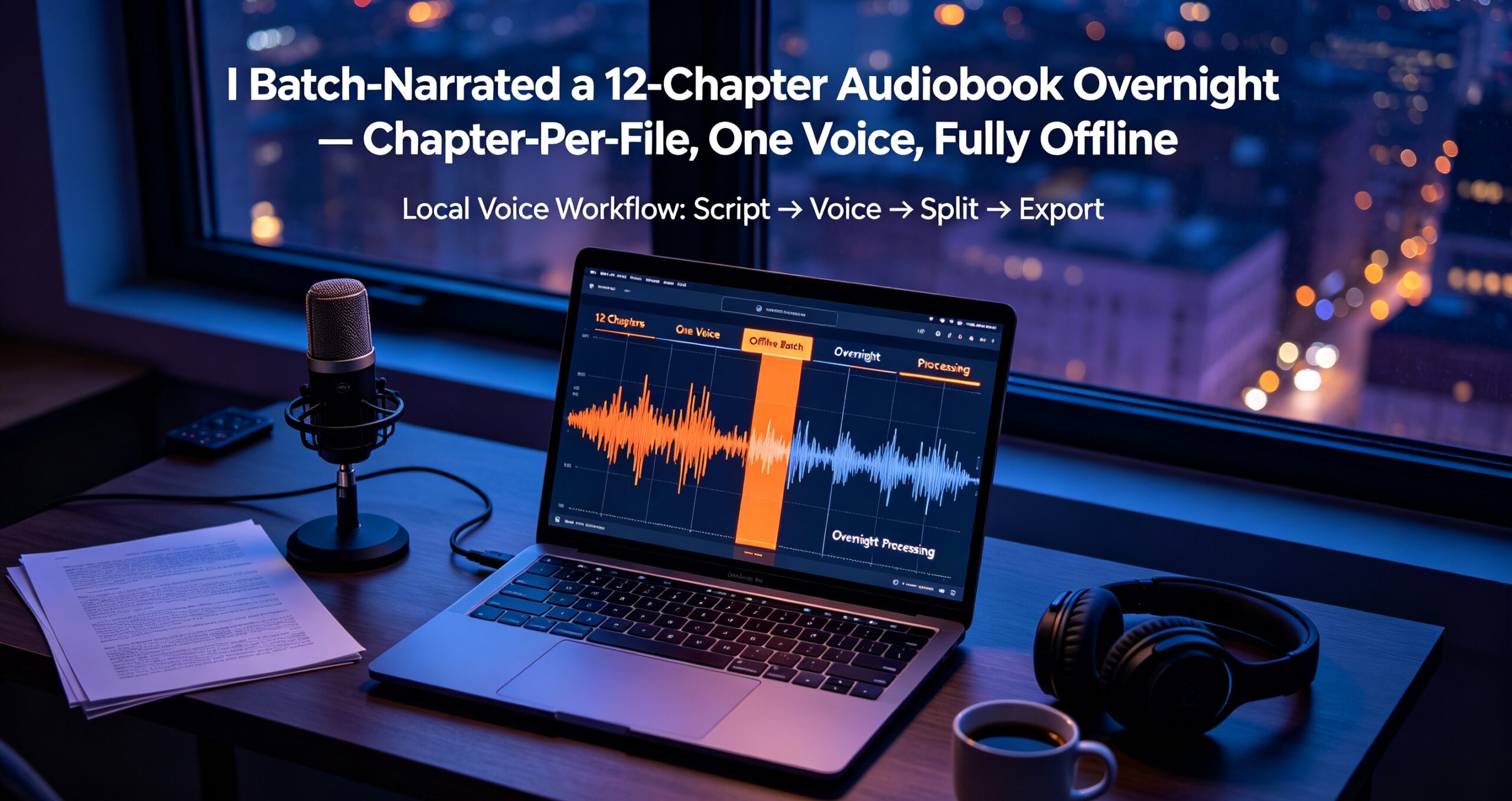
A first-time audiobook creator emailed me last month with a problem that has nothing to do with writing: she had a finished 12-chapter manuscript and a quote from a human narrator for $2,400 and four weeks. She wanted to know if AI could get her to a sellable product without sounding like a 2018 GPS.
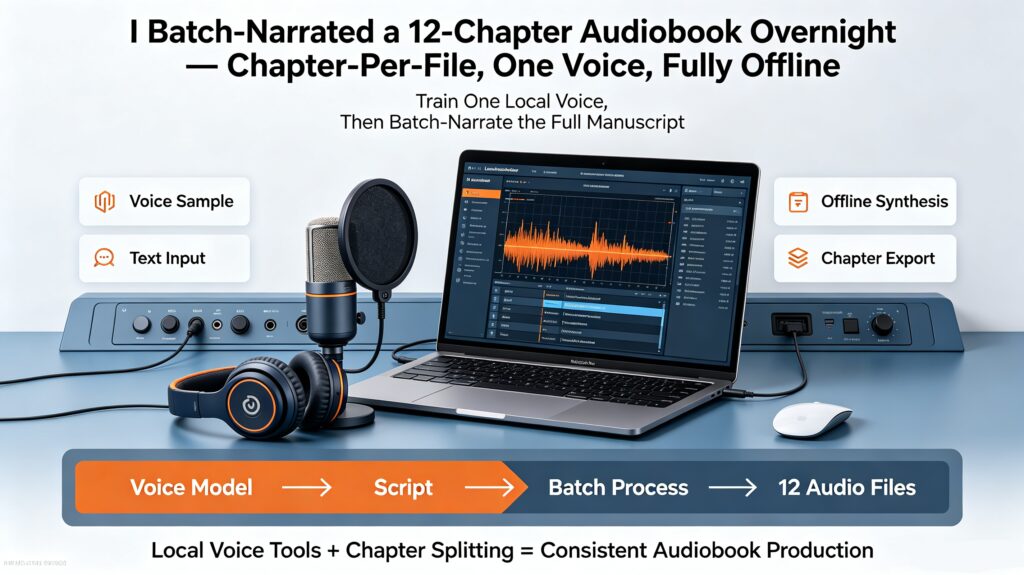
Short answer: yes – but not by pressing generate twelve times. My batch audiobook narration workflow splits the book into chapters, locks one voice, fixes pronunciation once, and exports one MP3 per chapter overnight on my own laptop. The hard part of audiobook narration at scale is never the voice. It is chapter-level automation: consistent voice across files, a pronunciation pass, and a file-per-chapter export you can actually upload to ACX, Audible, or Gumroad. Here is the exact pipeline I ran overnight.
Why batch audiobook narration is a different skill than one-off TTS
Anyone can paste a paragraph into a TTS box. The moment your input is a book, three new constraints show up:
- Consistency: every chapter must use the same voice, speed and pitch, or the listener notices the seams.
- Pronunciation: names, brands, acronyms and units must be forced to sound right – once, globally.
- Deliverable structure: platforms want one file per chapter, with predictable naming.
Those three constraints are why a dedicated batch audiobook generator beats a chat-window TTS tool. They are also why the per-character pricing model of cloud TTS falls apart: a 90,000-word book is roughly half a million characters, and you will regenerate chapters several times before they are right.
The batch audiobook narration pipeline, step by step
1. Get the manuscript into chapter-chunked text
I import the manuscript as TXT or EPUB and let the tool auto-split on chapter headings. The output is a numbered list of segments – one job per chapter, not one giant blob. This single step is what makes everything downstream possible.
manuscript.epub -> [ch01, ch02, ... ch12] (auto-split on headings)2. Lock one voice across every chapter
I pick a single narrator voice and apply it to the whole batch. Changing voice per chapter is the fastest way to make an audiobook feel amateur.
3. Fix the pronunciation list before you render
This is the step everyone skips and then regrets. Before generating, I collect every proper noun, acronym and unit in the book and force the correct reading once. VoiceForge does this with SSML phoneme and emphasis control – the same markup specified by the W3C that professional studios use – rather than re-recording a line by hand.
<phoneme alphabet="ipa" ph="...">Kyiv</phoneme>4. Render the whole book as one overnight job
I queue all 12 chapters and let the batch run. No per-character meter is ticking, because the tool is local and licensed once. A 12-chapter book finished in a single overnight run on a mid-range laptop.
5. Export chapter-per-file
The batch exports one file per chapter, named predictably:
book-title_ch01.mp3 / book-title_ch02.mp3 / ... / book-title_ch12.mp3Three formats are available – MP3 up to 320 kbps, WAV 16/24-bit, and OGG – so you can hand a lossless master to a platform and a compressed copy to a podcast host. ACX, Audible’s production arm, accepts these chapter-per-file masters directly.
Why the batch audiobook narration approach is not just about voice
Once the whole book runs as a single batch audiobook narration job, the marginal cost of another pass collapses. That changes how you work: you stop accepting the first take and start regenerating chapters until they are right.
The economics: $39 once vs $22 per month forever
Cloud TTS tiers like ElevenLabs start around $22/month and cap your characters. For a book-length project you will hit that cap repeatedly, and the meter runs every time you regenerate. A one-time $39 offline license removes the meter entirely: the tenth regeneration of chapter 7 costs exactly as much as the first, which is nothing marginal.
Put another way: 12 months of the cheapest cloud tier is roughly $264. The offline tool pays for itself in under two months and never expires. I use VoiceForge for exactly this reason – it is a full SSML engine with a batch audiobook generator, not just a play-button TTS box, and it never sends the manuscript anywhere.
What went wrong on the first run
Honest notes, because these matter more than the feature list:
- Chapter split mis-fired on a manuscript that used styled headings instead of real H1s. Fix: normalize headings in the source first.
- One acronym was read letter-by-letter. Fix: add it to the pronunciation pass – again, the whole point of doing this globally.
- I over-punctuated early chapters for drama and it sounded robotic. Fix: fewer SSML pauses, not more.
Is AI narration actually sellable?
For nonfiction, tutorials, business books and self-published titles, AI narration is now genuinely competitive – and the cost difference is not subtle. For literary fiction, a human still wins on performance. (If you mainly need short voice-overs for client videos, see my client voice-over workflow instead.) The line I use: AI narration is a distribution strategy, not a performance strategy. It lets a self-published author ship an audiobook edition at near-zero marginal cost instead of carrying a $2,400 quote.
Takeaways
- Think in chapters, not paragraphs. Auto-split first.
- Lock one voice for the whole book.
- Do a pronunciation pass before rendering, not after.
- Choose tools by marginal cost: a 12-chapter book regenerated twice is brutal on per-character pricing.
- Export chapter-per-file in a lossless format, then down-compress for distribution.
That is the whole batch audiobook narration workflow. The manuscript that started as a $2,400, four-week quote shipped as a finished audiobook in one weekend. The narration cost was a single $39 license.
Disclosure: this article contains affiliate links to tools I actually use. If you buy through them, I may earn a small commission at no extra cost to you.