A client asked for thirty faceless shorts for a product launch — three weeks of content, delivered in four days. Every “AI video” subscription I looked at priced the job by the minute, which meant the invoice scaled with my workload instead of my work. Instead I ran the whole batch through a faceless video generator that lives on my own machine, one payment, no per-minute meter. Thirty finished MP4s came out of a single offline pipeline. Here is the exact workflow, what actually breaks, and why a one-time tool beats a monthly credit plan for batch video.
This is not a “best AI video tools” roundup. It is the pipeline I now use whenever a job needs more than a handful of short, faceless videos — product shorts, quote clips, listicles, talking-style explainers with a synthetic voiceover. Once the pattern is set, you stop thinking about each video and start thinking about the batch.
Why faceless video is its own production problem
Making one video is an editing problem. Making thirty is a systems problem with a rendering problem underneath it. The hard parts are rarely the visuals:
- Volume — thirty videos means thirty scripts, thirty voiceovers, thirty exports. Any per-video manual step gets multiplied by thirty.
- Metered pricing — credit-based generators charge by the minute. The bigger the job, the more the tool costs, which punishes exactly the clients you want.
- Watermarks and limits — free tiers stamp your output or cap resolution, and the “unlimited” paid tier is unlimited only until the fair-use clause bites.
- Privacy and offline — client footage and unreleased product shots should not be uploaded to a random web service just to render a clip.
Most AI video websites solve the “one nice clip” case and ignore the batch case. They give you a prompt box, a progress bar and a download button, one video at a time, metered by the second. For real batch work that is the wrong shape entirely.
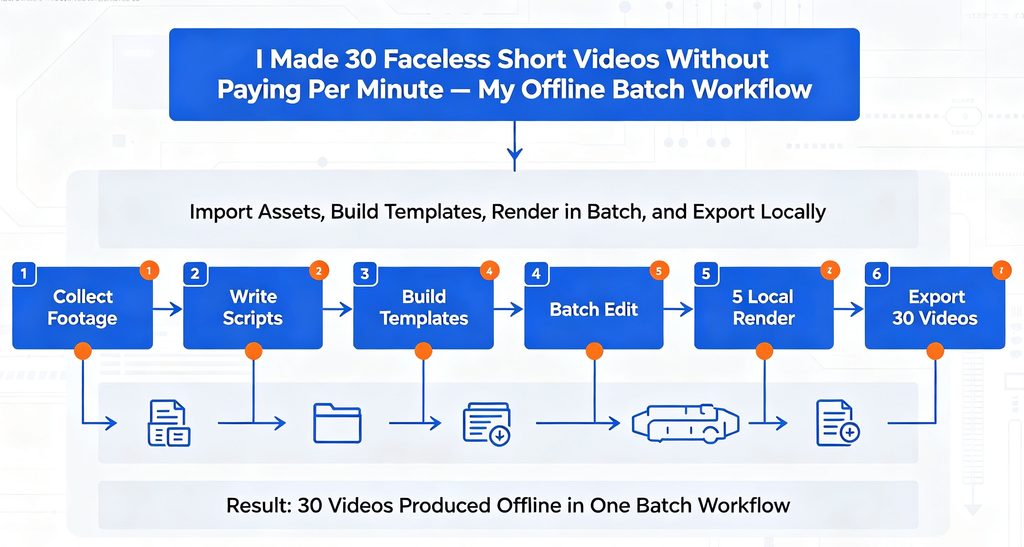
The offline faceless video workflow, step by step
Here is the full pipeline, from a content brief to a folder of finished clips. I run the generation half in ClipEngine, a local faceless video generator that ships on a pre-configured USB drive, but the first three steps are tool-agnostic prep that saves the most time.
Step 1 — Turn the brief into one row per video
Batch video lives or dies on a clean shot list. One row = one video. One column = one field the template will use. I keep a working sheet with headers like hook, script, cta, voice, template, output_name. Before generating anything I read the longest script out loud once — that is the row that will overrun its template, and it is much cheaper to find here than in a folder of thirty finished clips.
Step 2 — Write scripts that survive being narrated
An AI voiceover will read your script exactly as written, which means every awkward clause becomes an awkward pause. I keep scripts short — a hook in the first three seconds, one idea in the middle, one call to action at the end — and I write for the ear, not the page. If a line reads oddly to me at this stage, it will read worse once a synthetic voice delivers it.
Step 3 — Pick one template and freeze it
Choose the template that matches the format — quote clip, product short, listicle, explainer — and lock it before the batch. Changing templates halfway through produces a folder where three videos look like a different channel, which is exactly the inconsistency a batch is supposed to eliminate. ClipEngine ships with ten-plus templates precisely so you can standardise on one and reuse it across a whole week of content.
Step 4 — Generate voice and music once per batch
Faceless video carries its personality in two places: the voiceover and the music. Set your voice once at the start of the run and keep it consistent — a channel that switches narrator every clip reads as spam. The built-in music library serves the same purpose: one track family per batch, chosen up front, applied everywhere.
Step 5 — Render the batch and export clean MP4s
Feed the shot list through the generator, hit render, collect a folder of MP4s. One-click export to MP4 with no watermark matters more than people admit: client-facing and monetised content has to be clean, and a paid tier that adds a watermark on download is useless for real work. On a GPU the render is fast enough that thirty short clips finish in an afternoon, not overnight.

What the output actually looked like
Thirty shorts in one pass. Every clip opened with the same branded hook card, carried the same narrator voice, and ended on the same call to action. The part that would have taken days by hand — open editor, drop in script, wait for render, export, rename, repeat thirty times — collapsed into the time it took to clean the shot list and start the run.
| Task | Per-clip editing (30 videos) | Batch render |
|---|---|---|
| Build template | once | once |
| Script into editor | 30 pastes | 0 |
| Voiceover pass | 30 generations | 1 run |
| Export & rename | 30 exports | 0 |
| Per-minute tool cost | metered | $0 |
| Realistic elapsed time | 3–4 days | under 1 day |
Where an offline faceless video generator beats a subscription
The moment a job runs to thirty clips, per-minute pricing stops being convenient and starts being a tax on your own productivity. A one-time tool flips that: the render is a fixed cost, so the tenth video costs the same as the first, and there is no credit balance to run dry mid-batch. Running locally also means client footage and unreleased product shots never leave the machine — a real requirement for agency and brand work, not just a nice-to-have.
ClipEngine is built exactly for this shape of work: it generates faceless video from text prompts, ships with ten-plus pre-built templates and a built-in music library and voiceovers, and exports clean MP4s with no watermark. It arrives on a pre-configured USB drive with the AI models already installed, so there is no multi-hour setup — you plug it in and make your first clip within minutes. The licence is one payment, not a monthly plan, and it runs fully offline once installed, so a batch never depends on someone else’s server staying up.
Honest limits
- Garbage in, garbage out. If the shot list reuses the same hook three times or a script overruns, the batch will faithfully render a repetitive feed. Clean the sheet first.
- It renders footage, it does not invent strategy. The tool turns scripts into clips; deciding what to post and when is still your job.
- GPU helps. Rendering is GPU-accelerated, so a machine with a dedicated GPU finishes a batch noticeably faster than a thin laptop.
FAQ
Can I generate many faceless videos from one session?
Yes — that is the point of batching. Feed a shot list, freeze one template, and render a whole week of content in a single pass instead of one clip at a time.
Do I need to show my face or record my voice?
No. ClipEngine is built for faceless video: the visuals come from the template, and the narration uses the built-in AI voiceovers, so you never appear on camera or record audio yourself.
Is there a per-minute or per-video cost?
No. ClipEngine is a one-time purchase with a lifetime licence. Unlike Runway, Pika or Synthesia, which charge a monthly fee and meter your usage, your render count is limited only by your machine.
Will the exported videos have a watermark?
No watermark. Output is one-click MP4 at full resolution and clean for commercial use, which is what client and monetised content needs.
Turning it into a habit
The creators who win at faceless video treat it like a build step, not a craft project. Keep one master shot list per niche, keep one frozen template per format, and re-render the batch whenever the scripts change. If you already run bulk jobs like batch-narrating audiobooks or generating documents from a spreadsheet, faceless video batch production slots into the same rhythm: prepare once, render many, review the output folder.
If your work is mostly client deliverables, the same logic applies to editing client video and compressing video offline — the leverage is always in batching the repetitive half.
Want the whole local toolkit in one place? The AI Power Suite bundle packs ClipEngine together with the rest of the suite at a one-time price.
The bottom line
A faceless video generator that lives on your own machine turns video production from a metered expense into a fixed one. One clean shot list, one frozen template, one render pass — and thirty client-ready MP4s land in a folder while you get on with the next job. It costs a one-time $79 instead of a monthly plan, ships ready to run on a USB drive, and your unreleased footage never leaves your desk.