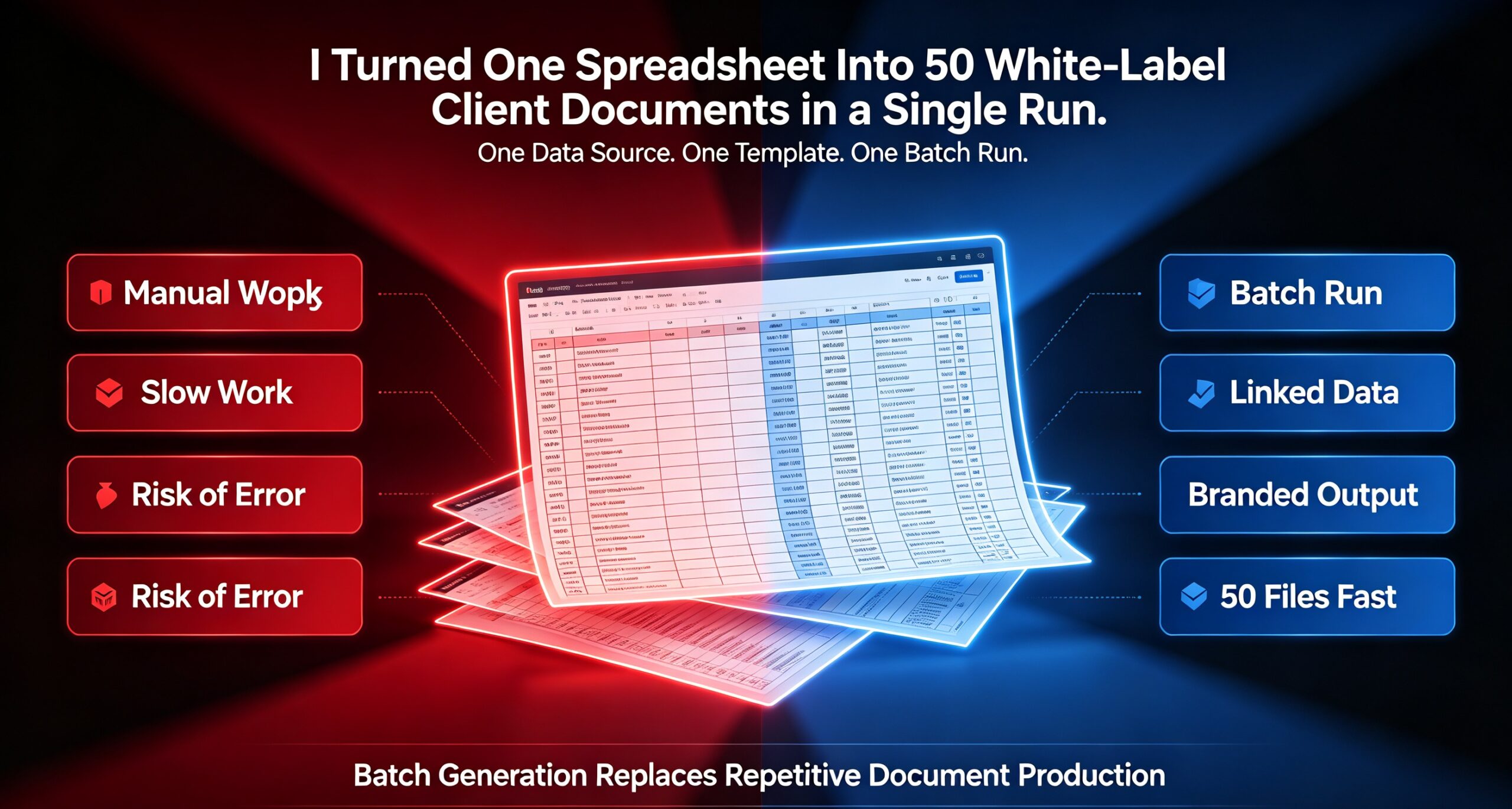
I had 50 clients on a spreadsheet and one afternoon to send every one of them a branded proposal. Doing it by hand meant 50 copies of the same template, 50 logo swaps, 50 export cycles — the kind of work that eats a whole day and still ends with a typo in row 37. Instead I did batch document generation from a single spreadsheet and walked away with a ZIP of 50 finished, white-labelled PDFs in about nine minutes. Here is exactly how the workflow runs, what actually breaks, and when a local tool beats yet another monthly subscription.
This is not a “10 best AI document tools” list. It is the pipeline I now use whenever a job involves more than about five documents that share a structure — quotes, proposals, product sheets, certificates, invoices, one-pagers. Once you see the pattern, you stop dreading bulk paperwork.
Why batch document generation is its own skill
Generating one beautiful document is a design problem. Generating fifty is a data problem with a design problem bolted on top. The hard parts are not fonts and colours — they are:
- Consistency — row 1 and row 50 must look identical, including tables that reflow when a client name is unusually long.
- Sources — your real data lives in a spreadsheet, in a supplier photo, or in a screenshot someone emailed you.
- Branding — every page needs *your* client’s logo, phone and website, not the tool vendor’s watermark.
- Output format — the same content has to leave as PDF for the client, Word for the one who wants to edit it, and PPTX for the meeting.
Most “AI document” websites solve item one and ignore the rest. They give you a nice chat box and a download button, one document at a time, watermarked on the free tier, and they want your client data uploaded to their server. For real batch work that is the wrong shape entirely.
The batch document generation workflow, step by step
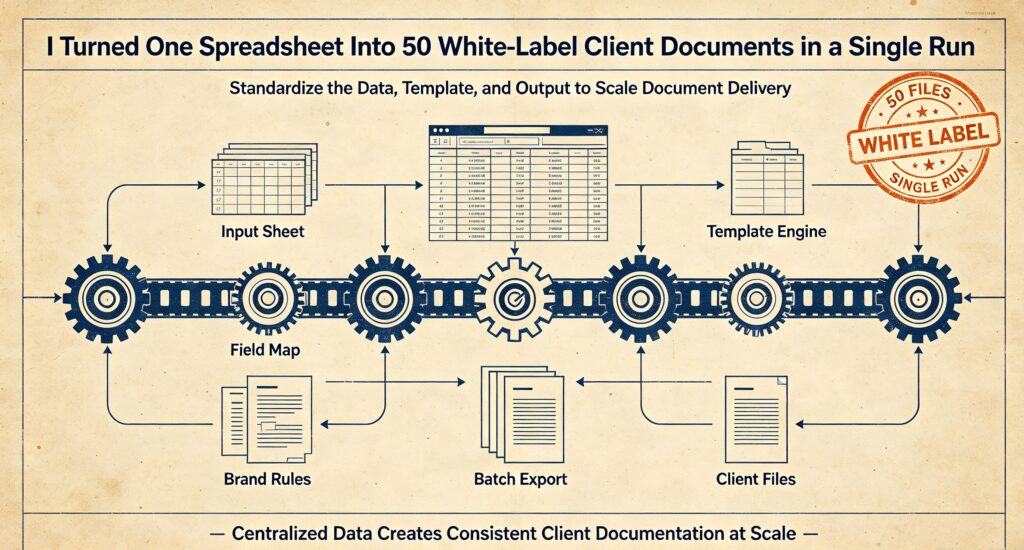
Here is the full pipeline, from a messy spreadsheet to a folder of finished documents. I run the generation half in DocGenTool, a local app that turns a photo or a short brief into a structured document, but the first three steps are tool-agnostic prep work that saves you the most time.
Step 1 — Shape the spreadsheet into one row per document
Batch document generation lives or dies on a clean table. One row = one document. One column = one field the template will use. I keep a working sheet with headers like client_name, company, contact_email, line_items, total, logo_url. Before generating anything I sort by length and eyeball the longest value in every column — that is the row that will break your layout, and it is much cheaper to find it here than in a 50-document ZIP.
Step 2 — Collect the source material per row
Two kinds of source show up in real jobs. Structured data comes straight from the spreadsheet columns. Unstructured data — a supplier’s product photo, a scanned certificate, a screenshot of a spec sheet — usually arrives as an image. This is where OCR earns its keep: if your generator can read text off an image, you can point it at a folder of photos and skip the retyping entirely.
Step 3 — Pick one template and freeze it
Choose the template that matches the job (quotation, product sheet, company profile, slide deck, resume, e-commerce listing) and lock it before you generate the batch. Changing a template halfway through produces a folder where three documents look like a different company — which is exactly the inconsistency batch mode is supposed to eliminate.
Step 4 — Map branding fields once, not per document
White-labelling is the point of batch generation for agencies. Set your company name, logo, phone, email and website once in the branding settings and let them flow onto every cover and footer. If the tool forces you to repeat that per document, it is not a batch tool — it is a template with a for-loop stapled on.
Step 5 — Run the batch and export what each recipient needs
Feed the spreadsheet in, hit generate, collect a ZIP. The output format matters more than people admit: PDF is the default for anything client-facing, Word (.docx) for the client who will edit it themselves, PowerPoint (.pptx) when the document doubles as a pitch, and Excel (.xlsx) when the “document” is really a data sheet. A good batch run gives you all four from the same source, so you never regenerate.

What the output actually looked like
Fifty proposals, one pass. Every cover carried the same client-facing brand block; every footer carried the contact line; every table stayed aligned even where the client name ran long, because the template handled the reflow instead of me nudging a text box. The part that would have taken a full working day — open template, paste row, swap logo, export, name file — collapsed into the nine minutes it took to set the branding fields and start the run.
| Task | By hand (50 docs) | Batch run |
|---|---|---|
| Set up template | once | once |
| Branding on every page | ~50 swaps | once |
| Swap in row data | 50 copy-pastes | 0 |
| Export 4 formats | 200 export clicks | 0 |
| Realistic elapsed time | 6–9 hours | under 15 min |
Where a local batch document generator beats a subscription
The moment your documents contain client names, prices or anything under contract, uploading them to a random web service is a liability, not a convenience. Running generation on your own machine means the spreadsheet never leaves the laptop, there is no per-document credit to run out mid-batch, and no monthly fee that quietly renews after the client work is done.
DocGenTool is built exactly for this shape of work: it reads text off photos and screenshots with built-in OCR, writes and structures the document through an AI engine you choose, and exports PDF, Word, PowerPoint or Excel. The batch mode takes an Excel file and returns a ZIP of finished documents with your own white-label branding on every cover and footer. Ten-plus AI engines are supported — you bring your own API key and switch whenever you like — and the whole thing runs offline at a local address with no account required.
Honest limits
- Garbage in, garbage out. If the spreadsheet has duplicate rows or blank required cells, the batch will happily generate a mess. Clean the table first.
- You still need an API key. The local app handles structure, layout and export, but the writing step uses an AI engine, and on very large runs that costs a small amount of tokens.
- Templates are a starting point. The six built-in templates cover common jobs; genuinely bespoke layouts may still want a designer.
FAQ
Can I generate dozens of documents from one spreadsheet at once?
Yes — that is exactly what batch mode is for. One row per document, one batch run, one ZIP of finished files. The practical ceiling is your patience for cleaning the spreadsheet, not the tool.
Can it read text from photos and scanned pages?
Yes. Built-in OCR reads text straight off product photos, screenshots and scanned pages, so you can turn a folder of images into structured document content without retyping anything.
Does a local batch document generator keep my data private?
Processed documents and your spreadsheets stay on your own machine — no cloud upload and no account. The only outbound step is the AI writing call to whichever engine you configured with your own API key.
Which output formats does it produce?
Four: PDF, Word (.docx), PowerPoint (.pptx) and Excel (.xlsx), all from the same source run, in eight languages including English, Chinese, Japanese and German.
Turning it into a habit
The teams that win at this treat document generation like a build step, not a craft project. Keep one master spreadsheet per client type, keep one frozen template per document type, and rerun the batch whenever the data changes. If you already run bulk jobs like processing invoices offline or auditing content in one pass, batch document generation slots into the same rhythm: prepare once, generate many, review the output folder.
If your work is mostly freelance client deliverables, the same logic applies to PDF editing and SEO audit jobs — the leverage is always in batching the repetitive half.
Want every local tool in one place? The AI Power Suite bundle packs DocGenTool together with the rest of the toolkit at a one-time price.
The bottom line
Batch document generation is the difference between doing paperwork and shipping it. One clean spreadsheet, one frozen template, one branding block, one run — and fifty client-ready documents land in a folder while you get on with the next job. It runs on your own machine, costs a one-time $39 instead of a subscription, and your client data never leaves your desk.