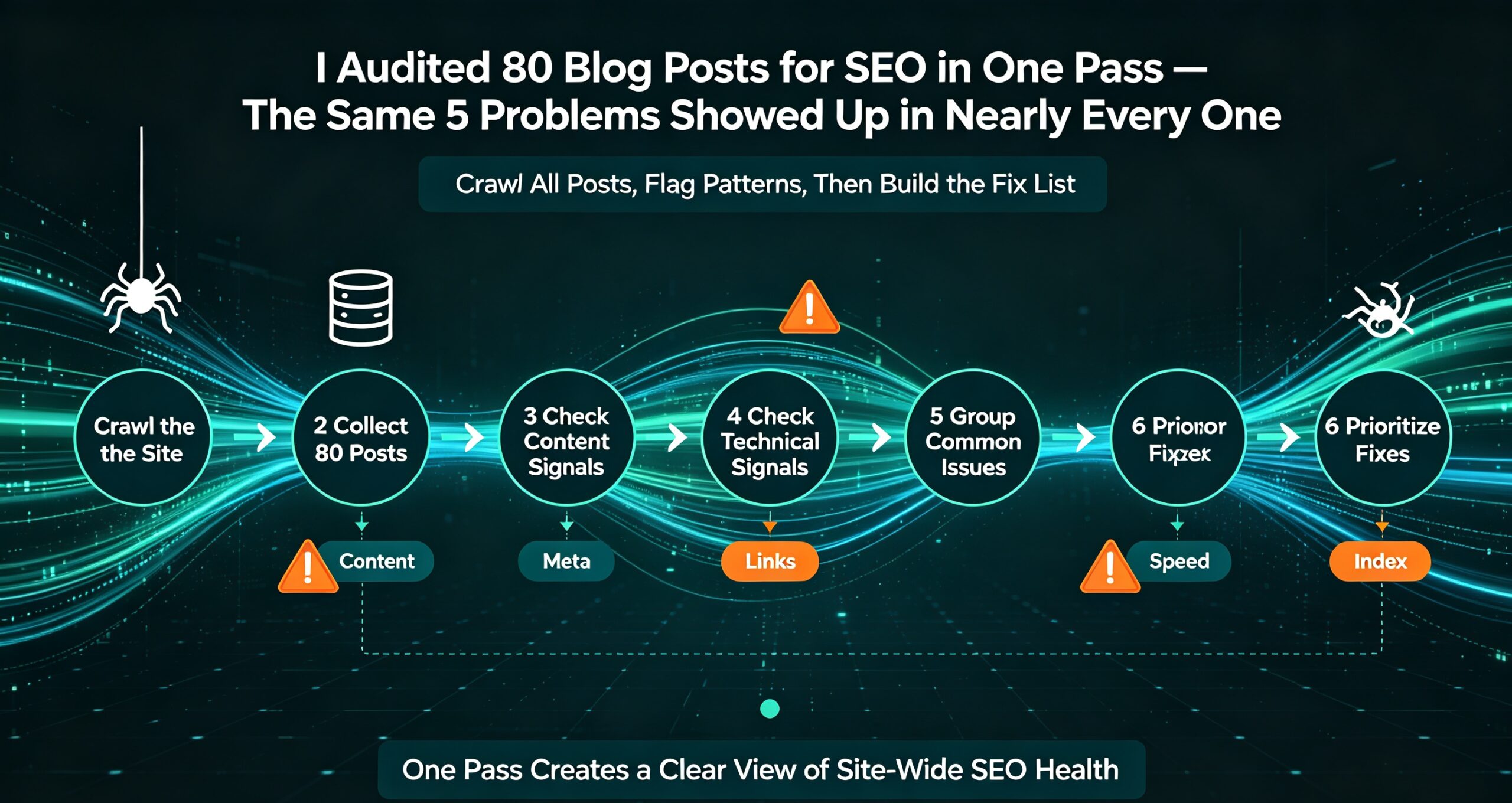
I audited 80 blog posts for SEO in a single pass — and the same five problems showed up in almost every single one. Not typos, not broken links: structural issues that were quietly capping every article’s rankings. The whole audit took under four minutes, ran on my own laptop, and cost me nothing per month.
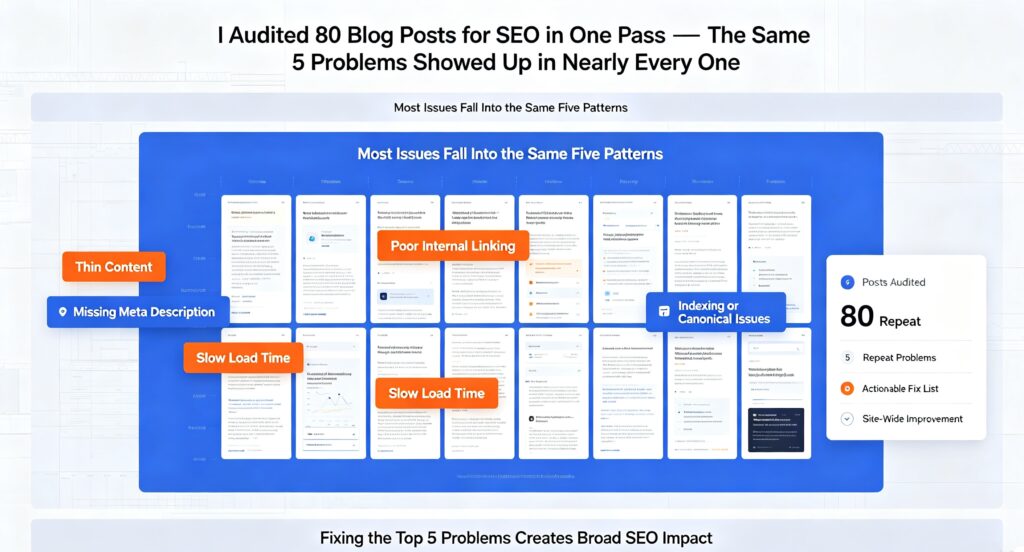
Here is the thing nobody tells you about SEO: the work is not writing more articles. It is finding the fixable problems in the 80 you already published. I had been writing new posts every week for months while a growing pile of older ones sat there with no meta description, a truncated title, and a keyword that appeared exactly once — in the H1 and nowhere else.
This is the exact batch SEO audit workflow I now run on the whole site before I write anything new: how I pull 80 articles into one pass, score them against real on-page rules, find the five failure patterns that repeat, and turn the output into a ranked fix-list instead of a vague feeling that “SEO isn’t working.”
Why single-page SEO tools never fix anything
Every SEO tool on the market will happily audit one URL. You paste a link, wait, get a score out of 100, feel briefly informed, and then close the tab. Do that 80 times and you have spent an afternoon producing a pile of numbers with no priority order and no memory of what you found.
The problem is not the analysis. It is the shape of the output. A per-page score tells you that a page is weak; it does not tell you which of your 80 pages to fix first, or whether the same defect appears on 40 others. When a defect repeats across half the site, fixing it page-by-page is the wrong move — you want to see the pattern, fix the template, and batch it.
A batch SEO audit inverts the workflow. Instead of URL → score, you do a whole set at once: paste or import 80 articles, score all of them against the same rule set, and get one table sorted by severity. Now the same five problems surfaced across 55 articles become one afternoon of work instead of fifty.
The five problems that showed up in nearly every post
When I ran 80 published posts through one batch pass, the failures clustered hard. These are the five that repeated most:
- Meta description missing or truncated. Roughly two-thirds of the posts had no custom meta description at all, so the search engine was auto-generating a snippet by chopping the first 155 characters of the intro mid-sentence. Every one of those posts was losing click-through on searches it already ranked for.
- Keyword present once, in the H1. The classic thin-optimization signature: the target phrase appears in the title and then never again in the body, which reads perfectly well to a human and gives a search engine almost nothing to work with.
- Heading hierarchy that skips levels. H1 → H3 → H2 → H4, with no logic. This is invisible on the page (the sizes look fine) but it destroys the outline that a crawler uses to understand what each section is about.
- Paragraphs doing too much work. Posts with 200+ word paragraphs and zero list structure. Readability scores crater, and on mobile the wall of text kills scroll depth. The MDN heading reference is a useful reminder of what the levels are actually for.
- No internal links out of the post. Dozens of articles ended with no link to any related article, so they were orphans: reachable only from the archive, feeding weight to nothing.
Notice what these have in common: none of them are writing problems. You do not need to rewrite the post. You need to see them, all of them, in one list.
The batch SEO audit workflow, step by step
Here is the batch SEO audit I run. It works on any set of your own pages, and it runs entirely on local rules — no API keys, no per-seat subscription metering your own content.
Step 1 — Gather the content in bulk. Export your posts as a CSV or plain text, or paste them in. The point is to move all 80 at once, not one at a time. If your CMS has a REST API, you can pull title, body, and meta fields straight into a text file and drop that in.
Step 2 — Score every article against the same rules. For each page, run the read: Flesch Reading Ease and the other readability indices, keyword density and over-optimization warnings, title tag length, meta description length, heading hierarchy, paragraph length, and image alt-text presence. Doing this in parallel across the whole set is what makes the four-minute number possible.
Step 3 — Sort by severity, not by page. This is the step that changes the outcome. A flat list of 80 scores is noise. The same data sorted so that “missing meta description” groups 55 pages together is an instruction.
Step 4 — Fix the pattern, not the page. Take the top repeated defect. If 55 pages lack meta descriptions, you do not open 55 editors — you write the descriptions in a spreadsheet, then patch them in bulk through your CMS. The same goes for missing alt text and over-long titles.
Step 5 — Export the report and keep it. A color-coded CSV is not busywork. It is the baseline you re-run against after the fixes, so next month you can prove the numbers moved instead of guessing.
What the fix-list actually looked like
The output was a single table I could act on top to bottom. Sorted by how many pages were affected, it looked roughly like this:
| Defect | Posts affected | Fix cost | Priority |
|---|---|---|---|
| Missing / auto-generated meta description | 55 | Bulk edit via CMS | 1 |
| Target keyword appears once only | 41 | Insert 3-4 natural uses | 2 |
| Heading levels skipped | 33 | Re-tag two headings | 3 |
| Paragraphs over 150 words, no lists | 29 | Split into lists | 4 |
| No internal links out | 22 | Add 2 related links | 5 |
Two things jump out. First, the top defect affected 55 of 80 posts — that is a site-wide template gap, not 55 separate mistakes. Second, every single fix is mechanical. Nothing on that list required me to be a better writer; it required me to see the pattern once and apply it everywhere.
I started at the top. Rewriting 55 meta descriptions is not glamorous, but it is the highest-leverage hour in the whole audit: it changes the snippet that appears in search results for two-thirds of the site, on queries those pages already rank for.
Where a local audit tool beats a subscription
The reason I run this offline instead of paying for a seat on a cloud SEO platform is arithmetic, not ideology.
Take the common per-seat model: roughly $69 per month for a single seat. Over a year that is about $828 — for a tool that meters your own content through someone else’s servers and counts every audit against a plan limit. Batch-auditing 80 posts once a month is exactly the workload those plans are priced to discourage.
A local rules-based auditor is a different trade. You run it as often as you want, on as many pages as you want, and your content strategy never leaves your machine — which matters when some of those pages are drafts, client work, or unannounced product pages.
The honest caveats, because there always are some: a local rule-based audit does not do backlink analysis, it does not crawl competitors’ sites for you at scale, and it will not tell you what a search engine’s ranking model actually thinks. What it does do is catch the on-page defects that you control — the ones that are free to fix and that you have simply never listed in one place. For anything beyond that, you still want a search console and a backlink tool.
Turning the list into a habit
The audit is not a one-off spring clean. The value shows up when you run the same pass on the same set every month and watch the defect counts fall.
Two rules keep the habit honest:
- Always re-run against the same baseline. If you change the set every time, you cannot tell improvement from a change in what you audited.
- Fix by pattern, then re-audit only the fixed pattern. Regenerate the CSV, filter to the defect you just addressed, and confirm the count dropped. That is your proof.
One more thing I learned the hard way: audit before you publish, not only after. Once the pass is a habit, running each new article through it before it goes live is a two-minute gate that stops the defect from ever entering the backlog. A post that ships clean never needs to appear in next month’s list of 55.
FAQ
How many articles can I audit at once?
The limit is your machine, not a plan tier. Practical batches are in the hundreds; 80 posts scored in parallel is a sub-five-minute job on a normal laptop.
Do I need an API key?
No. The analysis runs on local rules — readability formulas, keyword density, title and heading structure. Nothing is sent to a third-party service, which is also why there are no per-audit limits.
Can it audit pages that aren’t mine?
It can score any content you feed it, but its real value is your own backlog: the pages you can actually edit. Scoring someone else’s page gives you a number you cannot act on.
Is a one-time tool really enough, or do I need a subscription?
For on-page defects, a one-time local tool covers it. You need ongoing subscriptions for things a local tool cannot do: backlink monitoring, competitor rank tracking, and historical position data.
How often should I run a batch audit?
Monthly for the whole site, and once before every new post goes live. The monthly pass catches accumulated drift; the pre-publish gate stops new drift from being created.
The bottom line
Writing more posts is the expensive way to grow. Cleaning the 80 you already have is the cheap way — and you cannot clean what you cannot see. One batch pass turned a vague sense that “SEO isn’t working” into a ranked list of five defects and 180 concrete fixes, and the top item alone changed the search snippet for two-thirds of the site.
The whole workflow costs one afternoon and, if you keep it in a local rules-based tool, nothing per month. Run the audit, fix the pattern at the top of the list, then re-run it next month and make the numbers prove it.
Put this into practice: export your last 50 posts, score them all in one pass, and write down the defect that appears most often. Fix that one pattern across every page it touches before you write a single new article.
Related Articles
- No Subscription Needed: The Free Way to Audit Your Content Library
- The Pre-Publish SEO Audit That Doubled My Blog Traffic
- Best Free AI SEO Tools 2026: Desktop App vs Yoast
- Free Keyword Density Checkers 2026: Tools Tested
Disclosure: Some links in this article are affiliate links. If you buy through them, we may earn a small commission at no extra cost to you. We only recommend tools we have used ourselves.