I edit video for a living, and for years my least favorite part of the job wasn’t the creative work — it was the waiting. Waiting for a 4 GB screen recording to upload to a web compressor. Waiting for a “free” converter to finish, only to hit a paywall on the download button. Waiting for a cloud service to render a GIF while my client pinged me for the third time.
So I did what I always do when a tool wastes my time: I looked for a way to do it offline. That search is why I built VideoForge, an offline video compressor and converter for Windows that does the boring jobs — compress, convert, trim, merge, extract audio, make GIFs, burn subtitles — without uploading a single byte of your footage.
This is the guide I wish I’d had: exactly when to compress, what settings actually matter, and how to get professional results without a subscription.
Why offline video compression matters more than you think
Every time you upload a client video to a free online compressor, you’re handing your footage to a server you don’t control. For a personal vlog that’s a minor risk. For a paid client project, a corporate screencast, or anything under NDA, it’s a real problem — you may be violating the contract you signed just by trying to shrink the file.
There’s also the practical side. Browser-based tools cap upload size (usually 500 MB to 2 GB), re-encode at whatever quality they choose, and often hide the download behind a premium tier. An offline tool sidesteps all of it. Your file stays on your machine, there’s no size cap, and the output quality is yours to control.
The three jobs an offline compressor actually solves
- Getting under a platform limit. Discord caps free uploads, email providers cap attachments, and some client portals reject anything over 100 MB.
- Saving storage. Raw footage eats drives fast. A 40% size reduction across a project can free up serious space with no visible quality loss.
- Faster delivery. A 200 MB deliverable uploads to a client far faster than a 900 MB one — and it plays back smoothly on their older hardware.
What VideoForge does (and what it deliberately doesn’t)
VideoForge is a seven-in-one offline toolbox. Each function sits in its own tab, so you open the app, pick the job, and go:
| Function | What it’s for |
|---|---|
| Compress | Shrink file size with a quality slider — the single most-used tab |
| Convert | MP4, MOV, WebM, MKV, AVI and more, with codec control |
| Trim | Cut a clip to length without a full re-encode where possible |
| Merge | Join multiple clips into one file |
| Extract Audio | Pull MP3 or WAV out of any video |
| Make GIF | Turn a clip into a looping GIF for social or docs |
| Burn Subtitles | Hard-code an .srt into the video frame |
As an offline video compressor, it does not try to be a full non-linear editor, and that’s the point. When I need to cut a 90-minute interview down to a 3-minute highlight reel with transitions and color grading, I open a real editor. When I need to shrink that reel so it’ll actually send over email, I open VideoForge. Keeping the two jobs separate is why it stays fast.
The compression settings that actually matter
Most people overthink video compression and then pick the wrong lever. Whatever offline video compressor you use, the same four settings decide your result. Here’s the short version.
1. Resolution is the biggest lever (and the one to touch least)
Dropping from 4K to 1080p cuts file size dramatically — often by 60-70% — but it’s also the most visible change. If the video is going to a phone screen or a social feed, 1080p is plenty. If it’s a client deliverable or going on a large display, leave resolution alone and manage size elsewhere.
2. Bitrate is the precision tool
After resolution, bitrate controls file size most directly. For 1080p talking-head video, 4-6 Mbps looks clean. For fast motion or gaming footage, you’ll want 8-12 Mbps to avoid mush. As a rule of thumb, cutting bitrate roughly in half halves the file size — so try one step down, watch 20 seconds, and decide.
3. Codec choice is a compatibility trade-off, not a quality one
H.264 (the default for MP4) plays virtually everywhere. H.265/HEVC gives you roughly the same quality at about half the size, but some older devices and Windows installs won’t play it without extra codecs. If the recipient is a client on an unknown machine, H.264 is the safe answer. If the video is only ever going to YouTube or your own archive, HEVC is the efficient answer.
4. Audio bitrate barely matters
Unless you’re compressing music, 128 kbps AAC is transparent to almost everyone. Don’t spend your size budget here.
A real workflow: 4 GB screen recording to a 60 MB deliverable
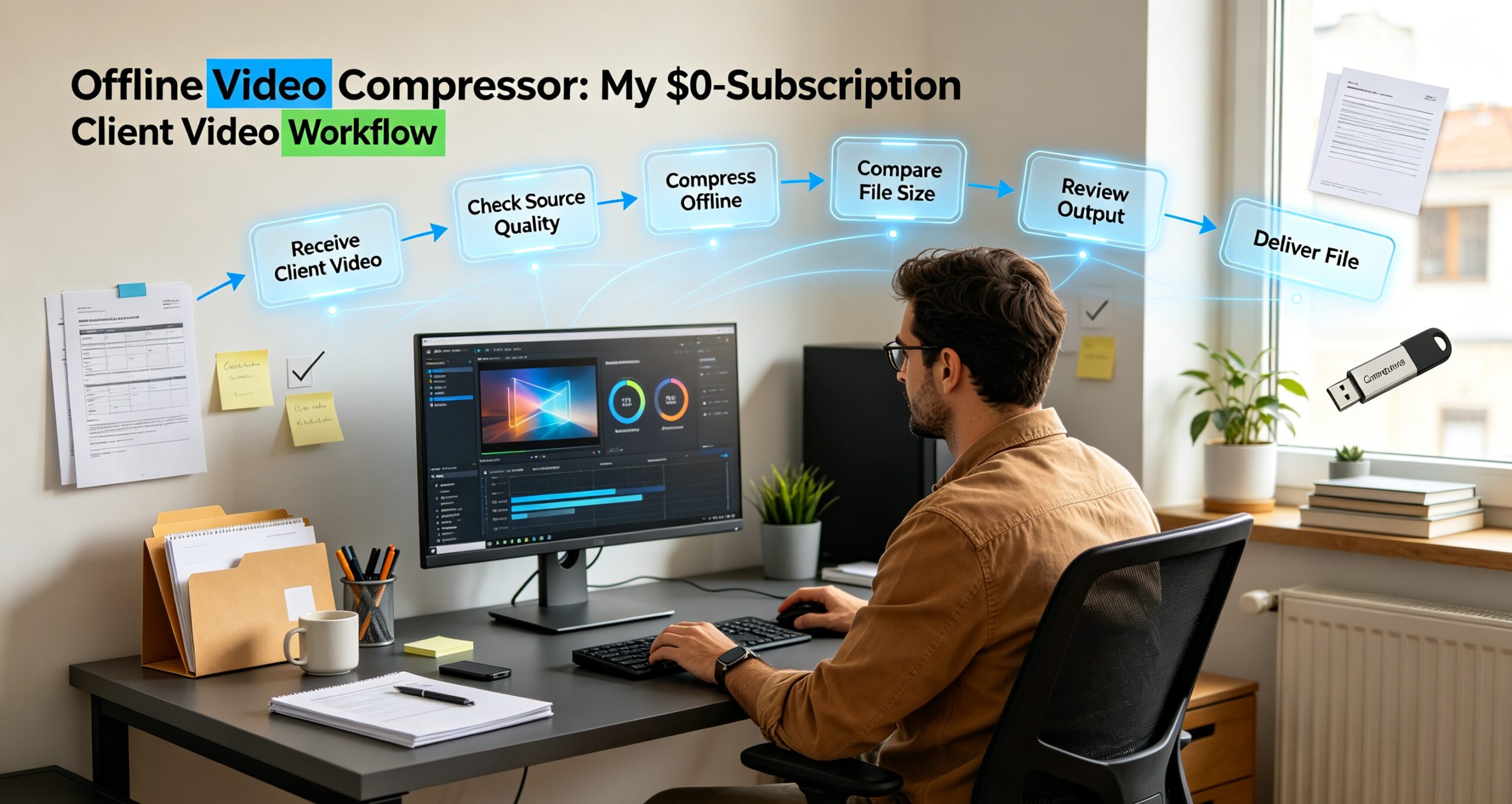
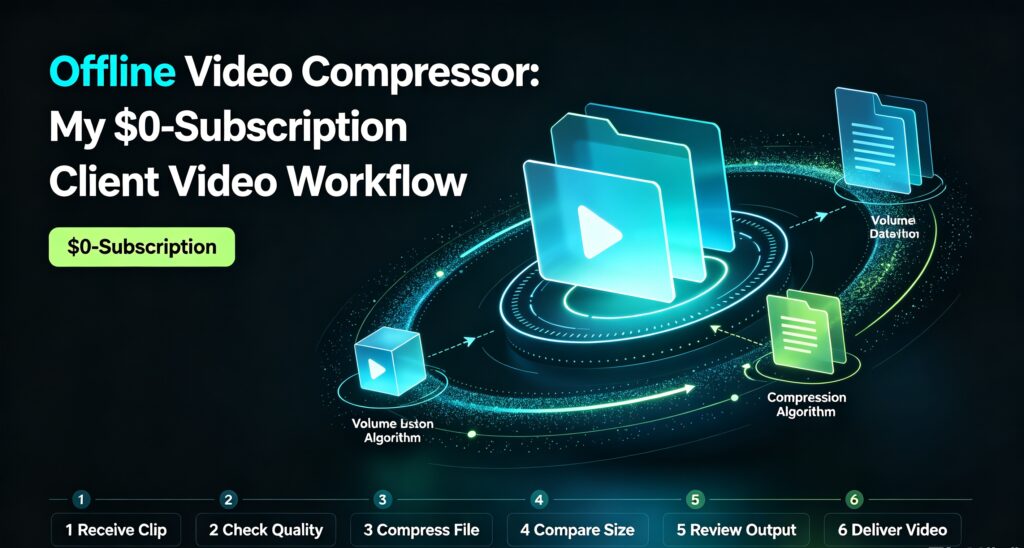
Here’s the exact sequence I use when a client sends back a bloated screen recording and asks me to “just make it sendable.”
- Triage the length. If most of the recording is dead air or setup, trim it first. Cutting 10 minutes of a 30-minute recording does more for file size than any encoder setting.
- Compress at 1080p, H.264, ~5 Mbps. This alone typically takes a 4 GB file to 300-500 MB.
- Check the audio. If it’s voice-only, re-export at 128 kbps. If there’s any noise, a quick pass in an audio cleaner before compression keeps the bitrate low without artifacts.
- Make a GIF for the preview. Clients often just want to see a 10-second highlight in their Slack. A GIF gets you out of sending the whole file.
That sequence has never failed me, and it takes minutes instead of a browser-tab roulette.
Extracting audio and burning subtitles — two underrated jobs
Two of VideoForge’s tabs save me more time than compression does.
Extract Audio is for the podcast and transcription crowd. Pull a clean MP3 or WAV out of a video in seconds, then drop it into your transcription tool of choice. If you’re hand-rolling subtitles, the MP3 is what you feed the transcriber. From there, if you want the subtitles actually baked into the video rather than sitting in a separate file, the Burn Subtitles tab hard-codes an .srt into the frame — which matters for social platforms that ignore sidecar subtitle files. If auto-generated subtitles are your workflow instead, that’s a different job: see our guide to generating subtitles offline.
Make GIF is the one clients ask for without knowing the name of it. “Can you send me a little looping clip for the deck?” — that’s a GIF. Ten seconds, trimmed, exported as a loop, done.
When a batch tool beats a video tool
One caveat worth knowing: video compression is a per-file, quality-sensitive job, so you’ll want to eyeball the output. But plenty of adjacent work — stripping backgrounds from product photos, processing a folder full of images — is pure repetition, and that’s where a batch tool wins. If your project involves both video and images, see how to process 100 photos in one pass.
Is an offline tool worth it versus free web apps?
If you compress one clip a month and don’t care about privacy, a free web app is fine. You’re not the customer this tool is for.
If you handle client footage, work under NDAs, compress regularly, or have ever hit an upload cap at the worst possible moment, the math turns quickly. Web tools are free until they aren’t — the paywall appears exactly when you need the file. VideoForge is a one-time purchase with no subscription, no watermarks, and no upload limits. There’s no account, no credit system, and nothing leaves your machine.
If you’d rather run a whole suite of AI and media tools locally instead of juggling subscriptions, that’s the philosophy behind everything we build — the same thinking behind our portable local AI toolkit.
System requirements
- Windows 10 or 11 (64-bit)
- FFmpeg — bundled detection handles the common cases, or install it once via
winget install Gyan.FFmpeg - No GPU required; compression is CPU-bound and runs fine on a modern laptop
Frequently asked questions
Does compressing a video reduce quality?
Any re-encode loses some data, but you can compress by 50-70% with no visible difference for most viewing conditions if you keep resolution and bitrate sensible. The quality drop only becomes obvious when you push resolution down aggressively or drop bitrate too far for fast-motion footage.
What’s the best format to convert to?
For maximum compatibility, MP4 with H.264 video and AAC audio. For smaller files where you control playback, MP4 with H.265/HEVC. WebM is a good choice for web embedding if you don’t need Safari-on-old-macOS support.
Can VideoForge remove a watermark from a video?
No. VideoForge compresses, converts, and edits your own footage — it doesn’t and won’t remove watermarks or DRM from files you don’t own. It also never adds a watermark of its own to your output.
Does VideoForge upload my files anywhere?
No. It runs entirely on your machine. Nothing is uploaded, no account is required, and there are no server-side size limits.
Is there a free trial?
VideoForge is a one-time purchase, not a subscription. There’s no recurring fee, so there’s nothing to cancel — you buy it, you own it.
The bottom line
An offline video compressor shouldn’t cost you a monthly subscription, a privacy compromise, or a size cap at the worst possible moment. VideoForge is the tool I built because I got tired of all three. It’s seven offline jobs in one window, and it does the unglamorous work that keeps a video project moving — compress, convert, trim, merge, extract audio, make GIFs, and burn subtitles, all without an upload.
Start with the compress tab and the 1080p / H.264 / ~5 Mbps recipe. Adjust one lever at a time, check 20 seconds of output, and you’ll rarely need more than one pass. That’s the whole skill.
Want the whole toolkit? VideoForge is part of the AI Power Suite — 9 Premium Tools Bundle, which packs video, audio, image, PDF and SEO tools into one one-time purchase ($169 for $281 of software).
Put this into practice: grab VideoForge for a one-time $34, compress the next bloated file you get from a client, and time how long the whole thing takes — including the part where nothing leaves your machine.
Disclaimer: This post contains affiliate links. If you buy through them, we may earn a commission at no extra cost to you. We only recommend tools we’ve actually used, and our opinions remain our own.