Last spring a Shopify store owner paid me $400 for five welcome-sequence emails using nothing but free tools. It took me an afternoon. He’d tried writing them himself for three weeks, hated every draft, and knew a good email copywriting service for clients would save him more than it cost. That job taught me something the freelancer blogs never say out loud: email copy is easier to sell than blog content, because the client can measure the result in revenue, not pageviews. This is the exact $0 workflow I use to run an email copywriting service for clients — no subscriptions, no agency overhead.
Email is the one channel every business owns. They don’t rent it from an algorithm, and they don’t lose it when a platform changes its rules. That’s why founders and agencies will happily pay for a dependable email copywriting service for clients — someone who can write sequences that get opened, clicked, and bought.
Why Clients Pay for Email Copywriting (Not Just Blog Posts)
A blog post builds traffic slowly. An email sequence moves money today. When I pitch an email copywriting service for clients, I’m not selling “words” — I’m selling abandoned-cart recovery, welcome sequences, and re-engagement campaigns the client can measure inside a week. That measurability is exactly why pricing holds up: a five-email welcome flow that lifts a store’s first-purchase rate is worth far more than its word count.
The clients who buy this most often are e-commerce stores, SaaS founders, course creators, and local service businesses with a list they’re not monetizing. Most have 500 to 50,000 subscribers sitting idle in Mailchimp, Klaviyo, or ConvertKit. They know the list is money and they don’t know what to send. That gap is the whole business.
The $0 Tool Stack Behind My Email Copywriting Service
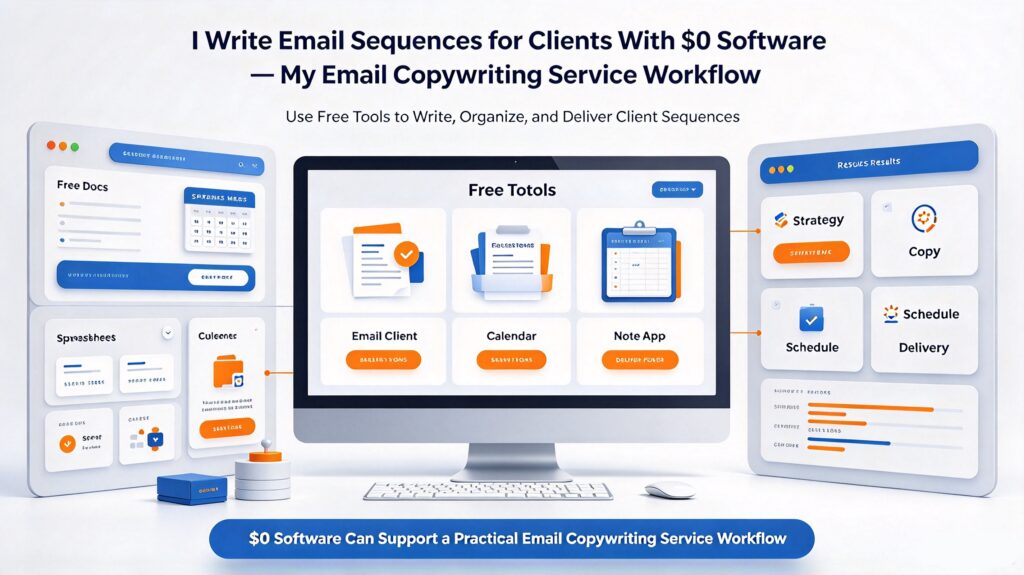
You do not need a paid copywriting AI to run this. Here is the free stack I use on every email job:
- Free AI chat assistants — for angle mining, subject-line variants, and first-pass drafts. I treat them as a junior copywriter, never the final voice.
- A free sentence rewriter — for tightening clunky lines and cutting the generic “AI tone” that makes email sound like spam.
- A free readability score checker — email must read at roughly a grade-6 level. If a subject line or body scores too high, it dies in the inbox.
- A free meta description generator — I reuse the same persuasive-summary skill to draft preview text (the snippet after the subject line), which most copywriters ignore and which lifts open rates.
- A free title generator — repurposed for subject-line brainstorming; I generate 10 options and hand-pick three.
- Free writing utilities in one place — the whole free AI tools hub covers rephrasing, summarizing, and checking, so I never pay a subscription at freelance volume.
That stack costs me exactly nothing. My margin comes from strategy and editing, not software.
My Exact Workflow for Every Email Job
This is the process I follow for a welcome sequence, a cart-recovery flow, or a single campaign. A five-email sequence takes roughly half a day once the client’s brand notes are in hand.
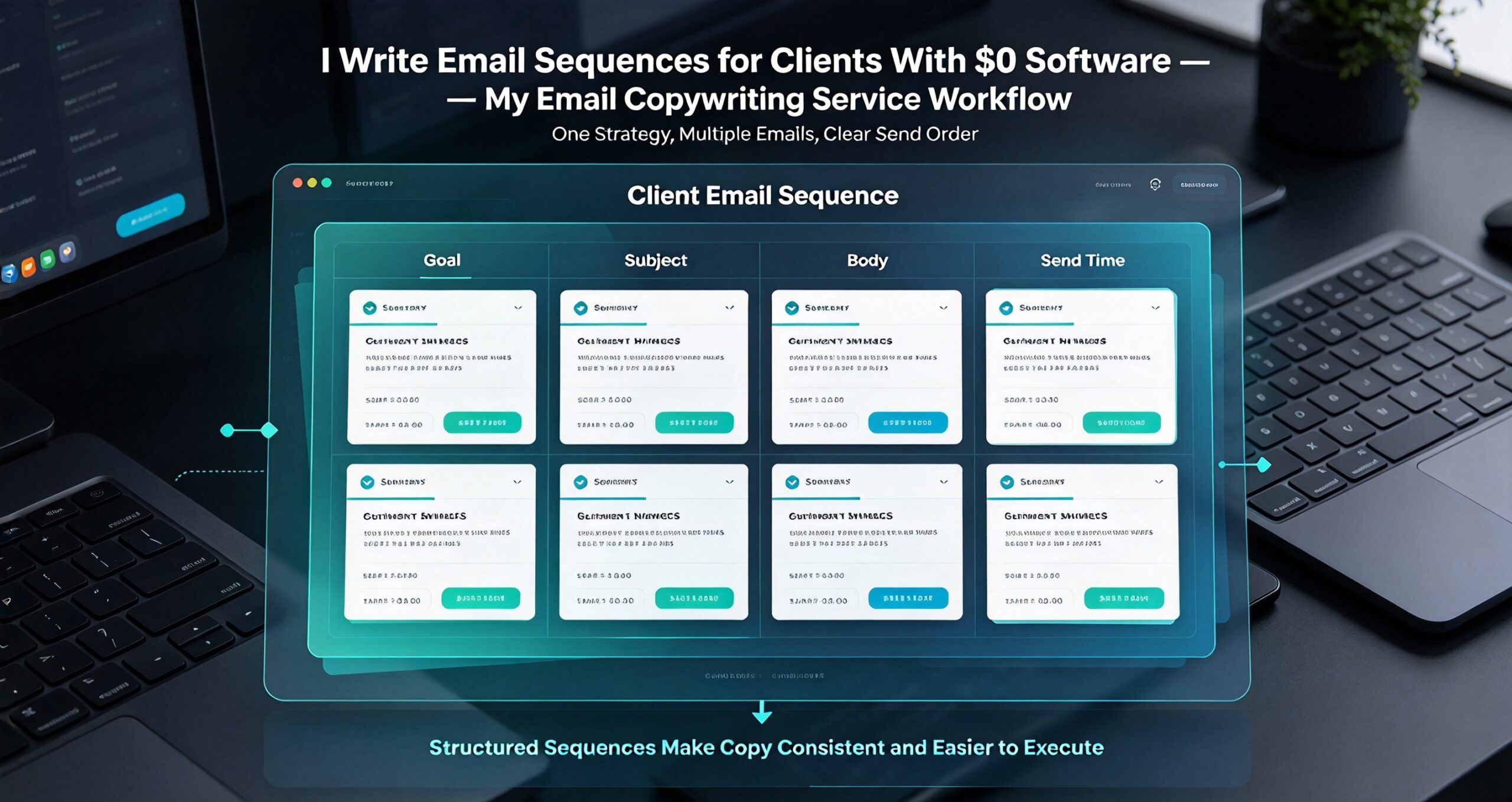
Step 1: Map the goal and the list segment
Before writing a word, I ask three questions: who is on this list, what do they want, and what single action should this email drive? A welcome email to new subscribers and a re-engagement email to dormant buyers need completely different voices. Pinning the segment and the one desired action is what makes the sequence convert instead of just look pretty.
Step 2: Outline the sequence as a story
I plan each email as a beat in a story: hook, value, proof, offer, urgency. For an abandoned-cart flow that’s typically 3 emails; a welcome flow is 5. I keep one goal per email — mixing three calls to action in one send is the fastest way to get nothing clicked. This outline is what I show the client for sign-off before drafting.
Step 3: Draft with AI, then rewrite in the brand’s voice
I draft each email from the outline, then rewrite every line by hand. Raw AI output reads like a press release; email has to sound like a person typing to a friend. I cut adjectives, shorten sentences, and read each one aloud. This rewrite step is the difference between a $50 email and a $500 sequence.
Step 4: Engineer the subject line and preview text
The subject line does 80% of the work. I generate at least ten options, split them into curiosity, benefit, and urgency types, and pick three for A/B testing. I write the preview text to extend the subject line rather than repeat it. A free title generator gives me the raw material; my judgment picks the winners.
Step 5: Check readability, then deliver a brief
I run every email through a readability checker and trim anything above grade 7. Then I deliver the sequence as a plain document the client can paste into their email tool, plus a one-page brief explaining the strategy, the send timing, and the A/B tests to run. That brief is why clients come back — it shows them I’m running a campaign, not selling words.
When a client wants a full lifecycle program — welcome, cart, post-purchase, win-back — I run several sequences in parallel. At that scale, local batch tools such as the AIXHDD USB toolkit, which bundles rewriters, checkers, and generators offline, keep my per-project cost near zero and let me quote retainers without guessing.
How to Price Email Copywriting
Email is priced per sequence, not per word, because the value is in the conversion. My benchmarks after dozens of jobs:
- Single campaign email — $75–$200 for a clean, tested send.
- Welcome or abandoned-cart sequence (3–5 emails) — $300–$800.
- Full lifecycle program + monthly campaigns retainer — $1,000–$2,500/month.
Retainers beat one-offs every time. Once a client sees an abandoned-cart sequence pay for itself, they stop haggling over single emails and move to a monthly arrangement. I always quote a paid trial sequence first — five emails is a small enough risk that clients say yes, and large enough to prove the value.
Where to Find Clients for Your Email Copywriting Service
The clients who need this cluster in predictable places. The channels that actually worked for me:
- E-commerce founder communities — Shopify, Klaviyo, and DTC Discords and Facebook groups are full of store owners asking how to write their welcome flow.
- Freelance marketplaces — Upwork and Fiverr list steady email-copy demand. Start low to build reviews, then raise prices quickly.
- Marketing agencies — agencies overflow with email work they don’t want to staff. Two or three agency partnerships can fill your calendar with white-label volume.
- Course creators and coaches — they live on launches and email sequences, and they’re usually the least confident writers in the room.
- Cold outreach with a fix — sign up to a prospect’s list, screenshot their broken welcome email, and send a rewritten version. It converts far better than a generic “I do email copy” pitch.
Common Mistakes That Kill an Email Copy Business
Three traps I fell into early — learn from them:
- Writing “beautiful” emails that don’t sell. Clever copy that never asks for the click is a hobby, not a service. Every email needs one clear next step.
- Ignoring deliverability. Great copy that lands in spam earns nothing. I avoid spam-trigger words, keep links clean, and always recommend the client warm up new domains. Google’s own sender guidelines are worth reading so your copy never fights the inbox filters.
- Delivering obvious AI text. If a subscriber can smell the template, the brand’s trust drops and your reputation follows. Rewrite, add specifics, and match the client’s real voice.
The Upside: Why Email Beats Most Freelance Niches
Email clients stay. A blog-post client has one project; an email client has a lifecycle, re-engagement, and campaigns every month. The recurring nature of the work is why this niche builds a real income instead of a gig-to-gig grind. Combine it with the same free-tools approach I use for blog writing, and you can run two services off one tool stack.
To go deeper on the strategy behind emails that convert without spamming, my earlier piece on the ethics of AI email marketing pairs well with this workflow. Start with one store, one sequence, and one measurable result — then let the results sell the next client for you.
Frequently Asked Questions
Do I need paid AI tools to run an email copywriting service?
No. Every tool in my workflow is free forever at freelance volume. The value you sell is strategy, editing, and the ability to write in the client’s voice — not the software license.
How long does a welcome sequence take?
A five-email welcome sequence takes about half a day once you have the client’s brand notes and offer details. With practice, the outlining and drafting steps get much faster.
Can I run email copywriting alongside other freelance services?
Yes — it shares the same free tool stack as blog writing, social media management, and content editing. Email simply adds a recurring, higher-margin service to your offer.
What if the client’s emails go to spam?
Copy is only half the job. Recommend warm-up, clean lists, and avoiding spam-trigger language. Pairing clean copy with good sending hygiene is what makes a sequence actually land.