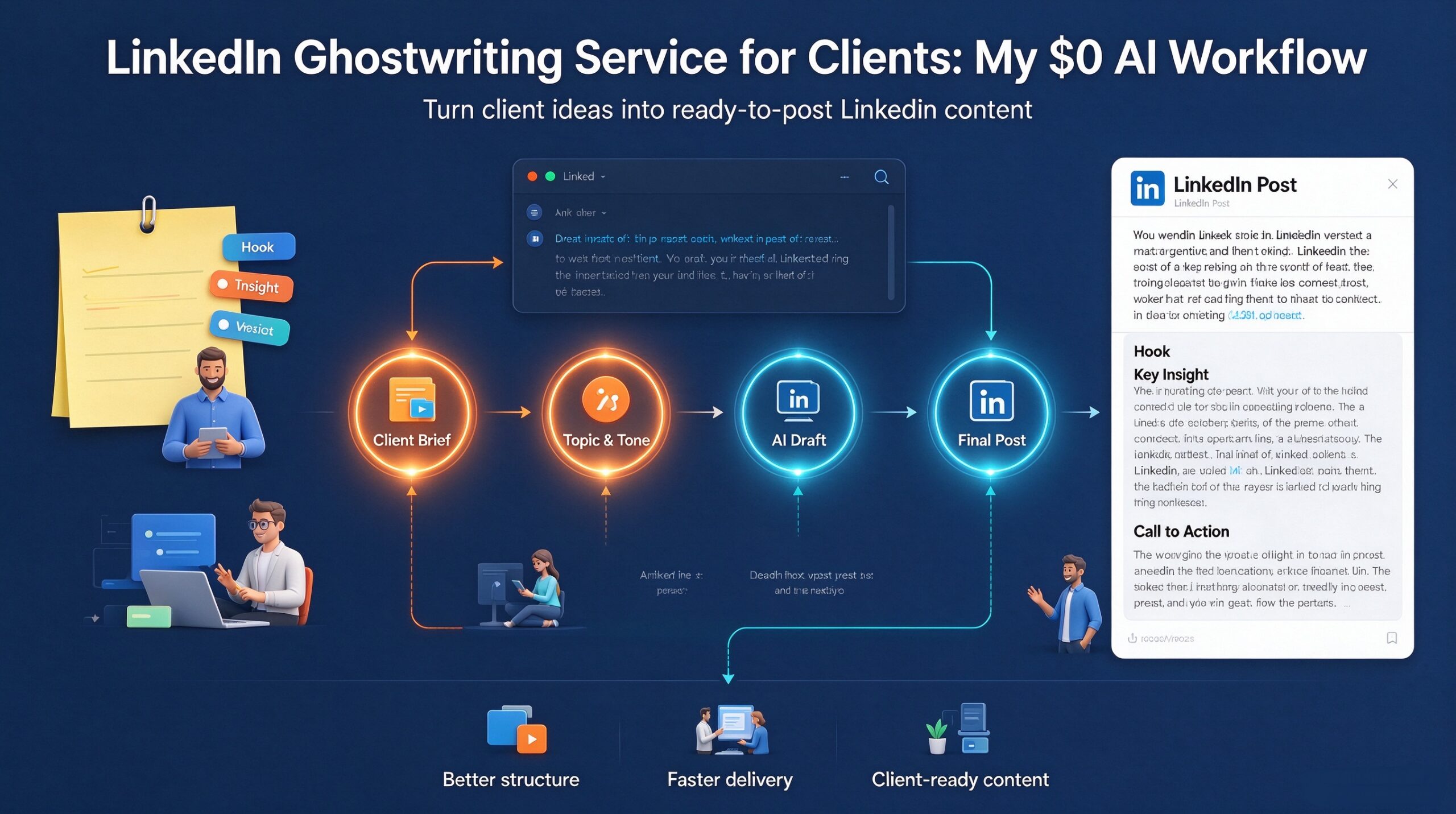
LinkedIn ghostwriting is one of the highest-paid writing niches that almost nobody talks about. Founders, executives, and B2B salespeople all know they should be posting — and almost none of them want to write. They will happily pay someone to turn their half-formed opinions into three sharp posts a week, as long as those posts sound like them and never embarrass them in front of their board.
I used to assume this work required a journalism background, a personal brand, and an expensive content agency behind me. It does not. The entire job — the angle, the draft, the polish, the posting cadence — can be run with free AI tools in about an hour per post. This is the exact workflow I use to ghostwrite LinkedIn content for clients, and what to charge for it.
Why LinkedIn ghostwriting is an underrated freelance service
Every profitable B2B company has at least one person who should be visible on LinkedIn and is not. Usually it is the founder, or the head of sales, or the CTO. Their buyer is on LinkedIn. Their competitors are on LinkedIn. And their profile has been dormant since they changed their job title three years ago.
That gap is the opportunity. LinkedIn ghostwriting is easy to explain, easy to scope, and easy to price, because the deliverable is simple: a set of posts that sound like the client and earn engagement. It also fits neatly on top of an existing content or copywriting business. If you already write blog posts or email sequences for clients, adding LinkedIn is a natural retainer upsell — same client relationship, same voice guide, same trust. You just need a repeatable process so you are not staring at a blank page every week.
The $0 tool stack
You do not need a social media management suite or a content agency’s tooling. Five free browser tools cover the whole workflow, and none of them cost a cent or require an account:
- Outline generator — turns a rough idea or a client call transcript into a post skeleton with a hook, body, and takeaway.
- Blog title generator — rapid-fire hook variations so you can test which opening line earns the first line.
- Grammar checker — catches the tense slips and passive constructions that make a founder sound unsure.
- Readability score checker — keeps posts scannable for a distracted feed, not dense like a memo.
- Meta description generator — for the client’s LinkedIn newsletter or the web version of the post.
Everything runs in the browser at the free AI tools hub, and nothing gets saved to a server. That matters more in ghostwriting than almost anywhere else: you are handling a client’s unpublished opinions about their industry, their competitors, and sometimes their own company. Being able to say “your drafts never leave my machine” is a real selling point. You can also run the whole stack offline if you keep the downloadable version on a USB stick, which I mention whenever a client asks where their drafts live.
The five-step workflow
1. Mine the client for raw opinions
Ghostwriting is not invention — it is extraction. Book a 30-minute call and ask the client what they believe about their industry that most people get wrong. Write down every contrarian take, war story, and hot opinion. Those are your posts. A single good call produces a month of content. Open the article outline generator, paste one raw opinion as the topic plus a supporting anecdote, and choose a short-post structure. You get a skeleton in seconds.
2. Build the hook before the body
On LinkedIn, the first two lines decide everything, because that is all that shows before the “see more” click. Take the core opinion into the blog title generator and generate fifteen hook variations. You are not looking for a slogan — you are looking for tension. The best hooks open a loop (“Everyone told me to raise prices. I did the opposite.”) or state a specific number. Keep the lines that read like a person talking, not a brand posting.
3. Draft fast, in the client’s voice
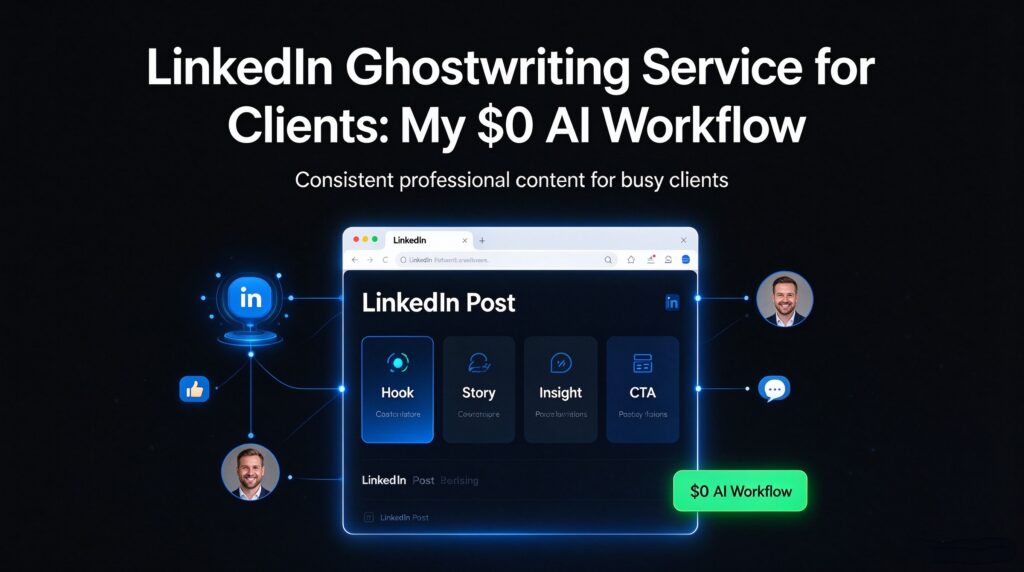
Now fill the outline. A solid LinkedIn post is: a two-line hook, a short story or observation, one concrete lesson or number, and a closing question or takeaway. Keep paragraphs to one or two sentences — the feed is read on phones. Match the client’s rhythm: if they swear, keep it light; if they are formal, stay formal. Once the draft is down, run it through the grammar checker before you read it yourself. You will catch more when the obvious errors are already gone.
4. Tune it for the feed and the skimmer
People scroll fast and decide in a second. Paste your draft into the readability score checker and aim for an easy score. Break any sentence that runs past a line and a half. Front-load each paragraph so the point lands before the reader’s thumb moves. Then strip the corporate filler — “I’m excited to share,” “humbled,” “at the end of the day.” This step is what separates a post that gets read from one that gets scrolled past.
5. Package for the client’s calendar and channels
Most clients want a batch, not a single post. Deliver a folder of eight to twelve posts scheduled across a month, each with a suggested posting day and a one-line note on why it works. If they also run a a LinkedIn newsletter, hand over both the short post and a longer newsletter version of the best one. Deliver in plain text as well as formatted, because scheduling tools strip formatting and some clients paste straight into the app.
What to charge
| Deliverable | Typical freelance price |
|---|---|
| Single LinkedIn post (ghostwritten, 150–300 words) | $75 – $150 |
| Monthly package (8–12 posts + scheduling notes) | $800 – $2,000 / month |
| Executive retainer (posts + profile rewrite + engagement strategy) | $1,500 – $4,000 / month |
| Profile rewrite (one-off) | $200 – $500 |
These numbers are not aggressive. Agencies charge several times this and often hand the actual writing to a junior. Your advantage is a fixed monthly price, a fast turnaround, and content that genuinely sounds like the client. An executive who pays $20,000 a year for a personal-brand consultant will happily switch to a writer who delivers sharper posts for a fraction of it.
Where to find clients
- Founders who post rarely — scan accelerator and VC portfolio pages, then check who has an active-but-thin LinkedIn feed.
- B2B sales leaders — sales teams live on LinkedIn and know a strong feed warms leads.
- Freelance marketplaces — search “LinkedIn ghostwriter” and you will find steady demand with thin supply of good writers.
- Your existing clients — the fastest sale is an upsell to a content client who already trusts your writing.
Confidentiality and the offline option
You are handling a client’s most personal professional asset: their reputation, in their own name, about topics they may not have announced yet. If a client is nervous about feeding private opinions into an online tool, run the workflow offline. A downloadable local version keeps every draft on the machine, so nothing unpublished leaves the building. Being the ghostwriter who can offer that — instead of the one who says “just paste it into ChatGPT” — is a genuine competitive edge with executives and security-conscious B2B clients.
Frequently asked questions
Do I need my own big LinkedIn following to sell this?
No. You are writing for the client’s audience, not yours. What sells the service is a portfolio of sample posts written in a convincing voice, plus a clear story about how you extract and shape someone else’s opinions.
How long does one post take?
With this workflow, one LinkedIn post takes 30 to 45 minutes from raw opinion to delivered draft. Batches of eight to twelve posts go much faster once you have a bank of client opinions from the discovery call.
Will the client’s posts sound generic?
Only if you draft from scratch. The extraction step is what prevents that. Every post built from a real client anecdote or contrarian take reads specific, and specific is what performs on LinkedIn.
Should I do the first month for free to build a portfolio?
No. Do one free sample post to land the client, then charge from the first real month. Free retainers signal low value, and the workflow is fast enough that paid pricing is justified immediately.
Start with one free sample
The easiest way to sell LinkedIn ghostwriting is to send a prospect three sample posts in their own voice, written from their public posts and talks, before they ask. It takes an hour with this workflow and it converts better than any pitch email. If you want the free tools in one place so you can build that sample today, start at the free AI tools hub — and if you would rather run everything offline for confidential drafts, the AI Power Suite bundle includes the local versions.