You sent the proposal eleven days ago. The client replied within an hour saying it looked great and they would review it with their partner. Then silence. You have opened the sent email more times than you would admit, drafted three follow-ups, deleted all three, and are now telling yourself a story that is almost certainly wrong — that the price was too high, that they found someone cheaper, that you somehow blew it in the call.
Here is what the data actually says: the overwhelming majority of silent proposals are not rejections. They are proposals that landed in a queue, in a busy week, in an inbox that gets 180 emails a day. The person who was excited about your work on Tuesday still likes your work on Friday. They have simply lost the thread — and the only thing standing between that proposal and a signed contract is a follow-up that does not feel like chasing.
This guide is the complete system for following up on a freelance proposal: the timing that works, the exact wording that gets replies, the mistakes that turn a warm proposal cold, and how to close the loop honestly when the answer is no. If you have not yet sent the proposal, start with how to write a website audit proposal so that the follow-up is a reminder rather than a rescue. And once the proposal is accepted, the client onboarding checklist is what stops the project from starting in chaos.

Why Freelancers Avoid Following Up on Proposals
Most freelancers do not have a follow-up problem. They have a self-image problem. Following up feels like admitting that the silence means something, and asking again feels like begging. So the proposal sits there, the freelancer sends one apologetic email two weeks later — “just checking in, no pressure” — and then gives up, which is the worst of both worlds: you did the annoying thing and you still did not get the answer.
There is also a genuine professional fear underneath it. If you follow up and get a no, the opportunity is officially dead. As long as you do not ask, the proposal is technically still open, and the fantasy of the deal stays alive. This is the same reasoning that keeps people from checking a bank balance they already know is low.
The trade to make is simple. One clean follow-up sequence at the right intervals produces a measurable reply rate — typically the majority of proposals that eventually close had at least one follow-up. Multiple touchpoints are not pestering. They are the normal rhythm of how business decisions get made in organisations where three people need to agree before anyone writes a cheque.
The Real Reasons a Proposal Goes Quiet
Before you fix the follow-up, understand what you are following up on. In practice, silence breaks down into a small number of causes, and each needs a different follow-up.
1. The decision is real but slower than yours
A freelance proposal that takes you an hour to write can take a small company three weeks to approve. Their budget may be in a quarterly cycle. The person who likes your proposal may not be the person who signs it. Your follow-up here is not a nudge — it is a calendar check.
2. The proposal has an unresolved objection
Sometimes the client got to the price line, hesitated, and did not want to say so. Others read the scope and did not understand what phase two actually buys them. Silence is often politeness around an objection. Your follow-up should make it easy to name that objection without losing face.
3. Nothing is wrong and they simply forgot
The most common case, and the one freelancers over-analyse the most. Your proposal is the number one priority in your world and the fourth item on a Tuesday to-do list in theirs. A short, concrete reminder is genuinely useful. They meant to reply.
4. The project has changed or died
Budgets get frozen. Priorities move. A decision-maker leaves. This is nobody’s fault, and it is the one case where a follow-up should make it easy for the client to say “not now” without embarrassment, because that answer keeps the door open for later.
5. They went with someone else and feel awkward
Clients rarely enjoy telling freelancers they lost. The awkwardness is theirs, not yours. Give them a graceful exit line and you will often be the first person they call next time — which happens more often than freelancers expect.
6. The proposal never reached the decision-maker
This one is more common than anyone admits. Your contact liked the proposal, forwarded it internally, and the forward died in a colleague’s inbox. Or your email landed in a shared “info@” inbox and was read by someone with no authority to buy. When a proposal has gone quiet and your contact has gone quiet with it, ask directly who else needs to see it. It is a normal, professional question, and it occasionally reveals that the whole proposal was sitting in the wrong mailbox the entire time.
7. Seasonal and operational blackouts
A proposal sent on 20 December to a business that closes between Christmas and New Year is functionally sent in January — and January is a month when every budget conversation gets postponed. The same is true of end-of-quarter crunch weeks, trade show weeks, and the two weeks after any major internal reorganisation. Before you interpret silence as a decision, check the calendar of the industry you are selling into. Sometimes the most useful follow-up is simply a better-timed one.
8. The proposal was too complicated to approve
Freelancers write proposals that demonstrate thoroughness. Buyers need proposals they can say yes to. If your proposal had six phases, four optional add-ons, and a pricing table with three variants, the silence may be a decision-fatigue problem rather than a commitment problem. The very first follow-up in that case should not be a reminder — it should be a simplification: one recommendation, one price, one start date.
The Follow-Up Timeline That Works
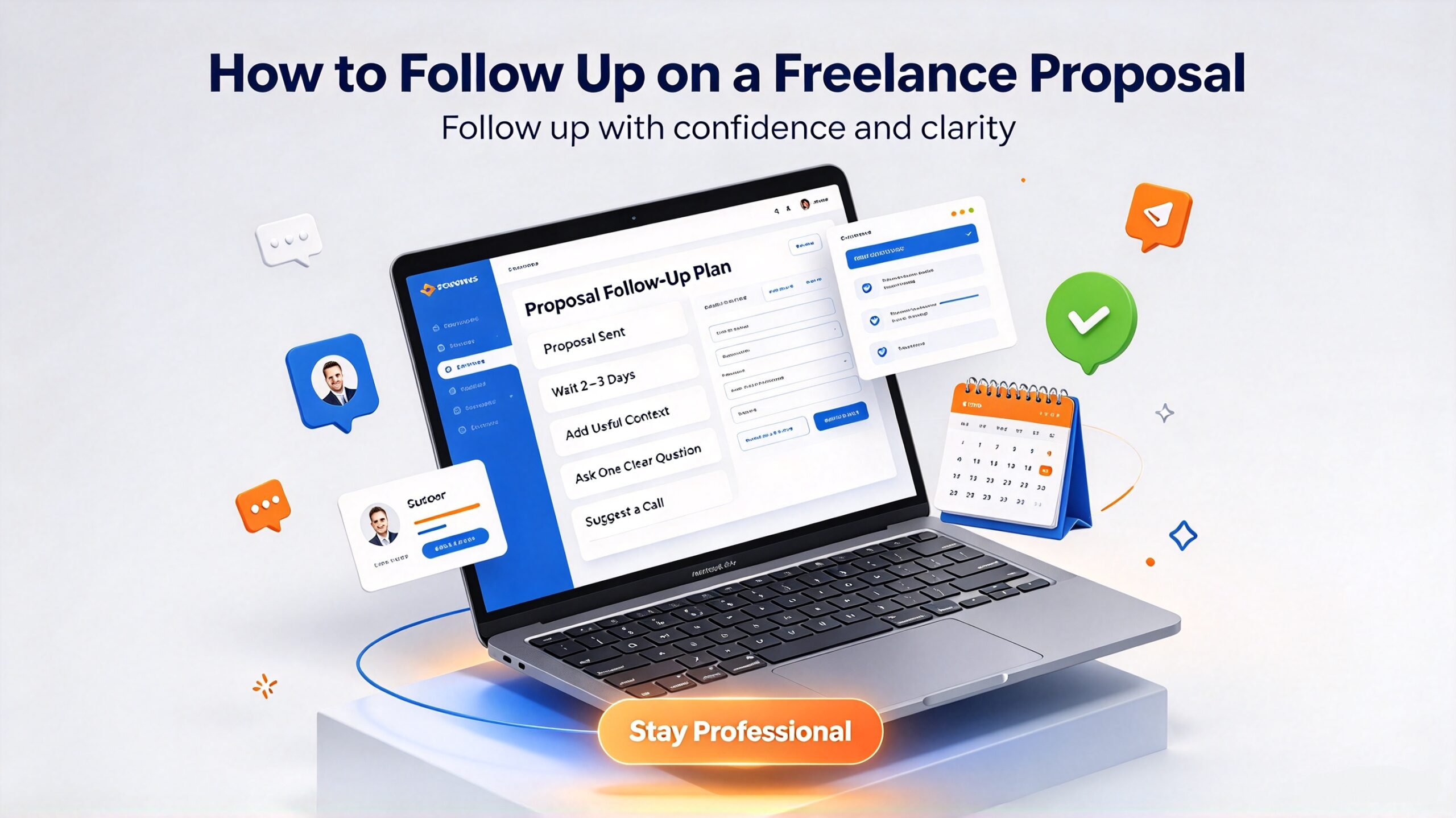
Send at most four touches, spaced out, each with a different job. The spacing matters more than the wording: too soon reads as anxious, too late reads as indifferent, and one email sent after three weeks of silence rarely gets an answer because it no longer feels like a conversation.
Day 3: The value-add check
Three working days after sending, send something that assumes the proposal is being read, not that it is being ignored. Attach a small piece of value — a screenshot of the issue you found during your audit, a link to a relevant example, one extra idea that did not fit in the proposal. Never write “just checking in” in this email.
Day 7: The concrete question
One week in, ask a question that requires a decision-shaped answer. “Is the scope in section two the right size for the budget you have in mind, or should we look at the smaller version first?” A question like this is answerable in one line, which is the whole point. Vague emails get vague silence.
Day 14: The polite close-the-loop
Two weeks in, make it easy to say no. This is the email most freelancers never send, and it is the one that produces the highest reply rate, because it removes the emotional cost of replying. “If the timing is wrong, just say so and I will check back in three months” is a gift to a busy person.
Day 30: The calendar re-open
If there is still no answer, park the proposal and put a reminder in your calendar for 60 to 90 days. One line then — “still here if the project comes back into focus” — costs you thirty seconds and occasionally produces a project six months later.
What to do when there is a hard deadline
If your availability is genuinely limited, say so once, plainly, in the day-7 email: “I can hold the start date until the 12th, after that I would need to re-check my calendar.” That is a real constraint, not a manipulation tactic. Use it only when it is true — fake scarcity is transparent and it costs you the deal.
How to Write a Follow-Up That Gets a Reply
Four rules, and they are all about reducing the client’s effort.
Keep it under 90 words. A follow-up is read on a phone between meetings. Anything longer than a screen gets archived for later, and later never comes. Your original proposal already did the persuading.
Reply to your own thread. Do not start a fresh email with a new subject line. The thread contains the proposal, the context, and the goodwill. Keep all of it in one place.
Ask one question with two options. “Should we start with phase one in November, or hold until January?” is easier to answer than “what do you think?” Two options let the client make a decision instead of composing one.
Never apologise for following up. No “sorry to bother you”, no “I know you are busy”, no “just”. You are doing your job professionally. Apologising communicates that the follow-up is an imposition — and clients unconsciously accept the frame you give them.
Three templates you can adapt
Day 3. “Hi Sarah — while reviewing your site again I noticed the mobile menu overlaps the sticky header on the pricing page, which likely costs you checkout clicks. Two-line fix, I have added it to the scope in section three at no extra cost. Let me know if the proposal otherwise looks right.”
Day 7. “Hi Sarah — one question so I can plan capacity: is the full scope in section two right, or should we begin with the audit and landing page and add the blog migration later? Either works from my side.”
Day 14. “Hi Sarah — closing the loop on my proposal so I can free the slot. If the timing is not right, just reply ‘not now’ and I will check back in January. If it is still moving forward, tell me who else needs to review it and I will send them a one-page summary.”
Follow-Up Mistakes That Kill Warm Proposals
These are the patterns that convert a patient client into a relieved non-client.
The guilt trip. “I have reached out twice now and have not heard back” puts the client in the role of the rude party. They will resolve the discomfort by closing the door.
The discount reflex. Dropping your price in the second email without being asked tells the client the first number was invented. If price is the objection, they will tell you — and then you can restructure scope instead of eroding rate.
The re-pitch. Re-sending the whole proposal as a PDF with a new cover note is a second unsolicited pitch, not a follow-up. It reads as if the first one was not received, and it makes you look disorganised.
The extra channel. Adding LinkedIn, a phone call, and WhatsApp within a week does not show persistence; it shows you cannot read a signal. One channel at a time, with spacing, is what professional persistence looks like.
The invented reason. “My schedule is closing!” sent on day 6 when your calendar is empty is the kind of lie a client can check. It works once and costs you a reputation.
Reading the Signals Between the Lines
Not every silence means the same thing, and the wording of a reply tells you how to respond next.
“We are still reviewing” without a date is usually a soft no with a delay attached. Ask once for a date: “Should I check back on the 20th?” If they cannot give you a date, treat it as parked.
“The budget is not approved yet” is a real constraint, not a rejection. Ask when the budget cycle next opens, and put the date in your calendar instead of sending more emails now.
“Can you send a version without X?” is a buying signal. Answer within a day, even if the answer is that X is essential — because a fast, clear trade is the most persuasive thing you can send at that moment.
Instructions forwarded from a colleague — a technical question from their developer, a note from their boss — means you are in active evaluation. Treat every forwarded question as a deadline. This is the moment deals are won or lost.
What to Do When the Answer Is No
A clean no is more valuable than three more weeks of hope, and it is the outcome you should be trying to surface. When it comes, do three things.
Thank them in one sentence, and do not negotiate. Ask one question: “Was it the price, the scope, or something else?” Many clients will answer honestly when it costs them nothing. Write the answer down — three proposals losing on the same objection is a positioning problem, not bad luck.
Then close the loop with permission: “Understood. If the priority comes back in the next six months, I would be glad to revisit it.” That single line is how a dead proposal turns into a phone call the following quarter.
One more thing worth doing: after a rejection, review the proposal itself with fresh eyes. The reasons clients decline are usually visible in writing before they say them — a scope that is hard to compare to other quotes, a price with no anchor, or a phase one that produces no visible outcome. Every decline is a free diagnosis of your proposal template.
Build a Follow-Up System Instead of Relying on Memory
Here is a worked example of what that looks like in practice. A three-person design studio operating in a spreadsheet — one tab per quarter, one row per opportunity — tracks columns for the date the proposal went out, the name of the decision-maker, the stated budget cycle, and the two follow-up dates generated automatically from the sent date. When a proposal is marked “no”, a single column records the stated reason. After three months the studio can open that column and read a pattern instead of a set of separate disappointments.
The reason this matters is that proposal follow-up is a system problem disguised as a personality problem. Freelancers with a disciplined follow-up habit are not more confident or less sensitive to rejection. They simply do not rely on remembering to feel brave on a particular afternoon. The system does the deciding, and the deciding is where all the loss happens.
A second useful practice is to keep one sentence of context per proposal in that list — the thing the client actually cares about, in their words. When you write the follow-up three weeks later, that sentence is what makes your email sound like a continuation of a conversation rather than a template. “You mentioned the migration has to happen before the trade show in March” is worth more than any clever subject line you could write.
Finally, review your follow-up log at the end of every quarter, not just every week. Count how many proposals were followed up the full sequence and how many were abandoned after one silent week. The second number is almost always the honest measure of lost revenue — and it is the number that improves fastest once you stop treating follow-up as a personality trait and start treating it as a checklist item.
The reason freelancers lose deals to silence is almost never inexperience with email. It is that the follow-up lives in the freelancer’s head, and the head is full of active projects. Whatever is not tracked gets dropped — usually the exact proposal that was close to closing.
The fix is deliberately boring. Maintain a single list of open proposals with four dates per row: sent, follow-up one, follow-up two, close-the-loop. Every Friday, spend ten minutes writing whatever is due. A simple spreadsheet beats a sophisticated CRM you do not open.
A useful habit: draft all four follow-ups at the moment you send the proposal, and save them as drafts. The tone is right when you are still confident, and the whole sequence costs about six minutes. Later, you only adjust dates and details, instead of writing an apology from a position of anxiety. A calendar reminder with a pre-written sentence is worth more than any amount of willpower.
If proposal follow-up is a recurring revenue line for you, treat it like any other deliverable: give it a process, a template, and a weekly review slot. That is the difference between a pipeline that closes on your terms and a pipeline that depends on whether you felt brave enough to send the email this week.
Frequently Asked Questions
How soon should I follow up after sending a proposal?
Three working days. That is long enough for the proposal to be read and short enough that the conversation is still warm. Anything earlier reads as anxious; anything after two weeks usually requires a restart rather than a follow-up.
How many times should I follow up before giving up?
Three substantive touches over two weeks, then one check-in at 60 to 90 days. Beyond that you are not building rapport, you are building a record of unanswered emails. Park it and move on — the calendar reminder does the rest.
Should I follow up if I quoted a high price?
Yes, and for a specific reason: if price is the blocker, silence hides it. A concrete question — “is the scope right for the budget, or should we start smaller?” — gives the client a way to say it. You cannot adjust a proposal you never get feedback on.
What if the client says they will get back to me and never does?
Treat the absence of a date as a soft no. Ask once for a specific date, and if none comes, park the proposal and put a reminder in your calendar for three months. Do not keep writing to find out whether you are still waiting.
Does following up make me look desperate?
Only when it apologises, explains itself, or arrives too often. A short, confident message with a concrete question reads as professionalism. Desperation is not the frequency of your follow-up; it is the tone of it.
Should I send a discount in the follow-up?
Not unprompted. Offer a smaller scope or a phased start instead. Discounting without being asked undermines the original number, and it trains clients to wait you out on every proposal.
The One-Line Rule to Remember
The purpose of a follow-up is not to ask the client for an answer. It is to make answering easy. Every good follow-up reduces the effort, the embarrassment, or the number of decisions required to reply — and every bad one adds a small social cost to ignoring you. Write with that rule in mind and your close rate on written proposals will move within a month.
Before the next proposal leaves your outbox, read how to structure an audit proposal that closes, and prepare the handoff with the client handoff checklist so the project ends as cleanly as it begins.