Most freelance disasters don’t start in week six. They start in the first 48 hours, when nobody wrote down what “done” means, who sends what, or when the first invoice lands. You win the project, you’re relieved, you jump straight into the work — and three weeks later you’re arguing about a deliverable you never agreed to build.
A client onboarding checklist is not bureaucracy. It’s the cheapest insurance you will ever buy for your business. Done properly, it takes about ninety minutes of setup effort per new client and prevents the single most expensive category of freelance loss: unpaid scope.
This guide is the exact onboarding sequence I use, built from running client-facing service work where every hour is billable and every ambiguity is a cost. It assumes you’ve already won the job.
One caveat before we start. Onboarding advice usually fails because it’s written for agencies with project managers and lawyers. This is written for the person who does the work, sends the invoices, and answers the emails — which is to say, for one to three people. Everything below can be set up in a single afternoon and run by yourself without a tool subscription.
Why onboarding fails (and it isn’t the client’s fault)
Three failure modes account for almost every bad project start.
1. Verbal agreement, no artifact. The scope lives in a call, in your memory, in a Slack message that scrolls away. When a dispute arrives, you have nothing to point at.
2. No single source of truth for assets. The logo is in an email, the copy is in a Google Doc someone else owns, the brand fonts were mentioned once. You spend the first week as a filing clerk instead of doing the work you were hired for.
3. No definition of “response time” on either side. You assume they’ll answer questions in a day; they assume you’ll work continuously. The project stalls, and the stall gets blamed on you.
All three are fixed by the same thing: a written onboarding package delivered in the first two days, before any production work begins.
There’s a fourth, subtler failure that tends to arrive later. It happens when the client’s expectations were never anchored to a specific artifact, so they evolve as the work appears. A client who imagined “a landing page” is disappointed by an excellent landing page that isn’t the one in their head — not because the work is bad, but because “a landing page” was never a specification. Onboarding is where vague briefs become concrete ones, and concrete briefs are the only kind you can actually satisfy.
The onboarding package: five documents, ninety minutes
You do not need a legal department. You need five short artifacts. Everything below is one page unless noted.
1. The one-page scope statement
Not a proposal — you already sent that. This is the compressed version, written after the sale, that states in plain language what you will deliver, in what format, and by when. If you need the earlier stage, the guide to writing a website audit proposal covers the document that gets you to this point; onboarding picks up where that document ends.
The out-of-scope list is the part people skip, and it’s the part that saves you. Every line there is a conversation you never have to have at 11pm.
Write it in deliverables language, not in effort language. “Not included: image sourcing” is enforceable. “Light support as needed” is a trap you built for yourself. The test is simple — could a stranger read the line and decide whether a specific request falls inside it? If not, rewrite it until they could. For projects where the deliverable is an obligation to maintain something over time, a written site audit checklist makes a clean, objective scope document — it defines the work in items rather than in effort.
2. The asset request list
Send this on day one, as a numbered list, with a deadline attached. Vague requests (“send me your brand stuff”) produce vague results. Precise requests produce files.
- Logos as SVG or high-resolution PNG, on transparent background
- Brand fonts as files, or exact names plus a license confirmation
- Existing copy or content in editable format, not PDFs of screenshots
- Access credentials, sent through a password manager, never by plain email
- Three examples of work they admire and three they dislike, with one sentence of why for each
That last item is worth more than the rest combined. It converts taste into specification, and it’s the fastest way to avoid “I’ll know it when I see it” feedback loops.
Attach a due date to the list and state the consequence in one sentence: “Production starts when these arrive.” That sentence does more work than any chase email you will ever write, because it moves the delay from your column to theirs. If you don’t want to sound harsh, phrase it as the honest truth — you cannot do the work without the inputs, so the start date is a function of their delivery, not your availability.
For credentials specifically, never accept a password in plain email — it becomes permanent in their outbox, their backups, and any forward they make. One shared password manager vault, or a one-time link with an expiry, costs nothing and removes a whole category of risk from your project.
3. The kickoff call agenda
Thirty minutes, fixed agenda, sent in advance. Not a discovery call — you already sold the work. This call exists to confirm alignment and surface blockers.
- Two minutes: restate the goal in their words, ask them to correct you
- Five minutes: walk the scope statement line by line, confirm or amend
- Eight minutes: review the asset list, note what’s missing and who owns it
- Five minutes: agree the communication rhythm — who, how often, through what channel
- Five minutes: agree the decision-maker and the escalation path when they disagree internally
- Five minutes: confirm first milestone date and first invoice date
Item five is the one that gets forgotten and the one that costs the most. If three stakeholders all “have to approve,” you need to know that on day one, not at the first review.
Ask it directly: “If two people on your side disagree about a direction, who decides?” The answer is either a name or it is a project that will stall. When the honest answer is “we discuss until we agree,” factor that into your timeline before you commit to one — consensus IS a valid process, but it has a different velocity, and pricing your work as if it moves at single-decision speed is how you end up working double the hours for the same fee.
Also agree the format of feedback on this call. Free-form comments across three channels produce contradictory notes that you then have to reconcile. One channel, one format, one collated list per round.
4. The communication contract
One paragraph, agreed in writing. It states your response window, their response window, and what happens when a response is late. A workable version:
“I check email twice daily and reply within one business day. Questions that block production are answered within 24 hours by the project lead. If assets or approvals are more than five business days late, the delivery date shifts by the same number of days.”
That last clause is not aggressive. It’s the only thing that makes your delivery dates mean anything.
Symmetry is what makes this document acceptable rather than adversarial. You commit to a response window; they commit to one. You commit to a delivery date; they commit to supplying inputs by a date. Most freelance friction is asymmetric commitment — you are held to deadlines, they are held to nothing — and a communication contract is mostly about restoring the second half.
Keep it to a paragraph because length signals distrust. A page of rules reads as an accusation; one measured paragraph reads as professional practice, which is what it is.
5. The invoice and payment terms sheet
Cover four facts on half a page: the deposit amount and that work does not start before it clears; the invoice schedule; the payment window (net 7 for new clients is reasonable, net 30 is a favor); and what happens to late payments. Attach it to the first invoice so the terms are impossible to miss.
A reasonable default for new clients is a fifty percent deposit on projects, or the first month up front on retainers. The specific number matters far less than the rule behind it: money moves before work moves, at least once, so that both sides have demonstrated the transaction is real. For the pricing side of the same conversation — how to set the retainer number in the first place — see how to price web maintenance retainers. Clients rarely object to a deposit; they object to a surprise. Which is why the terms belong in onboarding, not on the invoice that arrives three weeks in.
For late payment, avoid inventing penalties you won’t enforce. A single clear line — “work pauses on accounts more than 14 days overdue” — is credible because you will actually do it, and credibility is the only part of a payment term that has any effect.
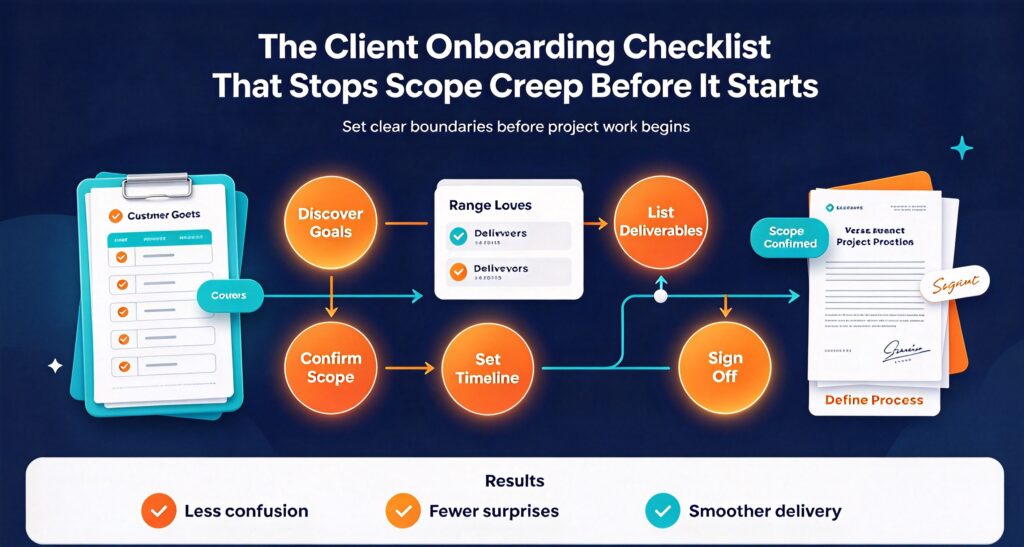
The 48-hour onboarding sequence
Timing matters more than content. Here is the sequence that works:
- Hour 0 — the day you win it: send the welcome email containing the asset list and the kickoff call booking link. Nothing else. Do not start work.
- Hour 24: hold the kickoff call. Send written confirmation of what was agreed within two hours of the call ending.
- Hour 48: send the scope statement, communication contract, and invoice terms as one package, plus the deposit invoice.
- Day 3–5: confirm assets received, or send one polite chase with a specific list of what is still missing and what it blocks.
- Deposit clears: production begins. Not before.
The rule that matters most: no production work until the deposit clears and the scope is confirmed in writing. Freelancers lose more money to “I’ll pay after the first milestone” than to any other single cause. If a client cannot or will not pay a deposit, that is information, and it is worth acting on before you’ve invested a week.
Note the word “clears.” A pending transfer, a promised check, and a screenshot of a bank app are not cleared funds. If you want to be generous, be generous with time, not with risk: hold the start date, keep the slot warm, and begin the moment the balance is real.
The forty-eight hour window is also doing hidden work. It tests the client’s responsiveness at the exact moment they are most motivated. A client who fills in the asset list and books the call within two days is very likely to stay responsive for the life of the project. One who goes quiet during the onboarding honeymoon will go quieter under deadline pressure. You are not just collecting documents — you are sampling behaviour, cheaply.
What to do when onboarding reveals a red flag
Onboarding exists partly to let you walk away cheaply. Four signals are worth taking seriously:
- They won’t put the scope in writing. Verbal-only clients are the most likely to dispute deliverables, because there is nothing to dispute against except memory.
- They can’t name a single decision-maker. Consensus-run projects move at the speed of the slowest stakeholder and change direction every time one of them gets an opinion.
- They want to skip the deposit. A client who won’t fund the start of a project is telling you how they will behave at the end of it.
- The asset list goes unanswered for a week while they ask about progress. This is the classic failure pattern: they want output without supplying input.
Any one of these can be worked through with a direct conversation. Two together usually means the project should not start, and the cheapest moment to discover that is during onboarding, when you’ve billed nothing and built nothing.
What good onboarding looks like in practice
Concrete beats abstract, so here is what a completed onboarding looks like for a small engagement — a four-post content package, priced at a flat fee.
Day one, welcome email: three paragraphs. It confirms the fee and start condition, links the asset list, and offers two kickoff slots. Nothing else. No attachment, no process document. The whole point of the first email is that it is short enough to be answered the same day.
Day two, kickoff call: thirty minutes, agenda sent in advance. Two of the six agenda items get stretched by the client (the goal restatement and the decision-maker question), and one item gets resolved in a way you did not expect — they don’t actually want the fourth post, they want a case study instead. This is the single most valuable moment in the project, because that change costs one line to make now and a renegotiation to make in week three.
Day two, plus two hours: a written recap. Six bullets: what was agreed, the one change, the assets still outstanding, the response windows, the first milestone date, the invoice date. The client replies “confirmed.” From this point on, no one has to remember anything, and no one can plausibly claim they don’t remember.
Day three, package and invoice: scope statement, communication contract, payment terms, deposit invoice. The client pays the deposit on day four. Production starts on day four.
Day six: one file remains outstanding — the brand font licence confirmation. Instead of chasing generically (“any update?”), the chase is specific: “Still needed: font licence confirmation. This blocks the first post’s typography. Delivery date moves one day per blocked day, per our terms.” The file arrives the same afternoon.
Nothing in that sequence is clever. That’s the point — the whole value is that it happens every time, in the same order, with the same written anchors, regardless of how busy you are or how charming the client is.
The small mechanics that prevent large arguments
Beyond the five documents, a handful of habits do disproportionate work.
Version every shared file, visibly. Dates in filenames, not “final” and “final-v2”. When two people discuss different versions of the same document, they have two different projects in their heads, and the argument that follows is about reality rather than taste.
Confirm verbal decisions in writing within the same day. One line is enough: “Confirming: we’re dropping the fourth post in favour of a case study, at the same fee.” This is not distrust; it’s transcription. The two minutes it takes eliminates the entire category of “I never agreed to that.” If meetings are where much of this gets decided, the meeting notes workflow is the natural companion — decisions captured while they happen rather than reconstructed from memory.
Invoice on a schedule, not on a feeling. The most common cause of freelance cash problems is not late clients, it’s invoices sent when the work “feels done.” Fixed invoice dates, agreed during onboarding, make payment a calendar event instead of a negotiation.
Keep a one-page project log. Dated lines: decisions made, assets received, approvals given. When the project hits week eight and the client asks why something changed, the log answers in ten seconds. It is also the document that makes the final invoice easy to justify.
Make onboarding a document, not a mood
The mistake nearly everyone makes is treating onboarding as something you “do” rather than something you “have.” If it lives in your head, it degrades the moment you’re busy — and you’re always busy in the week you win a new client.
Write the five documents once. Save them as templates. Then onboarding becomes a checklist you execute in fifteen minutes per client: swap the name, adjust the deliverables, send. The consistent ones win because the marginal effort drops to near zero.
Where templates stop being enough is the mechanical work: generating the same contract from the same data for ten clients, assembling per-client document packages, or producing the same report format every month. That is where a template stops and a local document generator starts — feeding a spreadsheet of client data into a document template and exporting every contract, invoice cover sheet, or report in one batch, without uploading anything to a third-party service. There’s a walkthrough of the mechanic in batch document generation from a spreadsheet. For a small practice that’s a few minutes saved; for anyone running ten or more client documents a month it’s the difference between hiring help and not needing to.
Frequently asked questions
How long should onboarding take?
For a standard project, the client-facing part should complete within five business days: kickoff call within 24 hours, scope and terms confirmed within 48, assets received within a week, deposit cleared before production. If onboarding drags past ten days, that is itself a signal about project health.
Should onboarding be a paid engagement?
For small projects, it’s absorbed into the project fee. For retainers or engagements above a few thousand currency units, a small paid discovery or onboarding phase is normal and healthy — it funds the setup work and filters out clients who aren’t serious.
What if the client refuses to sign anything?
Then you’re working without a scope, which means you have no protection and no basis for a change request. In that situation, either reduce the engagement to a single small deliverable with a tight, written definition, or decline. A written scope statement does not need to be a legal contract to be binding in practice — an email that says “confirming this is the scope” and gets a reply of “yes, confirmed” is enough to anchor every later conversation.
Do I need a client portal?
No. A shared folder with a consistent structure plus one agreed notification channel does the job for most freelance practices. Portals add surface area and cost; adopt one when you have more than roughly five active clients and are losing track of which files belong where, not before. If you already run a virtual assistant service, the virtual assistant client workflow covers the same structure at higher volume, where folder discipline stops being optional.
How do I handle a client who wants to “start now and formalize later”?
Say yes to a specific, bounded first step — one deliverable, one page of scope, deposit paid — and nothing beyond it. That gives them momentum without giving you exposure, and “later” arrives, or it doesn’t, with nothing at risk but one small piece of work.
The bottom line
Client onboarding is the part of freelance work that looks like overhead and behaves like profit. Ninety minutes of written setup per client eliminates the arguments that consume whole weeks: what’s in scope, who owes what, when it’s late, and who actually decides.
If you take one thing from this article, take the sequence: asset list on day one, kickoff call within 24 hours, written scope and terms within 48, no production until the deposit clears. Everything else is refinement. That sequence alone will change the shape of your next project more than any tool you could buy.
And once it’s a checklist you run without thinking, the remaining friction is the repetitive document work — and that’s a solvable problem too. You can see the rest of the offline workflow tools at the AIXHDD shop, all of which run on your own machine with no subscription. If you’re still choosing what to sell and to whom, AI for freelancers covers the positioning side; onboarding is what you run once that positioning converts.
The delivery side of the same engagement is covered in the client handoff checklist, which is the bookend this onboarding process is designed to reach.