Ever write something, reread it, and wonder why it feels heavier than it should? That heaviness has a name: low readability. Whether you are writing a blog post, a landing page, or a product description, how easy your text is to read directly affects whether people stay, understand, and click.
This guide explains what a readability score is, how the Flesch Reading Ease formula works, what a good readability score looks like, and how to check your own writing in seconds with a free readability score checker.
What Is a Readability Score?
A readability score is a number that estimates how easy a piece of text is to read and understand. It is calculated from objective signals in your writing: sentence length, word length, and syllable count. Short sentences with common words score as easy to read; long sentences with rare, multi-syllable words score as harder.
Readability scores are not a quality judgment. A dense technical paper can still be excellent content. But if your goal is to reach the widest possible audience, a readable score means more people actually finish what you wrote.
Think of readability as the bridge between your idea and your reader. The lower the friction on that bridge, the more likely someone walks all the way across — from headline, to first paragraph, to the call to action at the end.
The Most Common Readability Formulas
Different formulas weigh the same signals slightly differently. The three you will see most often are:
Flesch Reading Ease (the classic)
This is the most widely used formula. It produces a score from 0 to 100. Higher is easier to read.
- 90-100: Very easy (elementary school level)
- 60-70: Plain English (8th-9th grade level) — the sweet spot for general web content
- 30-50: Difficult (college level)
- 0-30: Very difficult (professional/technical)
Flesch-Kincaid Grade Level
The same underlying data expressed as a US school grade. A grade level of 8 means an eighth grader can read it comfortably. Most online content targets grade 6-8.
Gunning Fog Index
Estimates the years of formal education a reader needs. It penalizes long sentences and complex words heavily. A Fog index of 8-10 is common for general writing.
Readability Targets by Content Type
Not every piece of content needs the same score. Your target depends on who you are writing for and what you want them to do:
- Blog posts and articles: aim for a Flesch Reading Ease of 60-70 (grade 6-8). This reaches the broadest audience.
- Landing pages and product pages: go higher — 70-80. You want zero friction between the headline and the buy button.
- Email newsletters: 60-75 works well. Keep paragraphs short and scannable on mobile.
- Technical documentation and tutorials: 50-60 is acceptable, but use headers, short paragraphs, and code blocks to keep skimmability high.
- Academic or legal writing: 30-50 is normal, and readers expect density. Just keep sentences under control where possible.
When in doubt, optimize for the score your audience actually reads at, not the highest number you can reach.
Why Readability Matters for SEO and Conversions
Readability is not just a nice-to-have. It affects real business outcomes in three ways:
1. Dwell time and bounce rate. If readers bounce because your text is hard to follow, search engines notice the short sessions and high bounce rate.
2. Comprehension and trust. People trust what they can understand. Clear writing builds credibility, which leads to more shares, backlinks, and returning visitors.
3. Conversion. A product page or landing page that is easy to read converts better because the call to action is obvious. Complex writing buries your offer.
Major search engines have long favored content that matches user intent and is easy to consume. Pair clear writing with strong structure and you cover both.
What Is a Good Readability Score?
For general web content, aim for a Flesch Reading Ease score of 60-70, which corresponds to about an 8th-grade reading level. That is the same range most popular publications target.
For product pages, landing pages, and marketing copy, you can go even simpler — a score of 70-80 is often better because you want zero friction between the headline and the buy button.
For in-depth technical tutorials (like this one), 50-60 is acceptable. Just break the text into short paragraphs and use headers so readers can skim.
How to Check Your Readability Score Free
You do not need a paid tool. Our free readability score checker gives you instant results:
- Open the readability score checker.
- Paste your text into the box.
- Click Check Readability.
- Review your Flesch Reading Ease score, word count, sentence length, syllable analysis, and estimated reading time.
It is 100% free, runs in your browser, and needs no signup.
How to Improve Your Readability Score
If your score comes back low, these five changes move it fast:
- Shorten sentences. Split anything over 20 words into two sentences.
- Use simpler words. Replace jargon and long synonyms with everyday words.
- Write in active voice. “The tool converts the file” beats “The file is converted by the tool.”
- Add headers and short paragraphs. Aim for paragraphs of 1-3 sentences.
- Cut filler. Delete words and phrases that add no meaning.
After editing, run the text through the checker again to see your new score.
Common Readability Mistakes to Avoid
Even experienced writers trip on a few recurring problems. Watch for these:
- Long introductory clauses. If a sentence needs a comma before the subject appears, consider breaking it up.
- Passive voice everywhere. A little is fine; a page full of it feels slow and indirect.
- Wall-of-text paragraphs. Anything over four lines on mobile gets skipped. Split it.
- Jargon and acronyms without explanation. Define terms the first time you use them.
- Negation stacking. “Not uncommon” forces the reader to do mental math. Say “common” instead.
Run your draft through a readability check before publishing, and fix these before they cost you readers.
Readability vs. Keyword Density
Readability and keyword density work together. If you stuff keywords, your text reads unnaturally and your readability drops. Write naturally first, then use a keyword density checker to confirm your target phrases appear a reasonable number of times. Balance both and you get content that ranks and reads well.
The Flesch Reading Ease Formula, Explained Simply
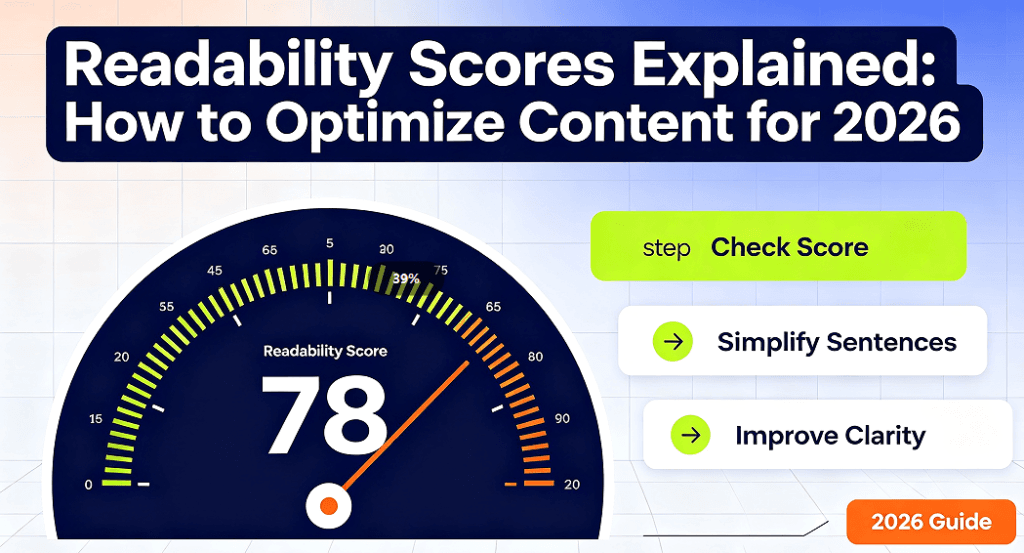
If you want to understand where your score comes from, here is the actual math behind most readability checkers. The Flesch Reading Ease score uses two ingredients: average sentence length and average syllables per word.
The formula is: 206.835 – (1.015 x ASL) – (84.6 x ASW)
- ASL = average sentence length (words divided by sentences)
- ASW = average syllables per word (total syllables divided by words)
What this means in practice: shorter sentences and shorter words push your score up. A sentence like “Cats eat mice” scores very high because it is short with mostly one-syllable words. A sentence full of 30-syllable technical terms scores low no matter how well written it is.
You do not need to do this math yourself. Any good readability score checker calculates it automatically, but knowing the formula helps you understand why your score changes when you shorten a sentence or swap in a simpler word.
Best Free Readability Checker Tools in 2026
You have plenty of free options for checking readability. Here is what I actually use and recommend:
- AIXHDD Readability Score Checker — free, no signup, gives you a Flesch Reading Ease score plus word count, sentence length, and estimated reading time in one click. Great for quick drafts.
- Hemingway Editor — highlights long sentences and passive voice, making it easy to see exactly what to fix, with a readability grade at the end.
- Grammarly — includes a readability score in its editor, handy if you already write there.
- WebFX Readability Test — a no-frills tool that shows multiple scores (Flesch, Gunning Fog, SMOG) side by side if you want the full picture.
- Readable.com — a more advanced option if you need detailed analytics, though its best features are paid.
For most writers, a simple free readability score checker is all you need. The point is to check every draft before you hit publish — consistency matters more than which tool you pick.
FAQ
What is a good Flesch Reading Ease score?
For general web content, 60-70 is the sweet spot. Above 70 is even easier and works well for marketing copy; below 50 is difficult for most readers.
Is readability a Google ranking factor?
Not a direct one, but it strongly influences signals that matter: dwell time, bounce rate, shares, and backlinks. Readable content tends to rank better over time.
What is the difference between Flesch Reading Ease and Flesch-Kincaid Grade Level?
They use the same core data but report differently: Reading Ease is a 0-100 scale (higher = easier), while Grade Level is a US school grade (lower = easier).
Does readability affect conversion rates?
Yes. Easier-to-read landing and product pages make the offer and call to action clearer, which tends to lift conversions.
Can I check readability for free?
Absolutely. Use our free readability score checker — no signup, no cost, instant Flesch Reading Ease score and detailed stats.
Start Checking Your Readability Today
Readability is one of the cheapest wins in content marketing. It takes minutes to check and a few edits to fix. Open the readability score checker, paste your next draft in, and see where you stand. While you are at it, pair it with a meta description generator and a blog title generator to polish the whole post before publishing.